Kangding Grassland
⭐ 4.60
Kangding City, Ganzi Tibetan Autonomous Prefecture, Sichuan Province, China
 **A Sacred Plateau with a Millennium of Faith**
Tagong Grassland, the spiritual heart of the region, has drawn Buddhist pilgrims for over a thousand years. Its monastery, Tagong Si, belongs to the Sakya school of Tibetan Buddhism—one of the four major schools, founded in 1073, roughly contemporaneous with the Norman completion of England's Canterbury Cathedral. The name "Tagong" means "the place beloved by the Bodhisattva" in Tibetan, and during the Tibetan New Year and the mountain-turning festival, thousands of worshippers still gather here for grand prayer ceremonies amid the fluttering prayer flags and chanting monks.
**Where Snow Peaks Meet Emerald Meadows**
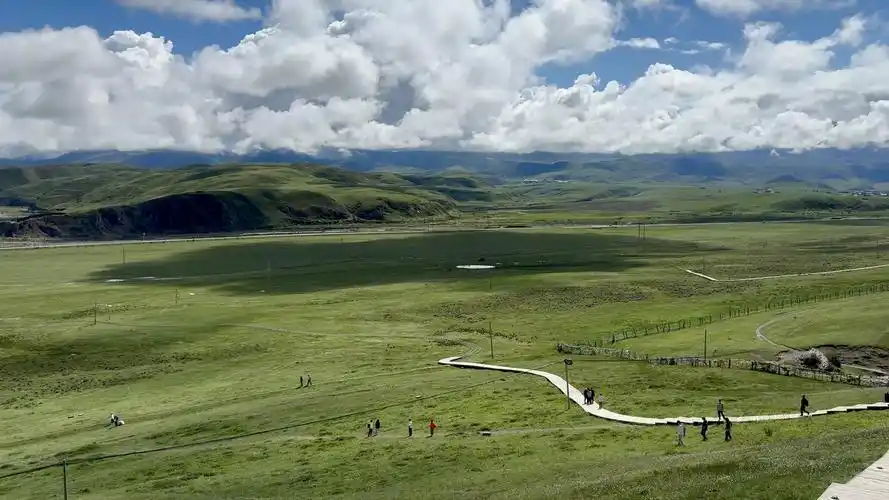
Rising to 3,730 meters with the sacred Yala Snow Mountain as its dramatic backdrop, Tagong Grassland unfurls in summer as a vast green carpet that contrasts startlingly with the year-round ice fields above. Think of Switzerland's Lauterbrunnen Valley meeting the open tundra of the Scottish Highlands—an improbable marriage of Alpine drama and pastoral calm. Across the region, Mugecuo Scenic Area adds another layer, with meadows cascading from 2,800 to 3,700 meters and a mirror-like alpine lake whose waters shift from sapphire to jade as the light moves across the sky, earning it the nickname "Little Jiuzhaigou of Western Sichuan."
**Sacred Architecture Against the Sky**
At Tagong, the golden-roofed Muya Golden Pagoda glitters beneath the snow peaks like a small cousin of Kathmandu's Boudhanath Stupa, while the monastery's painted halls shelter centuries-old Buddha statues and rare Tibetan scriptures. Visitors can wander among the prayer-flag arrays, where each colored banner represents an element—sky, air, fire, water, earth—and photograph the surreal composition of gilded temple spires framed against Yala's white summit.
**Practicalities for the High-Altitude Traveler**
Tagong lies about 113 kilometers northwest of Kangding city, a 2.5-hour drive along the legendary G318 National Highway—the same road that has carried travelers from Shanghai to the Tibetan border since the mid-20th century. Independent transport or a chartered vehicle is essential, as no public bus serves the grassland. Mugecuo, by contrast, is accessible via scenic-area shuttle from Kangding. August temperatures range from 15°C to 25°C, but nights drop sharply, so a windbreaker or light down jacket is essential. Tagong Grassland entry costs around 35 yuan per person, while Mugecuo's combined ticket with shuttle runs about 223 yuan.
**Why This Place Stays with You**
Few landscapes combine such effortless beauty with cultural depth. Mornings here invite horseback rides across the grass between prayer-flag poles, while afternoons reward photographers with the rare trifecta of yaks, golden temple roofs, and snow peaks in one frame. Mugecuo adds variety for every pace: lake cruises, forest hikes, and steaming hot springs where travelers can soak away the fatigue of altitude. Whether you come for the monastery bells, the wildflower meadows, or simply the silence of the high plateau, Kangding Grassland delivers a sense of openness that feels both ancient and immediate.
**Staying Safe and Showing Respect**
With elevations consistently above 3,000 meters, altitude sickness is a real concern—avoid strenuous activity, alcohol, and hot showers for the first 48 hours. UV radiation is intense even on cloudy days, so sunscreen, sunglasses, and a hat are non-negotiable; mosquitoes thrive on the meadows, making DEET-based repellent essential. Inside monasteries, never step on thresholds or point at Buddha statues, and carry out all rubbish. These small courtesies protect both your health and the integrity of a landscape that has welcomed pilgrims for a millennium.
**A Sacred Plateau with a Millennium of Faith**
Tagong Grassland, the spiritual heart of the region, has drawn Buddhist pilgrims for over a thousand years. Its monastery, Tagong Si, belongs to the Sakya school of Tibetan Buddhism—one of the four major schools, founded in 1073, roughly contemporaneous with the Norman completion of England's Canterbury Cathedral. The name "Tagong" means "the place beloved by the Bodhisattva" in Tibetan, and during the Tibetan New Year and the mountain-turning festival, thousands of worshippers still gather here for grand prayer ceremonies amid the fluttering prayer flags and chanting monks.
**Where Snow Peaks Meet Emerald Meadows**
Rising to 3,730 meters with the sacred Yala Snow Mountain as its dramatic backdrop, Tagong Grassland unfurls in summer as a vast green carpet that contrasts startlingly with the year-round ice fields above. Think of Switzerland's Lauterbrunnen Valley meeting the open tundra of the Scottish Highlands—an improbable marriage of Alpine drama and pastoral calm. Across the region, Mugecuo Scenic Area adds another layer, with meadows cascading from 2,800 to 3,700 meters and a mirror-like alpine lake whose waters shift from sapphire to jade as the light moves across the sky, earning it the nickname "Little Jiuzhaigou of Western Sichuan."
**Sacred Architecture Against the Sky**
At Tagong, the golden-roofed Muya Golden Pagoda glitters beneath the snow peaks like a small cousin of Kathmandu's Boudhanath Stupa, while the monastery's painted halls shelter centuries-old Buddha statues and rare Tibetan scriptures. Visitors can wander among the prayer-flag arrays, where each colored banner represents an element—sky, air, fire, water, earth—and photograph the surreal composition of gilded temple spires framed against Yala's white summit.
**Practicalities for the High-Altitude Traveler**
Tagong lies about 113 kilometers northwest of Kangding city, a 2.5-hour drive along the legendary G318 National Highway—the same road that has carried travelers from Shanghai to the Tibetan border since the mid-20th century. Independent transport or a chartered vehicle is essential, as no public bus serves the grassland. Mugecuo, by contrast, is accessible via scenic-area shuttle from Kangding. August temperatures range from 15°C to 25°C, but nights drop sharply, so a windbreaker or light down jacket is essential. Tagong Grassland entry costs around 35 yuan per person, while Mugecuo's combined ticket with shuttle runs about 223 yuan.
**Why This Place Stays with You**
Few landscapes combine such effortless beauty with cultural depth. Mornings here invite horseback rides across the grass between prayer-flag poles, while afternoons reward photographers with the rare trifecta of yaks, golden temple roofs, and snow peaks in one frame. Mugecuo adds variety for every pace: lake cruises, forest hikes, and steaming hot springs where travelers can soak away the fatigue of altitude. Whether you come for the monastery bells, the wildflower meadows, or simply the silence of the high plateau, Kangding Grassland delivers a sense of openness that feels both ancient and immediate.
**Staying Safe and Showing Respect**
With elevations consistently above 3,000 meters, altitude sickness is a real concern—avoid strenuous activity, alcohol, and hot showers for the first 48 hours. UV radiation is intense even on cloudy days, so sunscreen, sunglasses, and a hat are non-negotiable; mosquitoes thrive on the meadows, making DEET-based repellent essential. Inside monasteries, never step on thresholds or point at Buddha statues, and carry out all rubbish. These small courtesies protect both your health and the integrity of a landscape that has welcomed pilgrims for a millennium.