Mount Yala
⭐ 4.60
Yuzi West Scenic Area, Kangding City, Sichuan Province, China
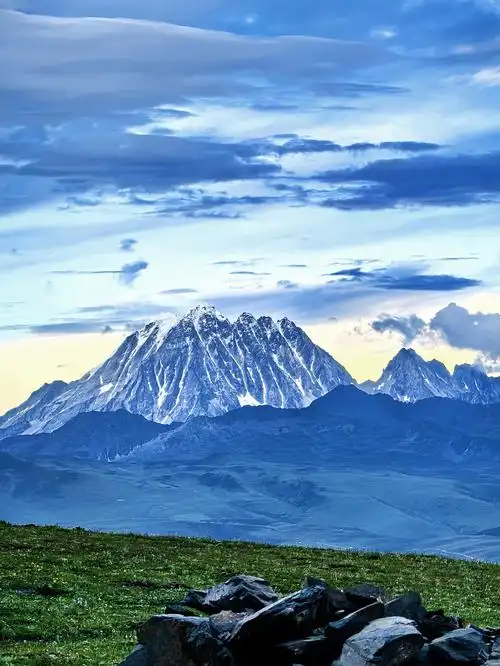 Yala Snow Mountain, known in Tibetan as "Xaxue Yala Gabo" or "Eastern White Yak Mountain," rises 5,820 meters where the Qinghai-Tibet and Sichuan-Yunnan tectonic plates collide. Revered as the "Second Shangri-La"—a phrase echoing James Hilton's mythical paradise from his 1933 novel *Lost Horizon*—it ranks among Tibet's four holiest peaks. Believed to embody the eldest son of the deity Amnye Machen, Yala has drawn pilgrims for centuries. Like the Matterhorn or Mount Olympus in Western imagination, it stands as a defining, spiritually charged symbol of its region—remote, formidable, and eternal.
The mountain's signature is its pyramid silhouette—often compared to Switzerland's Matterhorn—that blazes gold at sunrise in a phenomenon locals call "Sunshine on Golden Mountain." Below the snowline, the emerald Yala Youcuo Lake mirrors the peak like a polished mirror, while twin Sister Lakes and ancient red cedar forests layer a striking alpine ecosystem. The Beilu Zhana hot springs steam year-round along the slopes. This singular blend of snow peaks, glacial lakes, primeval woodland, and thermal waters rivals the scenic diversity of the Italian Dolomites or New Zealand's Southern Alps, marking Yala as a landscape of rare natural completeness.
Yala's flanks are scattered with mani stone cairns and colorful prayer flags, marking pilgrimage circuits walked for over a millennium. The mountain belongs to the "Three Protectors," a revered trinity in Vajrayana Buddhism believed to bestow blessings upon circumambulators. The historic Tea-Horse Trade Route—comparable in cultural weight to the Silk Road—once wound through these foothills, ferrying Chinese tea and Tibetan horses between civilizations. Like medieval pilgrims trekking to Santiago de Compostela, devotees still journey here, where animist nature worship and Buddhist devotion intertwine into a living cultural tapestry.
Foreign travelers must obtain a special Tibet Travel Permit through a licensed Chinese tour operator 20–30 days in advance, with a certified guide required throughout—no independent travel is allowed. Straddling Daofu, Kangding, and Danba counties, the scenic area's main entrance lies near Bamei Town, with an entry fee of about 150 RMB including shuttle. All core viewpoints sit above 4,000 meters, so acclimatizing in Kangding (2,500m) for one to two days is essential. Travelers prone to severe altitude sickness should consider alternative destinations.
Late summer through autumn offers the best window: August brings lush meadows and higher oxygen levels, though late-monsoon clouds may veil the peaks. Plan at least two days to accommodate weather changes. Budget-conscious travelers can pair the free Tagong Grassland with the Yala Cloud Viewpoint for sweeping vistas without entry fees; adventure-seekers should trek to Youcuo Lake or bathe in the wild hot springs. Pack a windproof waterproof shell, trekking poles, strong sunscreen, and altitude medication. With proper preparation, Yala offers what few places still can—a sacred, untamed encounter between wilderness and living spiritual tradition.
Yala Snow Mountain, known in Tibetan as "Xaxue Yala Gabo" or "Eastern White Yak Mountain," rises 5,820 meters where the Qinghai-Tibet and Sichuan-Yunnan tectonic plates collide. Revered as the "Second Shangri-La"—a phrase echoing James Hilton's mythical paradise from his 1933 novel *Lost Horizon*—it ranks among Tibet's four holiest peaks. Believed to embody the eldest son of the deity Amnye Machen, Yala has drawn pilgrims for centuries. Like the Matterhorn or Mount Olympus in Western imagination, it stands as a defining, spiritually charged symbol of its region—remote, formidable, and eternal.
The mountain's signature is its pyramid silhouette—often compared to Switzerland's Matterhorn—that blazes gold at sunrise in a phenomenon locals call "Sunshine on Golden Mountain." Below the snowline, the emerald Yala Youcuo Lake mirrors the peak like a polished mirror, while twin Sister Lakes and ancient red cedar forests layer a striking alpine ecosystem. The Beilu Zhana hot springs steam year-round along the slopes. This singular blend of snow peaks, glacial lakes, primeval woodland, and thermal waters rivals the scenic diversity of the Italian Dolomites or New Zealand's Southern Alps, marking Yala as a landscape of rare natural completeness.
Yala's flanks are scattered with mani stone cairns and colorful prayer flags, marking pilgrimage circuits walked for over a millennium. The mountain belongs to the "Three Protectors," a revered trinity in Vajrayana Buddhism believed to bestow blessings upon circumambulators. The historic Tea-Horse Trade Route—comparable in cultural weight to the Silk Road—once wound through these foothills, ferrying Chinese tea and Tibetan horses between civilizations. Like medieval pilgrims trekking to Santiago de Compostela, devotees still journey here, where animist nature worship and Buddhist devotion intertwine into a living cultural tapestry.
Foreign travelers must obtain a special Tibet Travel Permit through a licensed Chinese tour operator 20–30 days in advance, with a certified guide required throughout—no independent travel is allowed. Straddling Daofu, Kangding, and Danba counties, the scenic area's main entrance lies near Bamei Town, with an entry fee of about 150 RMB including shuttle. All core viewpoints sit above 4,000 meters, so acclimatizing in Kangding (2,500m) for one to two days is essential. Travelers prone to severe altitude sickness should consider alternative destinations.
Late summer through autumn offers the best window: August brings lush meadows and higher oxygen levels, though late-monsoon clouds may veil the peaks. Plan at least two days to accommodate weather changes. Budget-conscious travelers can pair the free Tagong Grassland with the Yala Cloud Viewpoint for sweeping vistas without entry fees; adventure-seekers should trek to Youcuo Lake or bathe in the wild hot springs. Pack a windproof waterproof shell, trekking poles, strong sunscreen, and altitude medication. With proper preparation, Yala offers what few places still can—a sacred, untamed encounter between wilderness and living spiritual tradition.