Mugecuo Scenic Area
⭐ 4.60
Mugecuo Scenic Area, Kangding City, Sichuan Province, China
 Mugecuo, meaning "Wildman Sea" in local legend, lies just 17 kilometers from Kangding—a frontier town that served for centuries as a vital gateway on the ancient Tea-Horse Road. This treacherous Himalayan trade route carried Yunnan tea northward in exchange for Tibetan horses, fueling commerce between lowland China and the Tibetan plateau from the Tang dynasty onward. The scenic area is popularly known as the "Kangding Love Song Scenic Area," echoing the romantic 1940s folk ballad that made Kangding synonymous with mountain romance, much as "Edelweiss" romanticizes the Swiss Alps in Western imagination.
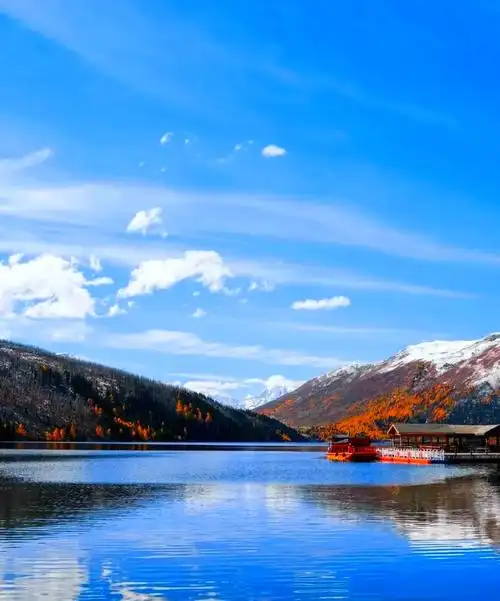
The crown jewel, Lake Mugecuo, plunges over 70 meters deep and ranks among the largest alpine lakes in western Sichuan. Framed by the towering Yala Snow Mountain—a peak often likened to a smaller cousin of the Matterhorn—its waters shift color throughout the day, offering visitors the chance to board sightseeing boats or stroll wooden lakeside boardwalks. Nearby, the crescent-shaped Seven-Color Sea dazzles with rainbow hues produced by mineral-rich algae and changing light, a phenomenon reminiscent of the famous color displays of Croatia's Plitvice Lakes.
At the Yaochi Boiling Springs, mineral-laden waters bubble up at 80–90°C, channeled into shallow pools where visitors can soak tired feet, enjoy a natural fish spa, or cook traditional "hot spring eggs" in the steaming vents. The therapeutic experience draws comparisons to Iceland's Blue Lagoon or Canada's Banff Upper Hot Springs, yet carries a distinctly Himalayan character. Local Tibetan communities have long regarded these waters as sacred healing sources, believed to ease ailments from arthritis to altitude fatigue.
Dujuanxia, or Azalea Gorge, stretches for kilometers through ancient primeval forest, earning recognition as one of Asia's longest natural rhododendron galleries. From April to July, the slopes explode with crimson, pink, and white blossoms—comparable to a Japanese cherry blossom season but on a wilder, alpine scale. By August the flowers have faded, but the area transforms into a cool oxygen-rich sanctuary, where mossy trails, tumbling streams, and old-growth conifers recall the primeval Caledonian pinewoods of the Scottish Highlands.
The park operates a smart one-way itinerary: visitors board shuttle buses at the entrance and ascend to the highest point, then walk gently downhill through Dujuanxia, Seven-Color Sea, and Yaochi Springs before ending at Lake Mugecuo—a manageable three to four hours suitable for families and casual walkers. Tickets cost 105 yuan for entry plus 90 yuan for the mandatory shuttle bus (approximately $27 USD total), with boats and hot spring soaks at extra cost. The prime season runs June through September, when temperatures hover around a pleasant 20°C.
What sets Mugecuo apart from more crowded Chinese scenic areas is its blend of accessibility and authentic Tibetan-Qiang cultural immersion—think Alpine grandeur crossed with Himalayan monastery culture. Because elevations range from 2,600 to 3,780 meters, travelers should acclimatize gradually, stay hydrated, and pack a windproof jacket plus sunscreen. Winter brings frozen lake surfaces and steaming hot springs against snowy backdrops, though boat services are suspended. Whether you come for the romance of the love song, the mineral-rich waters, or the alpine panoramas, Mugecuo delivers a quintessentially Tibetan plateau experience within easy reach of civilization.
Mugecuo, meaning "Wildman Sea" in local legend, lies just 17 kilometers from Kangding—a frontier town that served for centuries as a vital gateway on the ancient Tea-Horse Road. This treacherous Himalayan trade route carried Yunnan tea northward in exchange for Tibetan horses, fueling commerce between lowland China and the Tibetan plateau from the Tang dynasty onward. The scenic area is popularly known as the "Kangding Love Song Scenic Area," echoing the romantic 1940s folk ballad that made Kangding synonymous with mountain romance, much as "Edelweiss" romanticizes the Swiss Alps in Western imagination.
The crown jewel, Lake Mugecuo, plunges over 70 meters deep and ranks among the largest alpine lakes in western Sichuan. Framed by the towering Yala Snow Mountain—a peak often likened to a smaller cousin of the Matterhorn—its waters shift color throughout the day, offering visitors the chance to board sightseeing boats or stroll wooden lakeside boardwalks. Nearby, the crescent-shaped Seven-Color Sea dazzles with rainbow hues produced by mineral-rich algae and changing light, a phenomenon reminiscent of the famous color displays of Croatia's Plitvice Lakes.
At the Yaochi Boiling Springs, mineral-laden waters bubble up at 80–90°C, channeled into shallow pools where visitors can soak tired feet, enjoy a natural fish spa, or cook traditional "hot spring eggs" in the steaming vents. The therapeutic experience draws comparisons to Iceland's Blue Lagoon or Canada's Banff Upper Hot Springs, yet carries a distinctly Himalayan character. Local Tibetan communities have long regarded these waters as sacred healing sources, believed to ease ailments from arthritis to altitude fatigue.
Dujuanxia, or Azalea Gorge, stretches for kilometers through ancient primeval forest, earning recognition as one of Asia's longest natural rhododendron galleries. From April to July, the slopes explode with crimson, pink, and white blossoms—comparable to a Japanese cherry blossom season but on a wilder, alpine scale. By August the flowers have faded, but the area transforms into a cool oxygen-rich sanctuary, where mossy trails, tumbling streams, and old-growth conifers recall the primeval Caledonian pinewoods of the Scottish Highlands.
The park operates a smart one-way itinerary: visitors board shuttle buses at the entrance and ascend to the highest point, then walk gently downhill through Dujuanxia, Seven-Color Sea, and Yaochi Springs before ending at Lake Mugecuo—a manageable three to four hours suitable for families and casual walkers. Tickets cost 105 yuan for entry plus 90 yuan for the mandatory shuttle bus (approximately $27 USD total), with boats and hot spring soaks at extra cost. The prime season runs June through September, when temperatures hover around a pleasant 20°C.
What sets Mugecuo apart from more crowded Chinese scenic areas is its blend of accessibility and authentic Tibetan-Qiang cultural immersion—think Alpine grandeur crossed with Himalayan monastery culture. Because elevations range from 2,600 to 3,780 meters, travelers should acclimatize gradually, stay hydrated, and pack a windproof jacket plus sunscreen. Winter brings frozen lake surfaces and steaming hot springs against snowy backdrops, though boat services are suspended. Whether you come for the romance of the love song, the mineral-rich waters, or the alpine panoramas, Mugecuo delivers a quintessentially Tibetan plateau experience within easy reach of civilization.