Wukang Road
⭐ 4.20
Wukang Road, Xuhui District, Shanghai, China
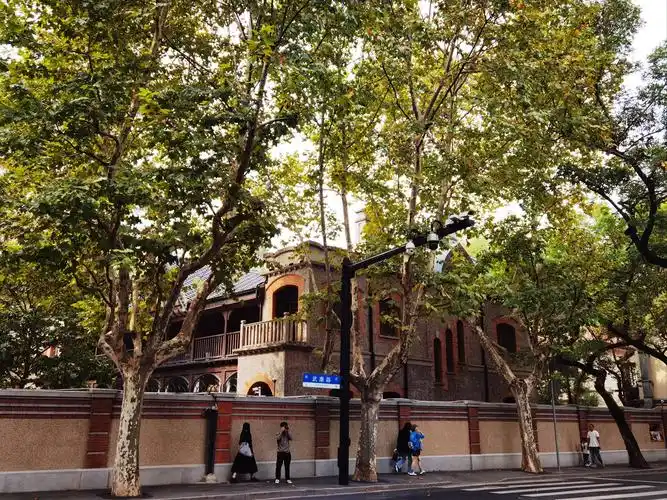 Laid in 1907 and originally named Ferguson Road after American missionary John Calvin Ferguson, Wukang Road was renamed in 1943 during the Japanese occupation. Its existence reflects Shanghai's extraordinary semi-colonial era, when the city functioned as a global trading hub rivalling London and Paris. The street survives as one of the finest remnants of the French Concession's urban planning, a planned international settlement established in 1849. The mature plane trees overhead create a canopy reminiscent of Parisian boulevards or Vienna's Ringstrasse, offering visitors a tangible link to the cosmopolitan world that shaped modern Shanghai.
The architectural ensemble along Wukang Road has been compared to an open-air museum of European design. The undisputed showpiece is the Wukang Mansion at the road's northern tip, a ship-shaped Art Deco colossus designed in 1924 by László Hudec, the Hungarian-Slovak architect whose work defined Shanghai's skyline alongside the Park Hotel and the Grand Theatre. Its arcaded ground floor, an ingenious response to Shanghai's narrow sidewalks, draws parallels to Venetian and Florentine loggias. Elsewhere, the "Butterfly Balcony" of the Delinassi Residence, Baroque-style garden villas, and whitewashed Mediterranean mansions showcase stylistic diversity rivaling anything found in Barcelona or the French Riviera.
Wukang Road also served as a stage for some of modern China's most consequential figures. The novelist Ba Jin, author of the celebrated "Torrents Trilogy" and a leading voice of the May Fourth Movement, lived and worked at No. 113 from 1955 until his death in 2005; his home is now a free memorial museum. Revolutionary statesman Huang Xing once resided at No. 393, while further along sits the former residence of Soong Ching-ling, vice president of the People's Republic and widow of Sun Yat-sen. Together, these addresses chart the literary and political currents that reshaped twentieth-century China.
The street is freely accessible year-round, with no entrance fees. The most convenient starting point is Jiaotong University Station on Metro Lines 10 or 11, from which visitors can stroll southbound along Wukang Road before looping through adjoining Anfu Road and Hunan Road. Morning hours between 7 and 9 a.m. and the early evening from 5 to 7 p.m. offer the softest natural light and the thinnest crowds. Numerous independent cafés punctuate the route, ideal for pausing between sights, though food and drink prices trend higher than average.
Visitors should remember that most buildings remain private residences or offices; entering courtyards uninvited or photographing residents directly is strictly inappropriate. Weekends draw significant crowds, particularly after noon, so off-peak visits are recommended. Several residences, including the Soong Ching-ling Memorial, require advance booking or charge admission, so checking current opening information before arrival is advisable. With its unparalleled concentration of heritage architecture and living cultural atmosphere, Wukang Road offers Western travellers an accessible, walkable immersion into the layered history that made Shanghai the "Paris of the East."
Laid in 1907 and originally named Ferguson Road after American missionary John Calvin Ferguson, Wukang Road was renamed in 1943 during the Japanese occupation. Its existence reflects Shanghai's extraordinary semi-colonial era, when the city functioned as a global trading hub rivalling London and Paris. The street survives as one of the finest remnants of the French Concession's urban planning, a planned international settlement established in 1849. The mature plane trees overhead create a canopy reminiscent of Parisian boulevards or Vienna's Ringstrasse, offering visitors a tangible link to the cosmopolitan world that shaped modern Shanghai.
The architectural ensemble along Wukang Road has been compared to an open-air museum of European design. The undisputed showpiece is the Wukang Mansion at the road's northern tip, a ship-shaped Art Deco colossus designed in 1924 by László Hudec, the Hungarian-Slovak architect whose work defined Shanghai's skyline alongside the Park Hotel and the Grand Theatre. Its arcaded ground floor, an ingenious response to Shanghai's narrow sidewalks, draws parallels to Venetian and Florentine loggias. Elsewhere, the "Butterfly Balcony" of the Delinassi Residence, Baroque-style garden villas, and whitewashed Mediterranean mansions showcase stylistic diversity rivaling anything found in Barcelona or the French Riviera.
Wukang Road also served as a stage for some of modern China's most consequential figures. The novelist Ba Jin, author of the celebrated "Torrents Trilogy" and a leading voice of the May Fourth Movement, lived and worked at No. 113 from 1955 until his death in 2005; his home is now a free memorial museum. Revolutionary statesman Huang Xing once resided at No. 393, while further along sits the former residence of Soong Ching-ling, vice president of the People's Republic and widow of Sun Yat-sen. Together, these addresses chart the literary and political currents that reshaped twentieth-century China.
The street is freely accessible year-round, with no entrance fees. The most convenient starting point is Jiaotong University Station on Metro Lines 10 or 11, from which visitors can stroll southbound along Wukang Road before looping through adjoining Anfu Road and Hunan Road. Morning hours between 7 and 9 a.m. and the early evening from 5 to 7 p.m. offer the softest natural light and the thinnest crowds. Numerous independent cafés punctuate the route, ideal for pausing between sights, though food and drink prices trend higher than average.
Visitors should remember that most buildings remain private residences or offices; entering courtyards uninvited or photographing residents directly is strictly inappropriate. Weekends draw significant crowds, particularly after noon, so off-peak visits are recommended. Several residences, including the Soong Ching-ling Memorial, require advance booking or charge admission, so checking current opening information before arrival is advisable. With its unparalleled concentration of heritage architecture and living cultural atmosphere, Wukang Road offers Western travellers an accessible, walkable immersion into the layered history that made Shanghai the "Paris of the East."