Tagong Monastery
⭐ 4.20
Tagong Town, Kangding City, Sichuan Province, China
 Tagong Temple dates to the 7th century, when, according to tradition, Princess Wencheng of Tang-dynasty China paused here during her legendary 641 AD journey to Lhasa to marry Tibetan King Songtsen Gampo. To put that in perspective, this monastery was already ancient when Charlemagne was crowned Emperor of the Romans. As a principal seat of the Sakya school—known as the "Flower School" for its emphasis on scholastic tradition and symbolic white-and-red lineage—Tagong rivals regional importance with far older pilgrimage centers like Lhasa's Jokhang. Devotees believe that circumambulating and praying here carries the same merit as traveling all the way to Lhasa, a conviction that has drawn pilgrims for over a millennium.
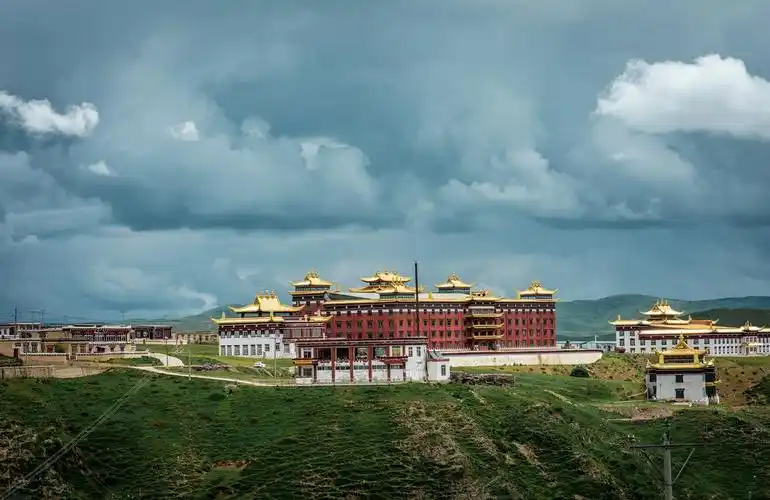
The architecture is a classic example of Tibetan monastic design: a fortress-like compound of whitewashed walls, deep crimson façades, and glittering gilded roofs reminiscent of Bhutanese dzongs or the layered pagodas of Nepal's Boudhanath complex. The central Great Hall and Founder's Shrine anchor the complex, while nearly one hundred chortens (stupas) ring the grounds, forming a sculptural forest of whitewashed reliquaries crowned with golden spires. Visitors should note that photography inside the prayer halls is strictly prohibited, and a respectful, hushed demeanor is expected throughout.
Beyond the architecture, Tagong offers a genuine encounter with living Tibetan Buddhist culture. Visitors can join pilgrims in the circumambulation path, spinning centuries-old prayer wheels and following the clockwise direction—never counterclockwise—that defines sacred movement here. Each year, in the sixth month of the Tibetan calendar, the monastery hosts the dramatic Cham dance festival, when masked lamas perform tantric rituals said to subdue malevolent forces. If your travels align with this period, plan well ahead, but always remember to dress modestly, never point at statues, and avoid stepping on thresholds.
The setting is what elevates Tagong from a worthy monastery to an unforgettable one. Step just outside the main gate and the composition assembles itself: crimson walls and golden roofs in the foreground, the pyramid-shaped peak of Yala Snow Mountain rising to 5,820 meters behind. In summer, the surrounding Tagong Grassland turns emerald and carpets with wildflowers; in autumn, it glows amber. Pilgrims' prayer flags snap constantly in the high-altitude wind, their colors echoing the prayer flags fluttering across passes in the Dolomites or the Himalayas. It is, by general acclaim of photographers who travel the Sichuan loop, the most cinematic fusion of human devotion and natural grandeur in western China.
Practical planning is essential at this altitude. Tagong sits about 113 kilometers from Kangding city, requiring a drive over the 4,300-meter Zheduo Pass—hiring a car for the round trip from Kangding (roughly 150 RMB) or hopping a local bus are the usual options. Entrance fees run a modest 10–20 RMB, and the site is open daily from 8:00 to 18:00. August, the tail end of the rainy season, sees daytime highs near 20°C and nighttime lows around 5°C, so a windproof layer and high-SPF sunscreen are non-negotiable. Allow 1.5 to 2 hours, combine the visit with the neighboring Muya Golden Pagoda and Tagong Grassland, and move slowly to acclimatize to the thin air—Tagong rewards those who linger.
Tagong Temple dates to the 7th century, when, according to tradition, Princess Wencheng of Tang-dynasty China paused here during her legendary 641 AD journey to Lhasa to marry Tibetan King Songtsen Gampo. To put that in perspective, this monastery was already ancient when Charlemagne was crowned Emperor of the Romans. As a principal seat of the Sakya school—known as the "Flower School" for its emphasis on scholastic tradition and symbolic white-and-red lineage—Tagong rivals regional importance with far older pilgrimage centers like Lhasa's Jokhang. Devotees believe that circumambulating and praying here carries the same merit as traveling all the way to Lhasa, a conviction that has drawn pilgrims for over a millennium.
The architecture is a classic example of Tibetan monastic design: a fortress-like compound of whitewashed walls, deep crimson façades, and glittering gilded roofs reminiscent of Bhutanese dzongs or the layered pagodas of Nepal's Boudhanath complex. The central Great Hall and Founder's Shrine anchor the complex, while nearly one hundred chortens (stupas) ring the grounds, forming a sculptural forest of whitewashed reliquaries crowned with golden spires. Visitors should note that photography inside the prayer halls is strictly prohibited, and a respectful, hushed demeanor is expected throughout.
Beyond the architecture, Tagong offers a genuine encounter with living Tibetan Buddhist culture. Visitors can join pilgrims in the circumambulation path, spinning centuries-old prayer wheels and following the clockwise direction—never counterclockwise—that defines sacred movement here. Each year, in the sixth month of the Tibetan calendar, the monastery hosts the dramatic Cham dance festival, when masked lamas perform tantric rituals said to subdue malevolent forces. If your travels align with this period, plan well ahead, but always remember to dress modestly, never point at statues, and avoid stepping on thresholds.
The setting is what elevates Tagong from a worthy monastery to an unforgettable one. Step just outside the main gate and the composition assembles itself: crimson walls and golden roofs in the foreground, the pyramid-shaped peak of Yala Snow Mountain rising to 5,820 meters behind. In summer, the surrounding Tagong Grassland turns emerald and carpets with wildflowers; in autumn, it glows amber. Pilgrims' prayer flags snap constantly in the high-altitude wind, their colors echoing the prayer flags fluttering across passes in the Dolomites or the Himalayas. It is, by general acclaim of photographers who travel the Sichuan loop, the most cinematic fusion of human devotion and natural grandeur in western China.
Practical planning is essential at this altitude. Tagong sits about 113 kilometers from Kangding city, requiring a drive over the 4,300-meter Zheduo Pass—hiring a car for the round trip from Kangding (roughly 150 RMB) or hopping a local bus are the usual options. Entrance fees run a modest 10–20 RMB, and the site is open daily from 8:00 to 18:00. August, the tail end of the rainy season, sees daytime highs near 20°C and nighttime lows around 5°C, so a windproof layer and high-SPF sunscreen are non-negotiable. Allow 1.5 to 2 hours, combine the visit with the neighboring Muya Golden Pagoda and Tagong Grassland, and move slowly to acclimatize to the thin air—Tagong rewards those who linger.