Kangding Love Song Square
⭐ 4.20
Kangding Love Song Square, Kangding City, Garzê Tibetan Autonomous Prefecture, Sichuan Province, China
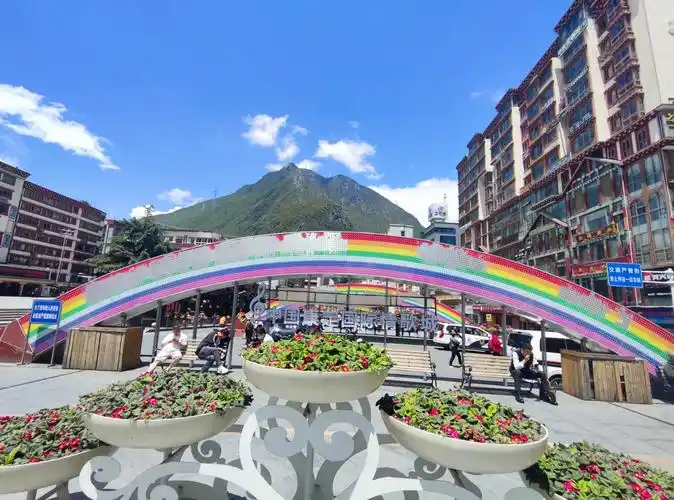 Kangding, historically known as Tatsienlu, served for centuries as the gateway between the Sichuan Basin and the Tibetan plateau along the ancient Tea-Horse Road, where caravans traded lowland tea for highland horses and medicinal herbs bound for Lhasa. The square anchors a town whose romantic fame was sealed by "Kangding Love Song," a folk ballad composed in the 1940s and later sung worldwide. Like Milan's Piazza del Duomo or Munich's Marienplatz, it is the civic heart where commerce, faith, and festival converge, though here the "cathedral" is the snow crown of Mt. Zheduo (4,962 m) rising above the rooftops.
The square's layout is deliberately intimate, a stone-paved trapezoid roughly the size of a small European piazza, edged by whitewashed Tibetan-style buildings with black-trimmed windows and gilded cornices that echo monasteries in Lhasa. At its centre rises a stainless-steel sculpture inspired by the song's lyrics, flanked by a "Chain of Love" installation where couples attach padlocks, recalling Paris's Pont des Arts but dedicated to the heroine of the ballad. Cultured-stone walls around the perimeter carve verses in both Chinese and Tibetan script, allowing visitors to read the lyrics as they wander.
The evening Guozhuang dance, beginning around 19:30, is the soul of the square. Guozhuang is a communal Tibetan circle dance performed for centuries at weddings and harvests; here it becomes a spontaneous ritual where strangers join hands and step in unison to accordion, fiddle, and dramyin. Unlike choreographed tourist shows in Lhasa or Shangri-La, this is genuinely voluntary: office workers, herders, and foreign backpackers fall into step together. When the music fountain erupts in synchronised jets of LED-lit water, the effect resembles an open-air ballet staged between the prayer flags strung above the Zheduo River.
The square sits at 156 Dongdajie, on the bank of the Zheduo River, open 24 hours and free of charge. Because Kangding sits at 2,560 m, visitors arriving from Chengdu (a 4-hour drive or rail ride) should plan to reach the city before noon, rest, and avoid alcohol, heavy exertion, or hot showers for the first 24 hours to prevent altitude sickness. Arrive between 17:00 and 18:00 to acclimatise along the riverside; the dancing and full light show ignite after 19:30. Parking is limited, so take a taxi or walk from any central hotel. Bring a windproof jacket even in July: summer evenings drop to 8–10 °C.
The annual Kangding Love Song International Music Festival, held around 19 August, expands the square with craft markets, Tibetan opera troupes, and a popular Rose Marriage Registration booth where couples can officially wed amid the festivities. Surrounding streets teem with affordable Tibetan cuisine: butter tea, yak skewers, and tsampa dumplings provide perfect pre- or post-dance refuelling. Combine the square with an evening walk along the Zheduo River and through the lantern-lit lanes of Liuliu Town, or next morning ride the cable car up Paoma Mountain to see where the song was born. It is, quite simply, the warmest, most welcoming evening stage in western Sichuan.
Kangding, historically known as Tatsienlu, served for centuries as the gateway between the Sichuan Basin and the Tibetan plateau along the ancient Tea-Horse Road, where caravans traded lowland tea for highland horses and medicinal herbs bound for Lhasa. The square anchors a town whose romantic fame was sealed by "Kangding Love Song," a folk ballad composed in the 1940s and later sung worldwide. Like Milan's Piazza del Duomo or Munich's Marienplatz, it is the civic heart where commerce, faith, and festival converge, though here the "cathedral" is the snow crown of Mt. Zheduo (4,962 m) rising above the rooftops.
The square's layout is deliberately intimate, a stone-paved trapezoid roughly the size of a small European piazza, edged by whitewashed Tibetan-style buildings with black-trimmed windows and gilded cornices that echo monasteries in Lhasa. At its centre rises a stainless-steel sculpture inspired by the song's lyrics, flanked by a "Chain of Love" installation where couples attach padlocks, recalling Paris's Pont des Arts but dedicated to the heroine of the ballad. Cultured-stone walls around the perimeter carve verses in both Chinese and Tibetan script, allowing visitors to read the lyrics as they wander.
The evening Guozhuang dance, beginning around 19:30, is the soul of the square. Guozhuang is a communal Tibetan circle dance performed for centuries at weddings and harvests; here it becomes a spontaneous ritual where strangers join hands and step in unison to accordion, fiddle, and dramyin. Unlike choreographed tourist shows in Lhasa or Shangri-La, this is genuinely voluntary: office workers, herders, and foreign backpackers fall into step together. When the music fountain erupts in synchronised jets of LED-lit water, the effect resembles an open-air ballet staged between the prayer flags strung above the Zheduo River.
The square sits at 156 Dongdajie, on the bank of the Zheduo River, open 24 hours and free of charge. Because Kangding sits at 2,560 m, visitors arriving from Chengdu (a 4-hour drive or rail ride) should plan to reach the city before noon, rest, and avoid alcohol, heavy exertion, or hot showers for the first 24 hours to prevent altitude sickness. Arrive between 17:00 and 18:00 to acclimatise along the riverside; the dancing and full light show ignite after 19:30. Parking is limited, so take a taxi or walk from any central hotel. Bring a windproof jacket even in July: summer evenings drop to 8–10 °C.
The annual Kangding Love Song International Music Festival, held around 19 August, expands the square with craft markets, Tibetan opera troupes, and a popular Rose Marriage Registration booth where couples can officially wed amid the festivities. Surrounding streets teem with affordable Tibetan cuisine: butter tea, yak skewers, and tsampa dumplings provide perfect pre- or post-dance refuelling. Combine the square with an evening walk along the Zheduo River and through the lantern-lit lanes of Liuliu Town, or next morning ride the cable car up Paoma Mountain to see where the song was born. It is, quite simply, the warmest, most welcoming evening stage in western Sichuan.