Three-Step Waterfall
⭐ 4.60
Three-Step Waterfall Scenic Area, Mount Lushan, Lushan City, Jiujiang City, Jiangxi Province, China
 While Europe's Romantic poets were discovering the sublime power of waterfalls in the Alps and Rhine Valley, China was already celebrating a comparable tradition of mountain pilgrimage. Li Bai, the Tang dynasty's most celebrated poet (701-762 CE)—often compared to Byron or Pushkin for his restless wandering spirit—sought inspiration at Three-Step Waterfall, as did the great Ming dynasty explorer Xu Xiake, whose travel writings stand alongside Marco Polo's accounts as foundational works of world geography. Designated a UNESCO World Heritage Site in 1996 as part of Mount Lu National Park, the falls have anchored Chinese landscape poetry for over a millennium, inspiring verses that read like medieval European hymns to untamed nature.
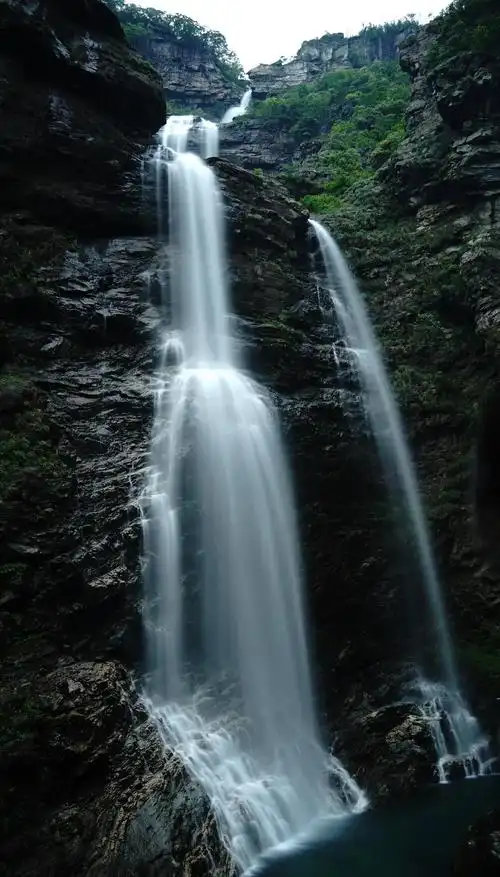
The waterfall earns its name from three distinct cascades, each dramatically different in character. The upper tier floats down like drifting snow, the middle shatters into flying jade and shattered ice, while the lower plunges like a jade dragon charging into the pool below—poetic descriptions that echo European travelers' raptures over Scotland's Falls of Clyde or Iceland's Gullfoss. Standing at the valley's viewing platform, visitors look up nearly 155 meters to where the cliff splits, the combined roar generating mist that drifts across the gorge like Alpine cloud formations. The geological drama rivals Switzerland's Staubbach Falls or Norway's Vøringsfossen, but with a uniquely Chinese aesthetic of tiered, sequential descent rather than a single drop.
Long before Western landscape conservation took root, this waterfall was already wrapped in layers of literary and spiritual meaning. Mount Lu itself became a cradle of Chinese Buddhism in the 4th century CE, and the surrounding valleys drew hermit monks who built cliffside temples—much as Capuchin friars established monasteries in Italy's Apennines or Carthusians retreated into the French Alps. The "Kuang-Lu" poetic tradition, named after the mountain's ancient designation, produced some of China's most quoted nature verses. Even today, schoolchildren memorize Tang poems about these waters, giving Chinese visitors a cultural resonance comparable to how Shakespeare's Stratford draws English pilgrims—though here the pilgrimage is to liquid poetry rather than to the Bard's quill.
Reaching Three-Step Waterfall requires planning rather than wandering. From Guling Town, the main tourist hub on Mount Lu's plateau reached from Jiujiang city, visitors board a sightseeing bus to the East Gate entrance, then descend approximately 1,600 stone steps to the valley floor viewing platform—roughly 2,600 to 3,000 steps round trip, comparable to climbing London's Shard or Paris's Eiffel Tower several times over. Fitness enthusiasts can complete the full hike, while casual travelers may take the cable car to the first cascade and walk down only. An alternative approach from Shanghai Town on the mountain's lower slopes offers gentler gradients for those with knee concerns or limited time.
Monsoon-fed and best visited between June and August, the falls reach peak volume one to two days after heavy rain—though the slick steps demand caution, similar to negotiating wet footpaths along Norway's fjords. Arrive before 7:30 AM to beat tour bus crowds and afternoon heat, allowing four to five hours for the full experience. Essential gear includes non-slip hiking shoes, trekking poles (knees will thank you after 3,000 steps), rain protection, a waterproof phone case, and ample water and snacks. The official "Visit Mount Lu" mini-program requires advance real-name booking; foreign visitors must present passports at entry. Swimming is prohibited, railings must be respected, and rainy weather demands extra care.
For Western travelers, Three-Step Waterfall offers something few European destinations can match: a thundering cascade embedded in 1,500 years of unbroken cultural memory. Where Schaffhausen's Rhine Falls impresses through sheer volume, and Croatia's Plitvice Lakes captivate with turquoise travertine pools, Mount Lu's signature waterfall delivers raw power paired with poetry—its mist soaked in Li Bai's verses and Xu Xiake's observations. Combine the visit with Mount Lu's other UNESCO treasures, including white-crested peaks, cliff villages, and the ancient White Deer Grotto Academy (one of China's earliest universities), and you have a travel experience as culturally layered as any pilgrimage route through Tuscany or the Scottish Highlands—only with rice terraces, calligraphy, and the language of a civilization that never stopped writing about mountains.
While Europe's Romantic poets were discovering the sublime power of waterfalls in the Alps and Rhine Valley, China was already celebrating a comparable tradition of mountain pilgrimage. Li Bai, the Tang dynasty's most celebrated poet (701-762 CE)—often compared to Byron or Pushkin for his restless wandering spirit—sought inspiration at Three-Step Waterfall, as did the great Ming dynasty explorer Xu Xiake, whose travel writings stand alongside Marco Polo's accounts as foundational works of world geography. Designated a UNESCO World Heritage Site in 1996 as part of Mount Lu National Park, the falls have anchored Chinese landscape poetry for over a millennium, inspiring verses that read like medieval European hymns to untamed nature.
The waterfall earns its name from three distinct cascades, each dramatically different in character. The upper tier floats down like drifting snow, the middle shatters into flying jade and shattered ice, while the lower plunges like a jade dragon charging into the pool below—poetic descriptions that echo European travelers' raptures over Scotland's Falls of Clyde or Iceland's Gullfoss. Standing at the valley's viewing platform, visitors look up nearly 155 meters to where the cliff splits, the combined roar generating mist that drifts across the gorge like Alpine cloud formations. The geological drama rivals Switzerland's Staubbach Falls or Norway's Vøringsfossen, but with a uniquely Chinese aesthetic of tiered, sequential descent rather than a single drop.
Long before Western landscape conservation took root, this waterfall was already wrapped in layers of literary and spiritual meaning. Mount Lu itself became a cradle of Chinese Buddhism in the 4th century CE, and the surrounding valleys drew hermit monks who built cliffside temples—much as Capuchin friars established monasteries in Italy's Apennines or Carthusians retreated into the French Alps. The "Kuang-Lu" poetic tradition, named after the mountain's ancient designation, produced some of China's most quoted nature verses. Even today, schoolchildren memorize Tang poems about these waters, giving Chinese visitors a cultural resonance comparable to how Shakespeare's Stratford draws English pilgrims—though here the pilgrimage is to liquid poetry rather than to the Bard's quill.
Reaching Three-Step Waterfall requires planning rather than wandering. From Guling Town, the main tourist hub on Mount Lu's plateau reached from Jiujiang city, visitors board a sightseeing bus to the East Gate entrance, then descend approximately 1,600 stone steps to the valley floor viewing platform—roughly 2,600 to 3,000 steps round trip, comparable to climbing London's Shard or Paris's Eiffel Tower several times over. Fitness enthusiasts can complete the full hike, while casual travelers may take the cable car to the first cascade and walk down only. An alternative approach from Shanghai Town on the mountain's lower slopes offers gentler gradients for those with knee concerns or limited time.
Monsoon-fed and best visited between June and August, the falls reach peak volume one to two days after heavy rain—though the slick steps demand caution, similar to negotiating wet footpaths along Norway's fjords. Arrive before 7:30 AM to beat tour bus crowds and afternoon heat, allowing four to five hours for the full experience. Essential gear includes non-slip hiking shoes, trekking poles (knees will thank you after 3,000 steps), rain protection, a waterproof phone case, and ample water and snacks. The official "Visit Mount Lu" mini-program requires advance real-name booking; foreign visitors must present passports at entry. Swimming is prohibited, railings must be respected, and rainy weather demands extra care.
For Western travelers, Three-Step Waterfall offers something few European destinations can match: a thundering cascade embedded in 1,500 years of unbroken cultural memory. Where Schaffhausen's Rhine Falls impresses through sheer volume, and Croatia's Plitvice Lakes captivate with turquoise travertine pools, Mount Lu's signature waterfall delivers raw power paired with poetry—its mist soaked in Li Bai's verses and Xu Xiake's observations. Combine the visit with Mount Lu's other UNESCO treasures, including white-crested peaks, cliff villages, and the ancient White Deer Grotto Academy (one of China's earliest universities), and you have a travel experience as culturally layered as any pilgrimage route through Tuscany or the Scottish Highlands—only with rice terraces, calligraphy, and the language of a civilization that never stopped writing about mountains.