Hanpokou
⭐ 4.60
Hanpokou, Lushan City, Jiujiang, Jiangxi Province, China
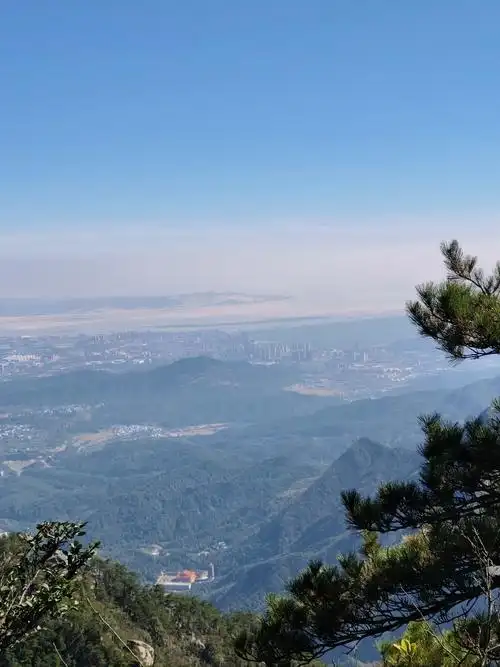 Hanpokou sits at the heart of Mount Lu, a UNESCO World Heritage site recognized since 1996 for both its natural beauty and its 2,000-year cultural legacy. Long celebrated by Chinese poets—from Li Bai in the Tang dynasty to the Ming essayist Xu Xiake—Lushan served as a gathering point for scholars, monks, and later statesmen. Mao Zedong held his pivotal 1959 Lushan Conference nearby, while Chiang Kai-shek built summer villas on its slopes in the 1930s. The mountain's layered history gives Hanpokou a cultural weight comparable to Switzerland's Alpine retreats, where sublime scenery has drawn thinkers and artists for centuries.
The name Hanpokou translates as "Poyang-Swallowing Mouth," drawn from a Qing dynasty poem comparing the ridge to a giant whale about to gulp the lake below. At 1,286 meters, this saddle between the Five Old Men Peaks to the north and Hanyang Peak to the south opens dramatically onto Poyang Lake—China's largest freshwater lake and a vital wintering ground for migratory Siberian cranes. The geological drama recalls viewpoints like Cape Sounion in Greece, where land and water collide in unforgettable fashion. On clear mornings, the view stretches across lake, plain, and distant horizons.
A modest cluster of pavilions—Hanpo Pavilion, Wangpo ("Gazing at Poyang") Pavilion, and Wanggui ("Forget Return") Pavilion—rests along the ridge, joined by an elegant stone memorial arch inscribed "Lake Light, Mountain Scenery." Built in the traditional Chinese manner, the structures use a covered-and-revealed placement: half-hidden among pines, half-open to the sky, never competing with nature. The restrained aesthetic echoes hilltop pavilions in English landscape gardens such as Stowe, where architecture frames the view rather than competing with it. Visitors can shelter from wind while still soaking in the panorama.
Hanpokou is, above all, a sunrise destination. Around 5 a.m., Wangpo Pavilion becomes the focal point as dawn breaks over the lake—first a violet line, then molten gold spilling across the water. After summer rains, warm air lifts moisture into rolling cloud seas that surge over the peaks like slow-motion waterfalls, sometimes submerging the viewpoint entirely. Photographers should arrive at least 30 minutes before sunrise; wind is biting even in July, so pack a windproof layer. Forget-the-Return Pavilion lives up to its name: many visitors linger far longer than planned.
No separate ticket is needed—Hanpokou is included with the main Lushan entry pass, which costs 160 yuan in peak season (April–October) and 135 yuan off-season. The site is open 6:00–20:00 daily. Catch the eastern-line sightseeing bus from Lushan town directly to Hanpokou Station, then walk ten minutes to the pavilions. A typical visit runs 15–30 minutes, though sunrise pilgrims stay longer. Pair it with the nearby Lushan Botanical Garden, founded in 1934 as China's earliest subtropical mountain garden, for a contrasting half-day.
The overlook is extremely weather-dependent: fog or rain reduces the experience to a wall of grey, so check forecasts and choose a clear morning. Spring and autumn are most reliable, though winter occasionally delivers crystalline visibility. The viewpoint is steep and exposed—sun protection is essential in summer, and sturdy shoes help on the slate paths. For Western travelers, Hanpokou delivers the same awe as a first glimpse of the Matterhorn from the Gornergrat, but with the bonus of an immense lake below. It is, simply, the soul of Mount Lu.
Hanpokou sits at the heart of Mount Lu, a UNESCO World Heritage site recognized since 1996 for both its natural beauty and its 2,000-year cultural legacy. Long celebrated by Chinese poets—from Li Bai in the Tang dynasty to the Ming essayist Xu Xiake—Lushan served as a gathering point for scholars, monks, and later statesmen. Mao Zedong held his pivotal 1959 Lushan Conference nearby, while Chiang Kai-shek built summer villas on its slopes in the 1930s. The mountain's layered history gives Hanpokou a cultural weight comparable to Switzerland's Alpine retreats, where sublime scenery has drawn thinkers and artists for centuries.
The name Hanpokou translates as "Poyang-Swallowing Mouth," drawn from a Qing dynasty poem comparing the ridge to a giant whale about to gulp the lake below. At 1,286 meters, this saddle between the Five Old Men Peaks to the north and Hanyang Peak to the south opens dramatically onto Poyang Lake—China's largest freshwater lake and a vital wintering ground for migratory Siberian cranes. The geological drama recalls viewpoints like Cape Sounion in Greece, where land and water collide in unforgettable fashion. On clear mornings, the view stretches across lake, plain, and distant horizons.
A modest cluster of pavilions—Hanpo Pavilion, Wangpo ("Gazing at Poyang") Pavilion, and Wanggui ("Forget Return") Pavilion—rests along the ridge, joined by an elegant stone memorial arch inscribed "Lake Light, Mountain Scenery." Built in the traditional Chinese manner, the structures use a covered-and-revealed placement: half-hidden among pines, half-open to the sky, never competing with nature. The restrained aesthetic echoes hilltop pavilions in English landscape gardens such as Stowe, where architecture frames the view rather than competing with it. Visitors can shelter from wind while still soaking in the panorama.
Hanpokou is, above all, a sunrise destination. Around 5 a.m., Wangpo Pavilion becomes the focal point as dawn breaks over the lake—first a violet line, then molten gold spilling across the water. After summer rains, warm air lifts moisture into rolling cloud seas that surge over the peaks like slow-motion waterfalls, sometimes submerging the viewpoint entirely. Photographers should arrive at least 30 minutes before sunrise; wind is biting even in July, so pack a windproof layer. Forget-the-Return Pavilion lives up to its name: many visitors linger far longer than planned.
No separate ticket is needed—Hanpokou is included with the main Lushan entry pass, which costs 160 yuan in peak season (April–October) and 135 yuan off-season. The site is open 6:00–20:00 daily. Catch the eastern-line sightseeing bus from Lushan town directly to Hanpokou Station, then walk ten minutes to the pavilions. A typical visit runs 15–30 minutes, though sunrise pilgrims stay longer. Pair it with the nearby Lushan Botanical Garden, founded in 1934 as China's earliest subtropical mountain garden, for a contrasting half-day.
The overlook is extremely weather-dependent: fog or rain reduces the experience to a wall of grey, so check forecasts and choose a clear morning. Spring and autumn are most reliable, though winter occasionally delivers crystalline visibility. The viewpoint is steep and exposed—sun protection is essential in summer, and sturdy shoes help on the slate paths. For Western travelers, Hanpokou delivers the same awe as a first glimpse of the Matterhorn from the Gornergrat, but with the bonus of an immense lake below. It is, simply, the soul of Mount Lu.