White Deer Grotto Academy
⭐ 4.20
White Deer Grotto Academy, Lushan, Jiujiang City, Jiangxi Province, China
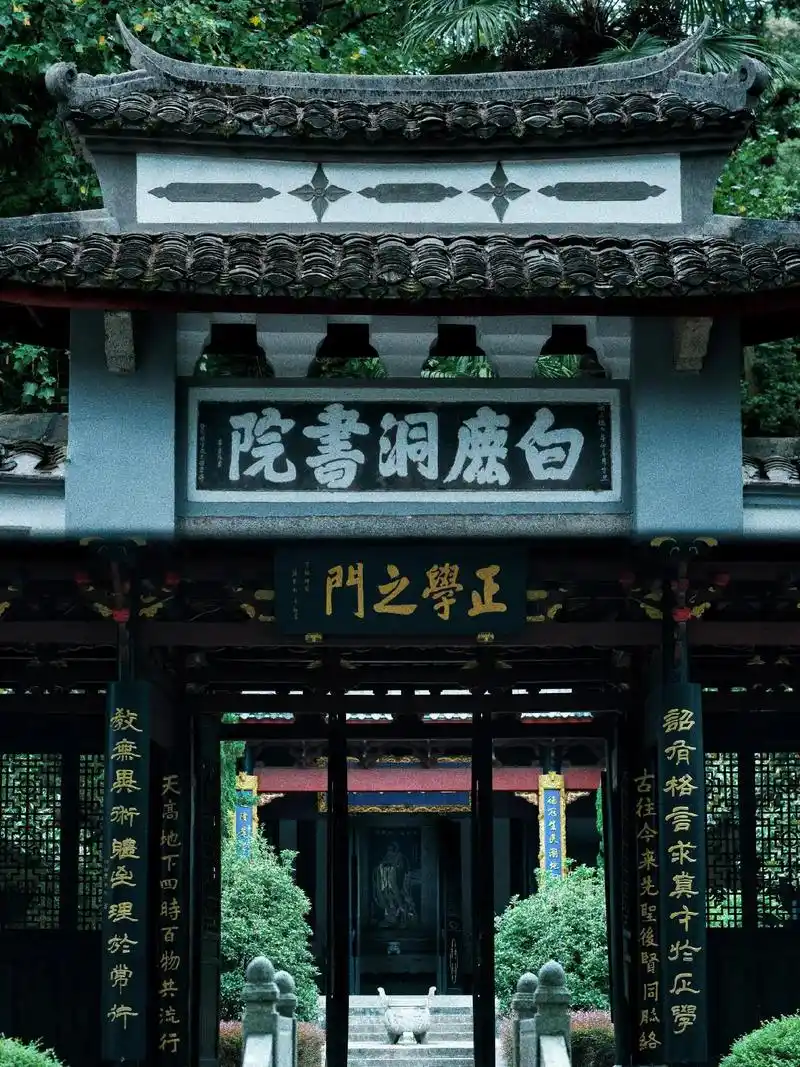 The academy's roots reach back to the Tang dynasty, when the scholar Li Bo retreated to this secluded valley to raise a white deer as a companion—hence the poetic name. By the tenth century, a state-sponsored school had taken shape here, and in 1179 the celebrated Neo-Confucian master Zhu Xi, newly appointed prefect of nearby Nankang, restored the crumbling complex and drafted its famous charter. His five guiding principles—broad learning, careful questioning, diligent reflection, clear discernment, and earnest practice—echo the humanist ideals later articulated by Erasmus, and shaped Chinese pedagogy as profoundly as Oxford and Bologna shaped Europe's.
The surviving buildings, mostly rebuilt during the Ming and Qing dynasties, follow the contours of the mountainside in a manner reminiscent of a hillside Tuscan hermitage. Visitors enter through the Lingxing Gate, one of China's oldest surviving wooden ceremonial archways, then cross the arched "Scholar's Bridge" spanning the semicircular Pan Pool. The Hall of Confucius anchors the central axis, dominated by a Kangxi-era plaque reading "Model Teacher for Ten Thousand Generations." Beyond, the Minglun Lecture Hall marks the very spot where Zhu Xi once held forth to his students.
A short walk leads to the Imperial Book Pavilion, where emperors once deposited their prized texts, and on to Guandao Stream, where more than sixty Song-through-Qing cliff inscriptions line the boulders—together with the academy's stele gallery, forming an open-air museum of Chinese calligraphy rivaling the engraved collections of any European cathedral cloister. White Deer Grotto set the standard for the other three great academies, exporting its "free teaching, practical learning" ethos across China and embedding Zhu Xi's synthesis of ethics and metaphysics at the core of East Asian intellectual life for centuries.
The academy sits at 27 Huanshan Road, Haihui Town, Lushan City, about 40 minutes by car from downtown Jiujiang. Entry is included with the Mount Lushan ticket (160 RMB per person, valid for seven days). Foreign visitors must pre-register via the "Visit Lushan" mini-program or major OTAs, presenting their reservation code plus the mountain pass at the gate. The visitor center runs a free shuttle, and parking costs about 10 RMB. Opening hours run daily from 8:00 to 17:00.
Allow two to three hours to follow the suggested circuit: Lingxing Gate, Pan Pool and Scholar's Bridge, Hall of Confucius, Minglun Hall, Imperial Book Pavilion, White Deer Cave, Sixian Terrace, and Stele Gallery. As a nationally protected monument, visitors should keep voices low, avoid touching the stones, and switch off camera flashes indoors. Hiring a certified bilingual guide or downloading the official audio tour is strongly recommended to fully grasp Zhu Xi's educational philosophy. Recent additions include hands-on rubbings of the "Six Arts" and traditional pitch-pot games—special treats for cultural travelers and scholars alike.
The academy's roots reach back to the Tang dynasty, when the scholar Li Bo retreated to this secluded valley to raise a white deer as a companion—hence the poetic name. By the tenth century, a state-sponsored school had taken shape here, and in 1179 the celebrated Neo-Confucian master Zhu Xi, newly appointed prefect of nearby Nankang, restored the crumbling complex and drafted its famous charter. His five guiding principles—broad learning, careful questioning, diligent reflection, clear discernment, and earnest practice—echo the humanist ideals later articulated by Erasmus, and shaped Chinese pedagogy as profoundly as Oxford and Bologna shaped Europe's.
The surviving buildings, mostly rebuilt during the Ming and Qing dynasties, follow the contours of the mountainside in a manner reminiscent of a hillside Tuscan hermitage. Visitors enter through the Lingxing Gate, one of China's oldest surviving wooden ceremonial archways, then cross the arched "Scholar's Bridge" spanning the semicircular Pan Pool. The Hall of Confucius anchors the central axis, dominated by a Kangxi-era plaque reading "Model Teacher for Ten Thousand Generations." Beyond, the Minglun Lecture Hall marks the very spot where Zhu Xi once held forth to his students.
A short walk leads to the Imperial Book Pavilion, where emperors once deposited their prized texts, and on to Guandao Stream, where more than sixty Song-through-Qing cliff inscriptions line the boulders—together with the academy's stele gallery, forming an open-air museum of Chinese calligraphy rivaling the engraved collections of any European cathedral cloister. White Deer Grotto set the standard for the other three great academies, exporting its "free teaching, practical learning" ethos across China and embedding Zhu Xi's synthesis of ethics and metaphysics at the core of East Asian intellectual life for centuries.
The academy sits at 27 Huanshan Road, Haihui Town, Lushan City, about 40 minutes by car from downtown Jiujiang. Entry is included with the Mount Lushan ticket (160 RMB per person, valid for seven days). Foreign visitors must pre-register via the "Visit Lushan" mini-program or major OTAs, presenting their reservation code plus the mountain pass at the gate. The visitor center runs a free shuttle, and parking costs about 10 RMB. Opening hours run daily from 8:00 to 17:00.
Allow two to three hours to follow the suggested circuit: Lingxing Gate, Pan Pool and Scholar's Bridge, Hall of Confucius, Minglun Hall, Imperial Book Pavilion, White Deer Cave, Sixian Terrace, and Stele Gallery. As a nationally protected monument, visitors should keep voices low, avoid touching the stones, and switch off camera flashes indoors. Hiring a certified bilingual guide or downloading the official audio tour is strongly recommended to fully grasp Zhu Xi's educational philosophy. Recent additions include hands-on rubbings of the "Six Arts" and traditional pitch-pot games—special treats for cultural travelers and scholars alike.