Pingyao City Wall
⭐ 4.50
Pingyao City Wall, Pingyao County, Jinzhong, Shanxi Province, China
 **Historical Context**
The ramparts trace their origins to the Western Zhou dynasty (c. 1046–771 BCE), originally as earthen ramparts, before being rebuilt in fired brick during the Ming dynasty's Hongwu reign in 1370, a period when many of Europe's great stone fortifications were also being raised. Subsequent Ming and Qing restorations, numbering more than twenty, produced the structure visitors see today. Inscribed as part of the Pingyao Ancient City UNESCO World Heritage Site in 1997, the wall witnessed the rise of the legendary Shanxi merchant banks that, much like the Medici of Renaissance Florence, financed much of imperial China's commerce. Bullet holes from the抗日战争 (Second Sino-Japanese War) still scar the masonry, lending the ramparts a poignant modern dimension.
**Architecture and Layout**
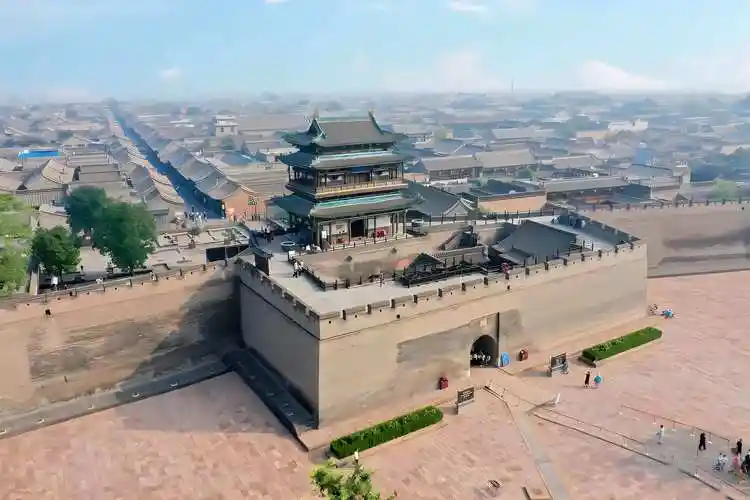
Stretching just over 6,100 meters with a height of 10 to 12 meters and a walkway 3 to 6 meters wide, the wall forms a "turtle city" plan, a shape believed to guarantee impregnability and longevity. Six gates, each protected by a barbican or wengcheng, are guarded by 72 enemy watchtowers and pierced by 3,000 crenellations, numbers deliberately chosen to evoke Confucius's 72 illustrious disciples and his legendary 3,000 followers. A surrounding moat completes the defense, while the engineering itself, an earthen core faced in grey brick, mirrors techniques used in contemporary European bastioned forts, offering visitors a striking East-West parallel in military architecture.
**Cultural Significance**
The wall represents a remarkable fusion of military engineering, Confucian symbolism, and Shanxi merchant identity. Gate names such as Yingxun (Welcoming Fragrance) and Gongji (Embracing the Pole Star) reflect traditional cosmological thinking, while the precise placement of corner towers and flanking bastions demonstrates the sophisticated planning of Ming-era fortification. Together with the ancient streets, draft banks, and temples inside the walled town, the ramparts form a complete surviving example of a Chinese county-level city from the imperial era, an integrity rarely matched even by Europe's most celebrated medieval centers.
**Practical Visit Information**
Access is via the Pingyao Ancient City combined ticket (125 RMB per person); the wall cannot be visited separately. The South Gate (Yingxun) and North Gate (Gongji) offer the best facilities and panoramic views. The golden hour between 17:00 and 19:30 provides soft light for photography and showcases both sunset and the city's atmospheric night illumination. The full circuit measures about 6.4 kilometers; foreign visitors are advised to walk only half, roughly 2–3 kilometers from the South Gate to the southwest corner tower and back, to avoid fatigue.
**Why Visit and Touring Tips**
Beyond its sheer scale, Pingyao's wall rewards visitors with an unbroken view of a living Ming-Qing townscape unobscured by modern towers, an experience increasingly rare in today's China. Wear flat, comfortable shoes; some parapet sections lack guardrails, so supervise children closely. Sections of the eastern rampart and certain watchtowers are under restoration in 2025–2026, so confirm open stretches on arrival. Pair the climb with the immersive performance "Encore Pingyao" for deeper insight into Shanxi merchant culture, or stay overnight in a courtyard inn within the old town. Visitors keen on historical detail should hire a licensed English-speaking guide to fully decode the turtle-city symbolism and Confucian numerology embedded in the defenses.
**Historical Context**
The ramparts trace their origins to the Western Zhou dynasty (c. 1046–771 BCE), originally as earthen ramparts, before being rebuilt in fired brick during the Ming dynasty's Hongwu reign in 1370, a period when many of Europe's great stone fortifications were also being raised. Subsequent Ming and Qing restorations, numbering more than twenty, produced the structure visitors see today. Inscribed as part of the Pingyao Ancient City UNESCO World Heritage Site in 1997, the wall witnessed the rise of the legendary Shanxi merchant banks that, much like the Medici of Renaissance Florence, financed much of imperial China's commerce. Bullet holes from the抗日战争 (Second Sino-Japanese War) still scar the masonry, lending the ramparts a poignant modern dimension.
**Architecture and Layout**
Stretching just over 6,100 meters with a height of 10 to 12 meters and a walkway 3 to 6 meters wide, the wall forms a "turtle city" plan, a shape believed to guarantee impregnability and longevity. Six gates, each protected by a barbican or wengcheng, are guarded by 72 enemy watchtowers and pierced by 3,000 crenellations, numbers deliberately chosen to evoke Confucius's 72 illustrious disciples and his legendary 3,000 followers. A surrounding moat completes the defense, while the engineering itself, an earthen core faced in grey brick, mirrors techniques used in contemporary European bastioned forts, offering visitors a striking East-West parallel in military architecture.
**Cultural Significance**
The wall represents a remarkable fusion of military engineering, Confucian symbolism, and Shanxi merchant identity. Gate names such as Yingxun (Welcoming Fragrance) and Gongji (Embracing the Pole Star) reflect traditional cosmological thinking, while the precise placement of corner towers and flanking bastions demonstrates the sophisticated planning of Ming-era fortification. Together with the ancient streets, draft banks, and temples inside the walled town, the ramparts form a complete surviving example of a Chinese county-level city from the imperial era, an integrity rarely matched even by Europe's most celebrated medieval centers.
**Practical Visit Information**
Access is via the Pingyao Ancient City combined ticket (125 RMB per person); the wall cannot be visited separately. The South Gate (Yingxun) and North Gate (Gongji) offer the best facilities and panoramic views. The golden hour between 17:00 and 19:30 provides soft light for photography and showcases both sunset and the city's atmospheric night illumination. The full circuit measures about 6.4 kilometers; foreign visitors are advised to walk only half, roughly 2–3 kilometers from the South Gate to the southwest corner tower and back, to avoid fatigue.
**Why Visit and Touring Tips**
Beyond its sheer scale, Pingyao's wall rewards visitors with an unbroken view of a living Ming-Qing townscape unobscured by modern towers, an experience increasingly rare in today's China. Wear flat, comfortable shoes; some parapet sections lack guardrails, so supervise children closely. Sections of the eastern rampart and certain watchtowers are under restoration in 2025–2026, so confirm open stretches on arrival. Pair the climb with the immersive performance "Encore Pingyao" for deeper insight into Shanxi merchant culture, or stay overnight in a courtyard inn within the old town. Visitors keen on historical detail should hire a licensed English-speaking guide to fully decode the turtle-city symbolism and Confucian numerology embedded in the defenses.