Xietongqing Exchange Shop
⭐ 4.50
Xietongqing Exchange Shop, Pingyao County, Jinzhong City, Shanxi Province, China
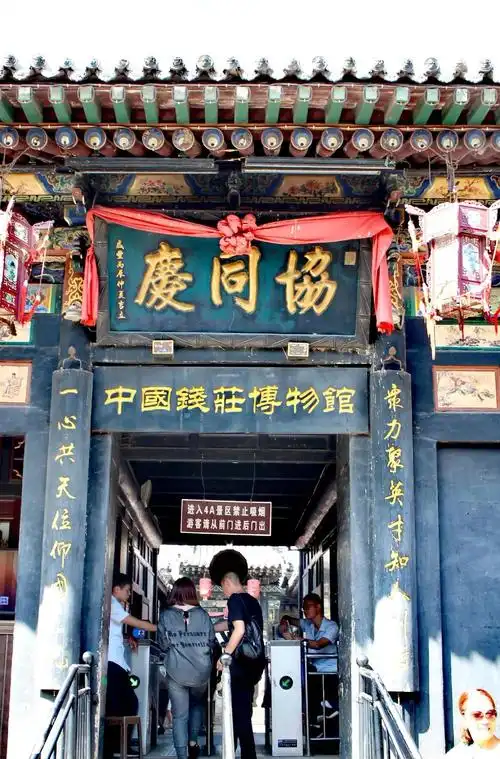 Founded in 1856 with a modest capital of 36,000 taels of silver, Xietongqing was a partnership between the Yuci Wang family and Pingyao's Mi family during the late Qing—a turbulent era when traditional China was being forced open by foreign trade. The bank embodied the Jin merchant philosophy of "knowing and rightly deploying talent," and at its height operated 33 branches stretching across the empire, much like the branch networks that European banking dynasties such as the Rothschilds would build a few decades later. After 57 years it closed in 1913, making it a vital witness to the rise and fall of China's indigenous financial system before Western-style banking took root.
The bank's layout is austere yet imposing, with five to seven successive courtyards preserving every functional zone of a working Qing-era exchange: reception hall, accounting office, mail and dispatch room, manager's quarters, clerks' dormitories and the subterranean vault. Brick carvings and woodwork throughout follow the disciplined conventions of Shanxi merchant architecture—a regional style often likened to the sober grandeur of Florentine palazzos—while deep, layered courtyards echo the spatial rhythm of a traditional Chinese courtyard house turned inward on itself.
The signature feature is the underground vault covering roughly 200–300 square metres, dug out beneath the courtyard and split into ten brick-vaulted chambers. Rising from its centre is a camphor-wood Dragon Treasure Pillar allegedly dating to the founding Ming dynasty—a relic so revered that locals call it Pingyao's "City-Protecting Treasure." This is the only vault in town open to public exploration, and visitors may step inside, touch the pillar for luck and handle replica silver ingots. Note that passages are narrow and ventilation is limited.
Beyond static displays, the museum stages an unusually lively visitor experience. Staff dressed in Qing-era robes play shopkeeper and accountant, leading short theatrical tableaux that recreate the drama of a draft being dispatched across the empire. Interactive stations let guests brush-write a remittance draft, weigh silver sycee ingots, or pose in period costume. The atmosphere deliberately evokes the commercial bustle that once animated Shanxi towns like Pingyao, drawing parallels to the merchant culture of cities such as Augsburg or Bruges at their trading peak.
No separate ticket is sold: admission requires the Pingyao Ancient City three-day pass, which covers 22 sites and is available with a passport at the city gates. The bank sits at No. 45 South Street, inside the walled town, and most visitors spend one to one-and-a-half hours exploring. English and other foreign-language audio guides can be reserved in advance, while bilingual guided tours depart at set times. Because the vault passages are narrow and slightly steep, those with mobility concerns or respiratory sensitivities should take care.
Xietongqing makes an essential pairing with the neighbouring Rishengchang—China's very first draft bank—and together they form the heart of any serious Jin-merchant itinerary. If Rishengchang is the cradle of Chinese modern banking, Xietongqing is the larger, more atmospheric showcase, where vault, courtyard and living history combine. For travellers who have marvelled at Florence's Medici palaces or Amsterdam's historic bourse, this is the Chinese counterpart that explains how a landlocked provincial capital once helped move silver across an empire.
Founded in 1856 with a modest capital of 36,000 taels of silver, Xietongqing was a partnership between the Yuci Wang family and Pingyao's Mi family during the late Qing—a turbulent era when traditional China was being forced open by foreign trade. The bank embodied the Jin merchant philosophy of "knowing and rightly deploying talent," and at its height operated 33 branches stretching across the empire, much like the branch networks that European banking dynasties such as the Rothschilds would build a few decades later. After 57 years it closed in 1913, making it a vital witness to the rise and fall of China's indigenous financial system before Western-style banking took root.
The bank's layout is austere yet imposing, with five to seven successive courtyards preserving every functional zone of a working Qing-era exchange: reception hall, accounting office, mail and dispatch room, manager's quarters, clerks' dormitories and the subterranean vault. Brick carvings and woodwork throughout follow the disciplined conventions of Shanxi merchant architecture—a regional style often likened to the sober grandeur of Florentine palazzos—while deep, layered courtyards echo the spatial rhythm of a traditional Chinese courtyard house turned inward on itself.
The signature feature is the underground vault covering roughly 200–300 square metres, dug out beneath the courtyard and split into ten brick-vaulted chambers. Rising from its centre is a camphor-wood Dragon Treasure Pillar allegedly dating to the founding Ming dynasty—a relic so revered that locals call it Pingyao's "City-Protecting Treasure." This is the only vault in town open to public exploration, and visitors may step inside, touch the pillar for luck and handle replica silver ingots. Note that passages are narrow and ventilation is limited.
Beyond static displays, the museum stages an unusually lively visitor experience. Staff dressed in Qing-era robes play shopkeeper and accountant, leading short theatrical tableaux that recreate the drama of a draft being dispatched across the empire. Interactive stations let guests brush-write a remittance draft, weigh silver sycee ingots, or pose in period costume. The atmosphere deliberately evokes the commercial bustle that once animated Shanxi towns like Pingyao, drawing parallels to the merchant culture of cities such as Augsburg or Bruges at their trading peak.
No separate ticket is sold: admission requires the Pingyao Ancient City three-day pass, which covers 22 sites and is available with a passport at the city gates. The bank sits at No. 45 South Street, inside the walled town, and most visitors spend one to one-and-a-half hours exploring. English and other foreign-language audio guides can be reserved in advance, while bilingual guided tours depart at set times. Because the vault passages are narrow and slightly steep, those with mobility concerns or respiratory sensitivities should take care.
Xietongqing makes an essential pairing with the neighbouring Rishengchang—China's very first draft bank—and together they form the heart of any serious Jin-merchant itinerary. If Rishengchang is the cradle of Chinese modern banking, Xietongqing is the larger, more atmospheric showcase, where vault, courtyard and living history combine. For travellers who have marvelled at Florence's Medici palaces or Amsterdam's historic bourse, this is the Chinese counterpart that explains how a landlocked provincial capital once helped move silver across an empire.