Zhenguo Temple
⭐ 4.80
Zhenguo Temple Scenic Area, Pingyao County, Shanxi Province, China
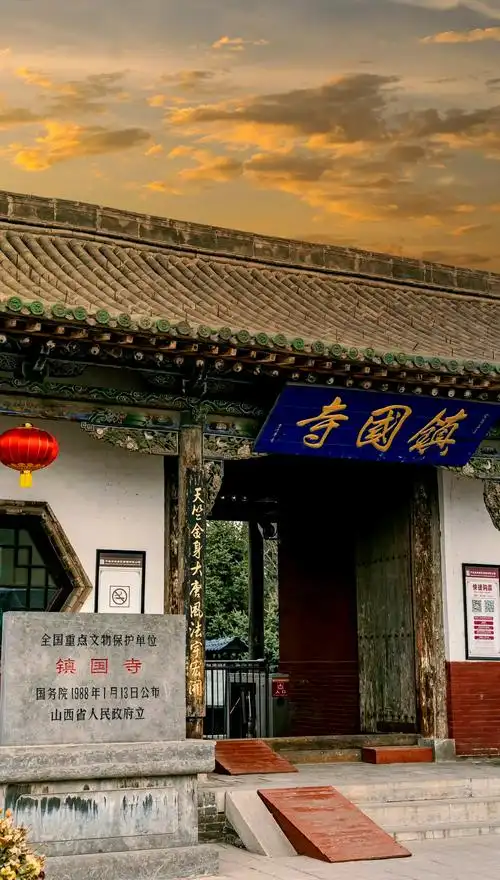 Built in 963 AD, when Otto I ruled the Holy Roman Empire and England remained divided among Anglo-Saxon kingdoms, Zhenguo Temple's Wanfo Hall offers something almost no European church of the same era can match: a continuously standing timber structure documented from its very year of construction. While Otto's contemporaries were laying the first Romanesque foundations in Burgundy, Chinese master carpenters were perfecting an elaborate joinery system that has held the hall together for over a millennium without a single nail. An ink inscription reading "Tianhui Year 7" on a main roof beam provides one of the earliest precisely dated records in East Asian architecture, predating most comparable European documentary evidence by centuries.
The Wanfo Hall itself is a compact, jewel-box structure crowned by a single-eave Xieshan roof that sweeps outward in broad, deep overhanging eaves—an unmistakably Tang-dynasty silhouette preserved a full century after the Tang fell. Inside, the Dougong bracket system, those interlocking wooden blocks that distribute the roof's weight, remains massive and even clumsy by later Song refinement, betraying its early-medieval origins. Visitors accustomed to European Romanesque interiors will be struck by the dim, intimate quality of the space, where natural light filters through latticed windows onto statues that have watched worshippers for over a thousand years.
The hall's greatest treasures are the eleven painted clay sculptures still standing in their original positions, a survival so complete that scholars rank it second only to the Dunhuang cave murals as a record of Five Dynasties religious art. A central Buddha flanked by two disciples, four bodhisattvas, two heavenly kings, and two donor figures display the plump, sensuous modeling and flowing drapery lines that mark the transition from Tang monumentality toward Song elegance. Their painted surfaces have been refreshed over the centuries, but the underlying forms remain essentially as they were when the Khitan Liao dynasty threatened the north and Europe braced for the millennium.
Admission runs around 25 RMB, with free entry commonly available for visitors over 60 and military veterans. The site opens 8:00–18:00 in peak season, closing an hour earlier off-season. Photography is strictly prohibited inside the Wanfo Hall, a rule respected by few Western travelers yet vital for preserving the sculptures. Allow 90 minutes to two hours, ideally between 9:00–11:00 or 15:00–17:00 when raking light illuminates both architecture and statues. The temple sits 12–15 km from Pingyao's North Gate, reached by Bus 209, a short taxi ride, or a 25-minute drive.
For Western travelers, Zhenguo Temple is best combined with Shuanglin Temple to the southwest, where Ming and Qing painted sculptures fill a dozen halls, completing a remarkable survey of Chinese Buddhist art across a millennium. Together with Pingyao's walled city, this UNESCO "One City, Two Temples" route comfortably fills a long day. Visitors drawn to medieval history will find Zhenguo a rarity on par with Europe's scattered Carolingian and Ottonian survivals, an authentic tenth-century encounter that brings to life a moment when both East and West were rebuilding civilization after centuries of upheaval.
Built in 963 AD, when Otto I ruled the Holy Roman Empire and England remained divided among Anglo-Saxon kingdoms, Zhenguo Temple's Wanfo Hall offers something almost no European church of the same era can match: a continuously standing timber structure documented from its very year of construction. While Otto's contemporaries were laying the first Romanesque foundations in Burgundy, Chinese master carpenters were perfecting an elaborate joinery system that has held the hall together for over a millennium without a single nail. An ink inscription reading "Tianhui Year 7" on a main roof beam provides one of the earliest precisely dated records in East Asian architecture, predating most comparable European documentary evidence by centuries.
The Wanfo Hall itself is a compact, jewel-box structure crowned by a single-eave Xieshan roof that sweeps outward in broad, deep overhanging eaves—an unmistakably Tang-dynasty silhouette preserved a full century after the Tang fell. Inside, the Dougong bracket system, those interlocking wooden blocks that distribute the roof's weight, remains massive and even clumsy by later Song refinement, betraying its early-medieval origins. Visitors accustomed to European Romanesque interiors will be struck by the dim, intimate quality of the space, where natural light filters through latticed windows onto statues that have watched worshippers for over a thousand years.
The hall's greatest treasures are the eleven painted clay sculptures still standing in their original positions, a survival so complete that scholars rank it second only to the Dunhuang cave murals as a record of Five Dynasties religious art. A central Buddha flanked by two disciples, four bodhisattvas, two heavenly kings, and two donor figures display the plump, sensuous modeling and flowing drapery lines that mark the transition from Tang monumentality toward Song elegance. Their painted surfaces have been refreshed over the centuries, but the underlying forms remain essentially as they were when the Khitan Liao dynasty threatened the north and Europe braced for the millennium.
Admission runs around 25 RMB, with free entry commonly available for visitors over 60 and military veterans. The site opens 8:00–18:00 in peak season, closing an hour earlier off-season. Photography is strictly prohibited inside the Wanfo Hall, a rule respected by few Western travelers yet vital for preserving the sculptures. Allow 90 minutes to two hours, ideally between 9:00–11:00 or 15:00–17:00 when raking light illuminates both architecture and statues. The temple sits 12–15 km from Pingyao's North Gate, reached by Bus 209, a short taxi ride, or a 25-minute drive.
For Western travelers, Zhenguo Temple is best combined with Shuanglin Temple to the southwest, where Ming and Qing painted sculptures fill a dozen halls, completing a remarkable survey of Chinese Buddhist art across a millennium. Together with Pingyao's walled city, this UNESCO "One City, Two Temples" route comfortably fills a long day. Visitors drawn to medieval history will find Zhenguo a rarity on par with Europe's scattered Carolingian and Ottonian survivals, an authentic tenth-century encounter that brings to life a moment when both East and West were rebuilding civilization after centuries of upheaval.