Nine-Curve Plank Road
⭐ 3.80
Nine-Curve Plank Road, Emeishan City, Leshan City, Sichuan Province, China
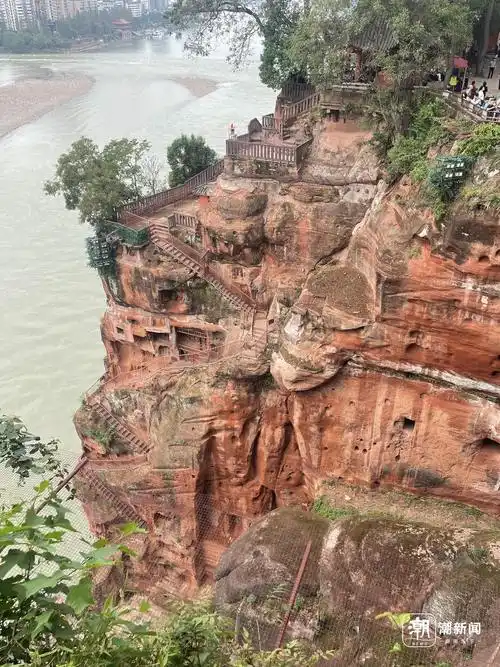 The plank road was hewn from living rock during the same Tang Dynasty campaign that produced the Giant Buddha itself, roughly contemporary with Charlemagne's coronation in Rome. Begun by the monk Haitong in 713 AD as both a construction route for hauling materials and a devotional pilgrimage path, it served a dual purpose from the outset: an industrial artery for one of antiquity's most ambitious sculptural undertakings, and a sacred approach for worshippers honouring Maitreya. Few medieval European routes survive in continuous use like this; imagine a chapel-cut staircase in a Tuscan hillside still carrying pilgrims a millennium later, and you grasp its singularity.
The walkway hugs the sheer cliff face of Lingyun Mountain in a series of hairpin switchbacks, descending about 70 metres over a length of roughly 200 metres. Its widest point measures 1.45 metres, its narrowest barely 0.6 metres, narrower than a typical Parisian doorway. The 217 steps, parapets, and platforms were cut directly from the bedrock rather than assembled, allowing the route to trace the natural contours of the cliff in a way no modern highway engineer could replicate without blasting. Walking it feels like threading the ramparts of Mont Saint-Michel, with the river roaring 200 feet below your elbow.
As you descend, the Buddha's anatomy reveals itself in sequence: first the spiralled ushnisha curls of the crown, then the flowing folds of the monastic robe across the chest, and finally, at the foot platform, the hidden drainage channels tucked behind the ears and along the pleated garments. These channels, though rarely mentioned in European guidebooks, are the reason the statue has survived: they funnel rainwater away from the stone, solving a conservation problem that defeated most medieval sculptors. A Tang-dynasty "Sutra Transformation" relief at the first switchback illustrates Buddhist parables in fluid lines that parallel the manuscript illumination of contemporary European monasteries like Lindisfarne.
Tickets must be booked through the official WeChat mini-program, 80 yuan per person for the daytime mountain route, and demand in July and August warrants booking a week ahead. Entry opens at 7:30, and the plank road operates strictly one-way with no stopping for selfies in the narrow sections, comparable to crowd-flow systems at the Uffizi. Most visitors enter through the North Gate, pass Lingyun Temple and the head-level viewing platform, descend to the Buddha's feet, then exit via the South or East Gate, completing the circuit in two to three hours. Arrive before 7:30 to beat the queue, which often stretches one to two hours even though the actual walk takes only fifteen to twenty minutes.
Those with vertigo, knee injuries, or very young children should think twice: the steps are steep, often damp, and unreversed. Wear grippy shoes in the rainy season, carry water and sun protection, and heed the single-direction rule. Should the plank road be fully booked or the climb inadvisable, river cruises between 70 and 150 yuan offer a panoramic alternative, allowing you to contemplate the Buddha in profile from the confluence of the Min, Dadu, and Qingyi rivers, much as travellers once admired cathedral facades from the deck of a Seine bateau-mouche.
The experience is unmissable not merely for the photograph, but for the rare intimacy it grants with a masterwork. Where most monumental sculpture demands you crane your neck from a tourist barricade, the Nine-Bend Plank Road invites you into the artisan's world: the chisel marks, the engineering compromises, the devotional intent carved into the living stone. Standing at the Buddha's feet, looking up past the knees and torso to the distant crown against the Sichuan sky, you understand why Chinese craftsmen called such climbs "touching the sky by hand," a sensation no museum visit and no riverside boat tour can quite reproduce.
The plank road was hewn from living rock during the same Tang Dynasty campaign that produced the Giant Buddha itself, roughly contemporary with Charlemagne's coronation in Rome. Begun by the monk Haitong in 713 AD as both a construction route for hauling materials and a devotional pilgrimage path, it served a dual purpose from the outset: an industrial artery for one of antiquity's most ambitious sculptural undertakings, and a sacred approach for worshippers honouring Maitreya. Few medieval European routes survive in continuous use like this; imagine a chapel-cut staircase in a Tuscan hillside still carrying pilgrims a millennium later, and you grasp its singularity.
The walkway hugs the sheer cliff face of Lingyun Mountain in a series of hairpin switchbacks, descending about 70 metres over a length of roughly 200 metres. Its widest point measures 1.45 metres, its narrowest barely 0.6 metres, narrower than a typical Parisian doorway. The 217 steps, parapets, and platforms were cut directly from the bedrock rather than assembled, allowing the route to trace the natural contours of the cliff in a way no modern highway engineer could replicate without blasting. Walking it feels like threading the ramparts of Mont Saint-Michel, with the river roaring 200 feet below your elbow.
As you descend, the Buddha's anatomy reveals itself in sequence: first the spiralled ushnisha curls of the crown, then the flowing folds of the monastic robe across the chest, and finally, at the foot platform, the hidden drainage channels tucked behind the ears and along the pleated garments. These channels, though rarely mentioned in European guidebooks, are the reason the statue has survived: they funnel rainwater away from the stone, solving a conservation problem that defeated most medieval sculptors. A Tang-dynasty "Sutra Transformation" relief at the first switchback illustrates Buddhist parables in fluid lines that parallel the manuscript illumination of contemporary European monasteries like Lindisfarne.
Tickets must be booked through the official WeChat mini-program, 80 yuan per person for the daytime mountain route, and demand in July and August warrants booking a week ahead. Entry opens at 7:30, and the plank road operates strictly one-way with no stopping for selfies in the narrow sections, comparable to crowd-flow systems at the Uffizi. Most visitors enter through the North Gate, pass Lingyun Temple and the head-level viewing platform, descend to the Buddha's feet, then exit via the South or East Gate, completing the circuit in two to three hours. Arrive before 7:30 to beat the queue, which often stretches one to two hours even though the actual walk takes only fifteen to twenty minutes.
Those with vertigo, knee injuries, or very young children should think twice: the steps are steep, often damp, and unreversed. Wear grippy shoes in the rainy season, carry water and sun protection, and heed the single-direction rule. Should the plank road be fully booked or the climb inadvisable, river cruises between 70 and 150 yuan offer a panoramic alternative, allowing you to contemplate the Buddha in profile from the confluence of the Min, Dadu, and Qingyi rivers, much as travellers once admired cathedral facades from the deck of a Seine bateau-mouche.
The experience is unmissable not merely for the photograph, but for the rare intimacy it grants with a masterwork. Where most monumental sculpture demands you crane your neck from a tourist barricade, the Nine-Bend Plank Road invites you into the artisan's world: the chisel marks, the engineering compromises, the devotional intent carved into the living stone. Standing at the Buddha's feet, looking up past the knees and torso to the distant crown against the Sichuan sky, you understand why Chinese craftsmen called such climbs "touching the sky by hand," a sensation no museum visit and no riverside boat tour can quite reproduce.