Mount Emei Buddhist Culture Museum
⭐ 3.80
Mount Emei Buddhist Culture Museum, Emeishan City, Leshan City, Sichuan Province, China
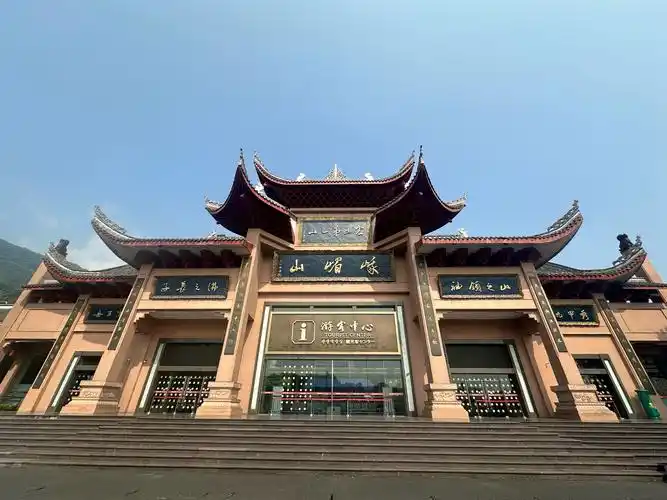 Reopened in 2021 after extensive renovation, the Mount Emei Buddhist Culture Museum occupies a 5,000-square-meter hall at the foot of one of China's Four Sacred Buddhist Mountains. It functions much like the interpretive centers at America's Grand Canyon or Scotland's Iona Abbey—orienting pilgrims and travelers before they encounter the sublime above. The museum contextualizes Mount Emei's 1996 recognition as a UNESCO Dual World Heritage Site, placing it in the company of Yellowstone and the Vatican as a place treasured for both natural marvel and cultural devotion across more than a millennium.
The galleries follow a "nature plus humanity" dual narrative. The Buddhist Art Hall anchors the spiritual journey, displaying Tang and Song dynasty sculptures, delicate palm-leaf sutras, and relics of revered Emei monks. Comparable in scope to Paris's Musée Guimet for Asian sacred art, it traces Emei's identity as the dwelling place of Samantabhadra, the Bodhisattva of Universal Compassion. A neighboring gallery offers gentler counterpoint: original works by twentieth-century masters Zhang Daqian and Xu Beihong, capturing mist-laden peaks in a manner reminiscent of J.M.W. Turner's romantic Alpine watercolors.
Holographic theaters and immersive soundscapes walk visitors through Emei's 800-million-year geological story, from primordial seas to the rise of its layered cliffs. Real dinosaur fossils and rare mineral specimens sit beside scientific explanations of the mountain's famed "Four Wonders"—Buddha's Halo, Sacred Lamps, Cloud Sea, and Sun Dogs—phenomena that medieval pilgrims attributed to divine intervention. A separate hall celebrates the rare syncretism of Confucianism, Buddhism, and Taoism on this single mountain, with martial-arts demonstrations, virtual blessing rituals, and digital life-release ceremonies designed for families and curious younger travelers.
Admission is free. The museum opens Tuesday through Sunday from 9:00 a.m. to 5:00 p.m., with last entry at 4:30 p.m.; it closes on Mondays. Multilingual AI translation screens and English audio guides make the collection accessible to non-Chinese speakers. Most visitors spend one to one-and-a-half hours inside, though pairing the museum with the adjacent free Baoguo Temple creates a richer half-day immersion. Both sites sit in the low-elevation Baoguo district at roughly 550 meters above sea level—the ideal acclimatization stop before tackling Emei's higher cable cars and the gilded Golden Summit beyond.
For travelers new to Mount Emei, this museum transforms a scenic cable-car ride into something far more meaningful. Instead of simply admiring the peaks, visitors leave able to identify the geological layers beneath them, the Buddhist figures carved into cliffside temples, and the atmospheric wonders that inspired Chinese poets for centuries. Few mountains worldwide offer such an elegant introduction—perhaps only Machu Picchu's visitor center comes close. Within these halls lies the key to understanding why more than three million pilgrims and travelers still ascend here each year.
Reopened in 2021 after extensive renovation, the Mount Emei Buddhist Culture Museum occupies a 5,000-square-meter hall at the foot of one of China's Four Sacred Buddhist Mountains. It functions much like the interpretive centers at America's Grand Canyon or Scotland's Iona Abbey—orienting pilgrims and travelers before they encounter the sublime above. The museum contextualizes Mount Emei's 1996 recognition as a UNESCO Dual World Heritage Site, placing it in the company of Yellowstone and the Vatican as a place treasured for both natural marvel and cultural devotion across more than a millennium.
The galleries follow a "nature plus humanity" dual narrative. The Buddhist Art Hall anchors the spiritual journey, displaying Tang and Song dynasty sculptures, delicate palm-leaf sutras, and relics of revered Emei monks. Comparable in scope to Paris's Musée Guimet for Asian sacred art, it traces Emei's identity as the dwelling place of Samantabhadra, the Bodhisattva of Universal Compassion. A neighboring gallery offers gentler counterpoint: original works by twentieth-century masters Zhang Daqian and Xu Beihong, capturing mist-laden peaks in a manner reminiscent of J.M.W. Turner's romantic Alpine watercolors.
Holographic theaters and immersive soundscapes walk visitors through Emei's 800-million-year geological story, from primordial seas to the rise of its layered cliffs. Real dinosaur fossils and rare mineral specimens sit beside scientific explanations of the mountain's famed "Four Wonders"—Buddha's Halo, Sacred Lamps, Cloud Sea, and Sun Dogs—phenomena that medieval pilgrims attributed to divine intervention. A separate hall celebrates the rare syncretism of Confucianism, Buddhism, and Taoism on this single mountain, with martial-arts demonstrations, virtual blessing rituals, and digital life-release ceremonies designed for families and curious younger travelers.
Admission is free. The museum opens Tuesday through Sunday from 9:00 a.m. to 5:00 p.m., with last entry at 4:30 p.m.; it closes on Mondays. Multilingual AI translation screens and English audio guides make the collection accessible to non-Chinese speakers. Most visitors spend one to one-and-a-half hours inside, though pairing the museum with the adjacent free Baoguo Temple creates a richer half-day immersion. Both sites sit in the low-elevation Baoguo district at roughly 550 meters above sea level—the ideal acclimatization stop before tackling Emei's higher cable cars and the gilded Golden Summit beyond.
For travelers new to Mount Emei, this museum transforms a scenic cable-car ride into something far more meaningful. Instead of simply admiring the peaks, visitors leave able to identify the geological layers beneath them, the Buddhist figures carved into cliffside temples, and the atmospheric wonders that inspired Chinese poets for centuries. Few mountains worldwide offer such an elegant introduction—perhaps only Machu Picchu's visitor center comes close. Within these halls lies the key to understanding why more than three million pilgrims and travelers still ascend here each year.