Fuhu Temple
⭐ 4.20
Fuhu Temple, Emeishan City, Leshan City, Sichuan Province, China
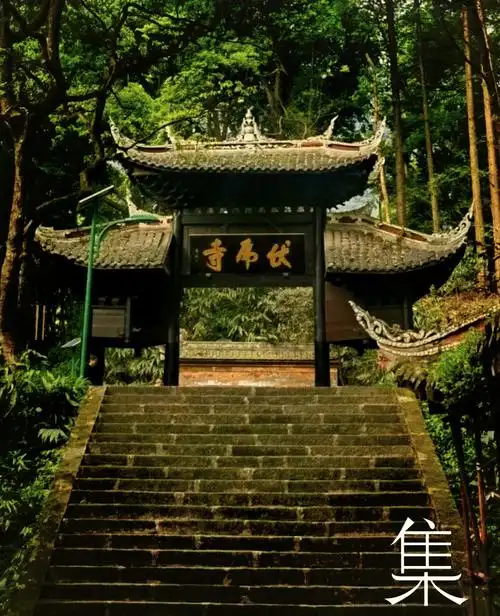 Fuhu Temple's origins in the Eastern Jin dynasty place its founding in the same era as the early Christian monasticism that would give rise to Monte Cassino. The temple was rebuilt in 1651, during the Qing consolidation under the Shunzhi Emperor—an era contemporary with Louis XIV's youth in France and Oliver Cromwell's rule in England. A legend explains its name: tigers once plagued the area, but their menace ceased after the temple's construction, giving "Fuhu" its meaning of "taming the tiger." The site also served as a filming location for the beloved 1986 Chinese television adaptation of Journey to the West, adding a layer of cultural nostalgia.
The temple follows a traditional Chinese Buddhist axial layout, ascending from the Mountain Gate through the Maitreya Hall, Samantabhadra Hall, and Great Hall to the Arhat Hall—a progression comparable to the cruciform planning of a Romanesque European cathedral. Yet Fuhu's most astonishing feature defies easy comparison: the "Garden Beyond Dust." Surrounded by ancient nanmu trees whose canopy arches thickly overhead, the temple's rooftops remain miraculously free of fallen leaves year-round. The Kangxi Emperor honored this phenomenon with a calligraphic plaque. Scholars attribute the effect to swirling air currents in the mountain hollow, a natural marvel that ranks alongside the most enigmatic sacred sites of medieval Europe.
Within the temple stands one of China's greatest Buddhist treasures: a Ming dynasty bronze pagoda rising 5.8 meters across 14 tiers, cast in purple copper and engraved with the complete Avatamsaka Sutra and over 4,700 miniature Buddha figures—comparable in devotion to the gilded reliquaries of Cologne Cathedral or Ghiberti's bronze doors in Florence. The Arhat Hall, rebuilt in 1995 in a distinctive grid layout, houses 500 gilded statues representing enlightened disciples of the Buddha, drawing pilgrims much as the carved portals of Chartres draw the faithful. As Mount Emei's principal nunnery, Fuhu remains a living institution where nuns maintain ancient chanting rituals at dawn and dusk.
The temple sits within the Bujin Forest, an ecological grove planted during the Qing dynasty where camphor trees are cultivated in numbers corresponding to characters in the Lotus Sutra. This sacred woodland offers a cool, cathedral-like atmosphere of ancient trunks, moss, and dappled light, ranking among Mount Emei's three celebrated forest landscapes. Walking beneath its towering canopy evokes the experience of wandering ancient yew groves surrounding English parish churches—a reminder that sacred landscapes across cultures share universal qualities of stillness, shade, and shelter from the world beyond.
Fuhu Temple is permanently free of charge from January 1, 2026, though visitors must hold a Mount Emei scenic area ticket (peak season approximately 160 yuan, off-season 110 yuan, roughly $15-22 USD). The temple generally opens from 8:00 AM to 4:00 PM, with most travelers spending one to two hours exploring. From Baoguo Temple's tourist center, it is a pleasant 10-15 minute walk along a tree-lined path crossed by three charming bridges named for tigers—Huxi, Huyu, and Huxiao—each spanning a small mountain stream. The approach itself is part of the experience.
Visit early in the morning, between 7:30 and 9:30 AM, when soft light filters through the trees, crowds are sparse, and the temple's contemplative mood is most palpable—ideal conditions for photographing red walls against ancient trunks. Dress modestly with shoulders and knees covered, remove hats when entering halls, and maintain respectful silence. Photography is forbidden inside the Arhat Hall. Summer visitors should bring insect repellent and wear sturdy flat shoes, as the grounds include mossy stone steps. For those tracing Mount Emei's Buddhist heritage, Fuhu Temple offers an unmissable fusion of architecture, legend, and living spirituality that rewards the curious traveler.
Fuhu Temple's origins in the Eastern Jin dynasty place its founding in the same era as the early Christian monasticism that would give rise to Monte Cassino. The temple was rebuilt in 1651, during the Qing consolidation under the Shunzhi Emperor—an era contemporary with Louis XIV's youth in France and Oliver Cromwell's rule in England. A legend explains its name: tigers once plagued the area, but their menace ceased after the temple's construction, giving "Fuhu" its meaning of "taming the tiger." The site also served as a filming location for the beloved 1986 Chinese television adaptation of Journey to the West, adding a layer of cultural nostalgia.
The temple follows a traditional Chinese Buddhist axial layout, ascending from the Mountain Gate through the Maitreya Hall, Samantabhadra Hall, and Great Hall to the Arhat Hall—a progression comparable to the cruciform planning of a Romanesque European cathedral. Yet Fuhu's most astonishing feature defies easy comparison: the "Garden Beyond Dust." Surrounded by ancient nanmu trees whose canopy arches thickly overhead, the temple's rooftops remain miraculously free of fallen leaves year-round. The Kangxi Emperor honored this phenomenon with a calligraphic plaque. Scholars attribute the effect to swirling air currents in the mountain hollow, a natural marvel that ranks alongside the most enigmatic sacred sites of medieval Europe.
Within the temple stands one of China's greatest Buddhist treasures: a Ming dynasty bronze pagoda rising 5.8 meters across 14 tiers, cast in purple copper and engraved with the complete Avatamsaka Sutra and over 4,700 miniature Buddha figures—comparable in devotion to the gilded reliquaries of Cologne Cathedral or Ghiberti's bronze doors in Florence. The Arhat Hall, rebuilt in 1995 in a distinctive grid layout, houses 500 gilded statues representing enlightened disciples of the Buddha, drawing pilgrims much as the carved portals of Chartres draw the faithful. As Mount Emei's principal nunnery, Fuhu remains a living institution where nuns maintain ancient chanting rituals at dawn and dusk.
The temple sits within the Bujin Forest, an ecological grove planted during the Qing dynasty where camphor trees are cultivated in numbers corresponding to characters in the Lotus Sutra. This sacred woodland offers a cool, cathedral-like atmosphere of ancient trunks, moss, and dappled light, ranking among Mount Emei's three celebrated forest landscapes. Walking beneath its towering canopy evokes the experience of wandering ancient yew groves surrounding English parish churches—a reminder that sacred landscapes across cultures share universal qualities of stillness, shade, and shelter from the world beyond.
Fuhu Temple is permanently free of charge from January 1, 2026, though visitors must hold a Mount Emei scenic area ticket (peak season approximately 160 yuan, off-season 110 yuan, roughly $15-22 USD). The temple generally opens from 8:00 AM to 4:00 PM, with most travelers spending one to two hours exploring. From Baoguo Temple's tourist center, it is a pleasant 10-15 minute walk along a tree-lined path crossed by three charming bridges named for tigers—Huxi, Huyu, and Huxiao—each spanning a small mountain stream. The approach itself is part of the experience.
Visit early in the morning, between 7:30 and 9:30 AM, when soft light filters through the trees, crowds are sparse, and the temple's contemplative mood is most palpable—ideal conditions for photographing red walls against ancient trunks. Dress modestly with shoulders and knees covered, remove hats when entering halls, and maintain respectful silence. Photography is forbidden inside the Arhat Hall. Summer visitors should bring insect repellent and wear sturdy flat shoes, as the grounds include mossy stone steps. For those tracing Mount Emei's Buddhist heritage, Fuhu Temple offers an unmissable fusion of architecture, legend, and living spirituality that rewards the curious traveler.