Wash Elephant Pool
⭐ 3.80
Wash Elephant Pool Scenic Area, Emeishan City, Sichuan Province, China
 **Historical Context**
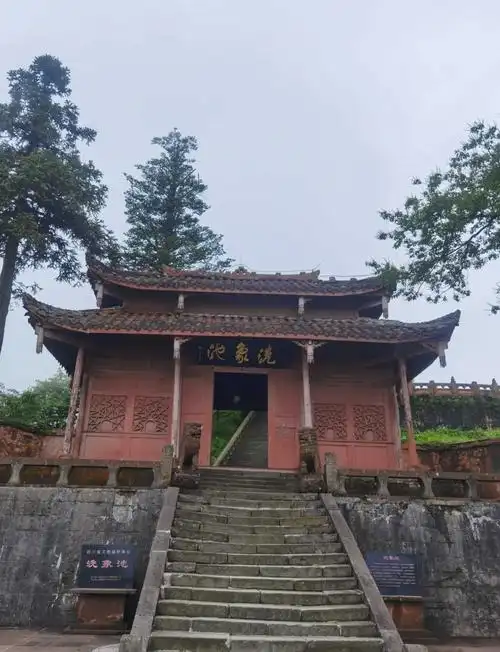
The Elephant Washing Pool Temple traces its origins to the early 1700s, during the long reign of the Kangxi Emperor—a period when Qing China rivaled the Ottoman and Habsburg empires as one of the world's great powers. Originally known as the "Pavilion of Initial Delight," the monastery was renamed after a beloved legend: that Samantabhadra, the patron bodhisattva of Mount Emei, paused here to bathe his white elephant in a sacred hexagonal pool. The temple has been rebuilt several times yet remains an active place of worship, holding dual World Heritage status alongside the giant Leshan Buddha as both a cultural and natural treasure.
**Architecture**
The compact temple complex clings to the mountainside in classic Chinese Buddhist style, comprising a Maitreya Hall, Great Hero Hall, Guanyin Hall, and Scripture Library arranged across stepped terraces. To withstand the punishing winters at this altitude—comparable in climate to alpine chapels in the Swiss Alps—craftsmen clad the roofs in tin and lead sheeting rather than traditional glazed tiles, creating a distinctive metallic shimmer against the surrounding spruce forests.
**Cultural Significance**
"Elephant Pool Moonlit Night" ranks among the Ten Scenic Wonders of Mount Emei and forms the spiritual heart of this site. On clear full-moon evenings, the orb reflects in the still waters of the hexagonal pool while clouds drift far below, an experience pilgrims have treasured for centuries. The monastery embodies the deep Buddhist and poetic traditions that have drawn travelers to Emei's slopes for over a millennium, longer than Canterbury Cathedral has stood in England.
**Practical Visit Information**
No separate admission is required—entry is included with the Mount Emei ticket, and the temple is open around the clock. From the Baoguo Temple Visitor Center, travelers take a sightseeing bus to Leidongping, then descend approximately 7.5 kilometers on foot (roughly three hours). Simple dormitory lodging is available within the temple, though foreign visitors should confirm guesthouse policies in advance. Sturdy hiking shoes, windproof layers, and rain gear are essential.
**Why Visit**
For Western travelers, the Elephant Washing Pool Temple offers something rare: an unspoiled mountain sanctuary far from the tour buses of China's great cities. Visiting at autumn's peak rewards you with crimson foliage, brilliant moonlight, and the chance to sleep within an ancient monastery, waking to a sunrise sea of clouds—an experience rivaling the solitude of high-altitude hermitages in the Greek Meteora or the remote chapels of the Italian Dolomites.
**Historical Context**
The Elephant Washing Pool Temple traces its origins to the early 1700s, during the long reign of the Kangxi Emperor—a period when Qing China rivaled the Ottoman and Habsburg empires as one of the world's great powers. Originally known as the "Pavilion of Initial Delight," the monastery was renamed after a beloved legend: that Samantabhadra, the patron bodhisattva of Mount Emei, paused here to bathe his white elephant in a sacred hexagonal pool. The temple has been rebuilt several times yet remains an active place of worship, holding dual World Heritage status alongside the giant Leshan Buddha as both a cultural and natural treasure.
**Architecture**
The compact temple complex clings to the mountainside in classic Chinese Buddhist style, comprising a Maitreya Hall, Great Hero Hall, Guanyin Hall, and Scripture Library arranged across stepped terraces. To withstand the punishing winters at this altitude—comparable in climate to alpine chapels in the Swiss Alps—craftsmen clad the roofs in tin and lead sheeting rather than traditional glazed tiles, creating a distinctive metallic shimmer against the surrounding spruce forests.
**Cultural Significance**
"Elephant Pool Moonlit Night" ranks among the Ten Scenic Wonders of Mount Emei and forms the spiritual heart of this site. On clear full-moon evenings, the orb reflects in the still waters of the hexagonal pool while clouds drift far below, an experience pilgrims have treasured for centuries. The monastery embodies the deep Buddhist and poetic traditions that have drawn travelers to Emei's slopes for over a millennium, longer than Canterbury Cathedral has stood in England.
**Practical Visit Information**
No separate admission is required—entry is included with the Mount Emei ticket, and the temple is open around the clock. From the Baoguo Temple Visitor Center, travelers take a sightseeing bus to Leidongping, then descend approximately 7.5 kilometers on foot (roughly three hours). Simple dormitory lodging is available within the temple, though foreign visitors should confirm guesthouse policies in advance. Sturdy hiking shoes, windproof layers, and rain gear are essential.
**Why Visit**
For Western travelers, the Elephant Washing Pool Temple offers something rare: an unspoiled mountain sanctuary far from the tour buses of China's great cities. Visiting at autumn's peak rewards you with crimson foliage, brilliant moonlight, and the chance to sleep within an ancient monastery, waking to a sunrise sea of clouds—an experience rivaling the solitude of high-altitude hermitages in the Greek Meteora or the remote chapels of the Italian Dolomites.