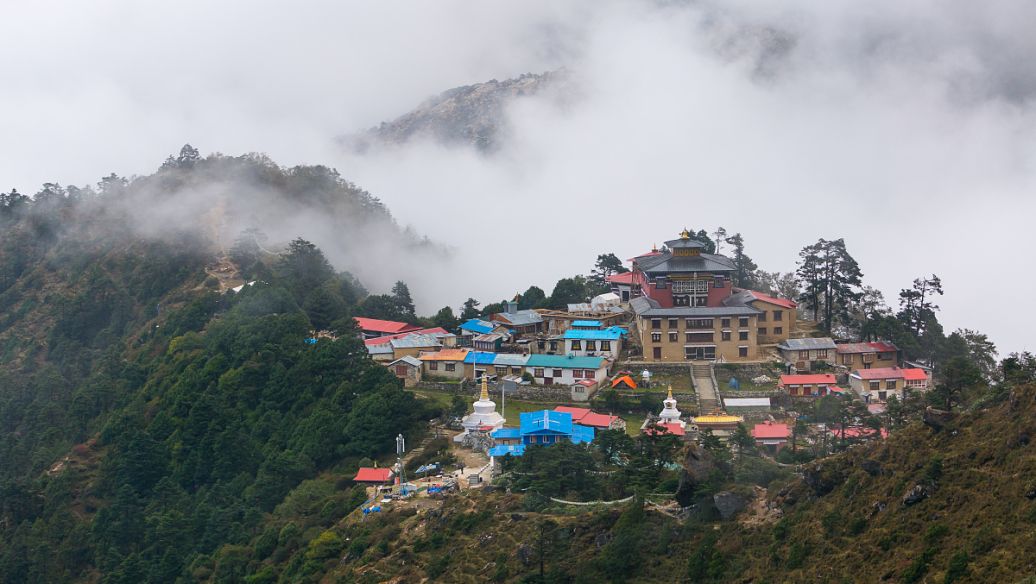
Golden Summit's history stretches back to the Eastern Han dynasty (25–220 CE), roughly contemporary with the late Roman Empire, when monks first established hermitages in its tranquil valleys. Bamboo Grove Temple was founded then and rebuilt through successive dynasties. Its Tang-style halls survive as an architectural echo of the cosmopolitan era when Chang'an stood as the world's largest city. The weathered ramparts of the Dragon Stockade recall more turbulent chapters—local hilltop fortifications from the late imperial era, echoing the fortified monasteries and watchtower castles familiar across medieval Europe.
The surviving temple complex exemplifies the restrained elegance of Tang Buddhist architecture, with halls nestled among bamboo groves rather than elevated stone platforms. Roofs curve gently upward in classic middle-period style, and weathered pillars frame quiet courtyards where incense still burns. The true marvel, however, lies along the cliff faces: the Golden Fan Buddhist Scripture Carvings, with calligraphy etched directly into living rock, their brushwork still bold after a millennium. Comparable to Europe's rock-cut chapels at Matera or the painted cave hermitages of Cappadocia, these living-stone scriptures offer an equally powerful fusion of faith and landscape.
Golden Summit embodies the syncretic religious landscape of central China, where Confucian, Buddhist, and Taoist traditions have long coexisted. Buddhist heritage dominates, with the celebrated "Golden Summit Purple Mist"—a luminous fog that gathers at dawn or after summer rain—long considered a sacred manifestation. Hikers ascending through bamboo and pine report the contemplative stillness pilgrims have sought here for generations. The mountain also serves as a contemporary wellness destination, credited with restorative powers much as Swiss Alpine spa towns attracted 19th-century European travelers seeking therapeutic mountain air.
The park lies roughly 20 kilometers southwest of Zhumadian city, reached via the Zhumadian South exit of the Beijing-Hong Kong-Macao Expressway and then along the Shang-Tong road, about an hour's drive. Admission runs 30–60 yuan, with discounts for seniors and students presenting ID. Gates open daily from 07:30 to 18:00. Although electric shuttles connect parking areas to trailheads, the summit climb requires walking on stone steps—some steep and uneven. Sturdy hiking shoes with good grip are essential, and travelers should allocate 3–5 hours for a full circuit.
The most rewarding loop begins at the entrance, passing the Golden Fan cliff carvings before climbing to Bamboo Grove Temple, then onward to the Dragon Stockade ruins and the Golden Peak summit, finally descending past the Cloud Sky Waterfall—roughly four hours total. Carry sufficient water and snacks, as summit refreshments are limited; in summer, pack insect repellent for the humid forest. Spring, autumn, and rainy summer mornings offer the best mist spectacles and the most comfortable hiking temperatures.
For travelers drawn off the well-trodden Great Wall and Terracotta Army circuits, Golden Summit offers an accessible, uncrowded encounter with authentic Chinese mountain culture. Where European equivalents like Tuscany's Monte Amiata or Bavaria's Bavarian Forest blend forested scenery with monastic heritage, Golden Summit merges comparable charm with a deeply East Asian spiritual legacy. Few mountains so close to a provincial capital deliver such an unhurried blend of bamboo, Buddhism, and breathtaking mist at so modest a price.