Confucius Temple – Qinhuai Scenic Area
⭐ 4.70
Confucius Temple – Qinhuai Scenic Area, Nanjing, Jiangsu Province, China
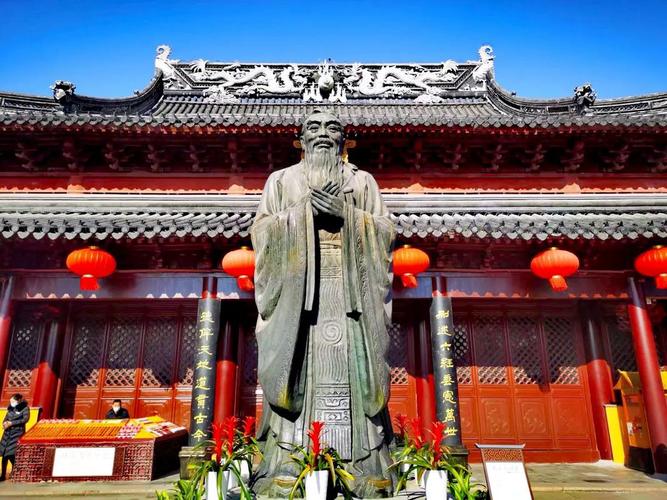 Set at the foot of the Purple Mountain and straddling the Qinhuai River, this district has been Nanjing's cultural pulse since the Six Dynasties (222–589 AD), a period often compared to Europe's early medieval flowering of learning and courtly culture. The Confucius Temple itself was first raised during the Wu kingdom and rebuilt in 1034 on its present site, evolving through the Ming and Qing into China's most revered center of Confucian learning—much as Oxford or Bologna anchored Western scholarship. Ming-era city walls and the imposing Zhonghua Gate fortress recall Nanjing's time as imperial capital, rivaling the scale and defensive ambition of contemporary European strongholds such as Carcassonne.
The area's architecture unfolds like a living museum of Chinese civilization. Enter beneath the "Pillar of Literary Empire" memorial archway, where the reflective Pan Pool mirrors the grand Hall of Great Accomplishment, its sweeping eaves and dougong brackets echoing the wooden-frame churches of medieval Europe. The Jiangnan Examination Hall, once capable of holding over 20,000 candidates at a time, dwarfs anything in Europe's testing tradition—comparable in scale to a sprawling medieval cathedral complex. Nearby, Zhan Yuan Garden, Nanjing's finest classical garden, rivals Suzhou's celebrated landscapes with its pavilions, rockeries, and lotus ponds, while modest Wuyi Lane still whispers of the noble Wang and Xie families immortalized in Tang poetry.
Culturally, this is where China's civil service examination system took its final mature form over nearly eight centuries, shaping a meritocratic ideal centuries ahead of its time. The riverbanks also fed the imagination of Ming and Qing novelists, whose tales of scholars, courtesans, and lantern-lit boats established the iconic imagery of "oar sounds and lamp shadows" that travelers still come to experience. Traditional crafts—lantern making, paper-cutting, and brocade weaving—remain practiced here, offering a tangible link to vanishing artisanal heritage found in few other world cities.
Visiting is refreshingly straightforward. Streets and riverside walkways are free and open 24 hours; the Jiangnan Examination Museum charges 50 yuan and stays open until 9:30 PM, while the main Confucius Temple costs 30 yuan (9 AM–9 PM). Evening boat rides along the inner Qinhuai run 80–140 yuan for roughly 50 unforgettable minutes. Take Metro Line 3 directly to the Confucius Temple station; driving in is discouraged, especially in summer, as parking is scarce and expensive. For inquiries, call 025-52209788.
To fully appreciate the area, arrive in late afternoon and stay well past dark—the transition from daylight to lantern glow creates the magical atmosphere celebrated by Du Mu's famous verse, "Mist veils the cold water; moon veils the sand." A recommended route runs from the main archway through the Examination Museum to the Wendé Bridge, a beloved viewpoint, then aboard a painted boat before dinner in the backstreets of Laomendong. Spring (March–May) and autumn (September–November) bring ideal weather, while the Lunar New Year lantern festival transforms the river into a glowing spectacle that rivals any European carnival. A final tip: skip the overpriced souvenirs along the main drag and seek out heritage eateries like Lianhu Cake Shop and Jiang's pan-fried dumplings in quieter Laomendong lanes—and always buy boat tickets through official channels.
Set at the foot of the Purple Mountain and straddling the Qinhuai River, this district has been Nanjing's cultural pulse since the Six Dynasties (222–589 AD), a period often compared to Europe's early medieval flowering of learning and courtly culture. The Confucius Temple itself was first raised during the Wu kingdom and rebuilt in 1034 on its present site, evolving through the Ming and Qing into China's most revered center of Confucian learning—much as Oxford or Bologna anchored Western scholarship. Ming-era city walls and the imposing Zhonghua Gate fortress recall Nanjing's time as imperial capital, rivaling the scale and defensive ambition of contemporary European strongholds such as Carcassonne.
The area's architecture unfolds like a living museum of Chinese civilization. Enter beneath the "Pillar of Literary Empire" memorial archway, where the reflective Pan Pool mirrors the grand Hall of Great Accomplishment, its sweeping eaves and dougong brackets echoing the wooden-frame churches of medieval Europe. The Jiangnan Examination Hall, once capable of holding over 20,000 candidates at a time, dwarfs anything in Europe's testing tradition—comparable in scale to a sprawling medieval cathedral complex. Nearby, Zhan Yuan Garden, Nanjing's finest classical garden, rivals Suzhou's celebrated landscapes with its pavilions, rockeries, and lotus ponds, while modest Wuyi Lane still whispers of the noble Wang and Xie families immortalized in Tang poetry.
Culturally, this is where China's civil service examination system took its final mature form over nearly eight centuries, shaping a meritocratic ideal centuries ahead of its time. The riverbanks also fed the imagination of Ming and Qing novelists, whose tales of scholars, courtesans, and lantern-lit boats established the iconic imagery of "oar sounds and lamp shadows" that travelers still come to experience. Traditional crafts—lantern making, paper-cutting, and brocade weaving—remain practiced here, offering a tangible link to vanishing artisanal heritage found in few other world cities.
Visiting is refreshingly straightforward. Streets and riverside walkways are free and open 24 hours; the Jiangnan Examination Museum charges 50 yuan and stays open until 9:30 PM, while the main Confucius Temple costs 30 yuan (9 AM–9 PM). Evening boat rides along the inner Qinhuai run 80–140 yuan for roughly 50 unforgettable minutes. Take Metro Line 3 directly to the Confucius Temple station; driving in is discouraged, especially in summer, as parking is scarce and expensive. For inquiries, call 025-52209788.
To fully appreciate the area, arrive in late afternoon and stay well past dark—the transition from daylight to lantern glow creates the magical atmosphere celebrated by Du Mu's famous verse, "Mist veils the cold water; moon veils the sand." A recommended route runs from the main archway through the Examination Museum to the Wendé Bridge, a beloved viewpoint, then aboard a painted boat before dinner in the backstreets of Laomendong. Spring (March–May) and autumn (September–November) bring ideal weather, while the Lunar New Year lantern festival transforms the river into a glowing spectacle that rivals any European carnival. A final tip: skip the overpriced souvenirs along the main drag and seek out heritage eateries like Lianhu Cake Shop and Jiang's pan-fried dumplings in quieter Laomendong lanes—and always buy boat tickets through official channels.