Xuancheng Confucian Temple
⭐ 3.20
Xuancheng Confucian Temple, Xuanzhou District, Xuancheng City, Anhui Province, China
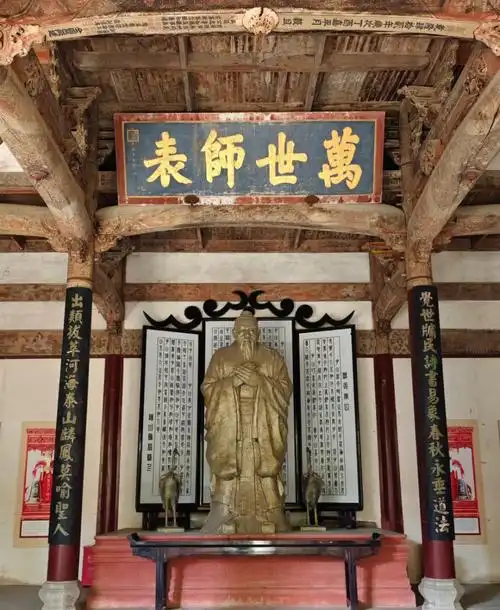 The Jingde Confucius Temple was first raised in 1102, during the era when Europe's great Romanesque cathedrals were rising across France and Germany. Like those medieval sanctuaries of learning and faith, it served as both school and shrine, dedicated to Confucius, the sage whose influence shaped East Asia as deeply as Aristotle shaped the West. Burned and rebuilt five times through wars and dynastic upheaval, the current timber halls survive from a 1645 reconstruction under the early Qing Dynasty, the year Rembrandt painted his masterworks. Designated a national key cultural relic in 2013, the temple occupies about 4,700 square meters on a strict north-south axis, mirroring the processional grandeur of a Gothic cathedral.
Step through the Lingxing Gate and cross the moon-shaped pond and bridge, symbolic thresholds that echo the baptismal fonts of European tradition. The Hall of Great Achievement (Dacheng Dian) rises beneath an imposing double-eaved hip-and-gable roof, its cavernous interior supported by four soaring timber columns that reach skyward like the nave pillars of a Romanesque abbey. Painted ceiling coffers depict the Eight Immortals and the Star of Literature in brilliant mineral pigments. Nearby, a five-story octagonal Wenchang Pagoda from the Qianlong era offers panoramic views over the ancient county town.
Jixi's temple is celebrated as "the finest academy south of the Yangtze," a boast it earns through sheer scale and craftsmanship. Its axial layout unfolds across a sprawling complex of gates, pools, and halls that rival the great monastic complexes of Tuscany. Inside, exquisite mortise-and-tenon joinery, Ming and Qing brick reliefs, and carved wooden panels showcase the signature Huizhou aesthetic: whitewashed walls, slate-grey tiles, and richly ornamented beams, akin to the refined ornamentation of a Florentine palazzo.
Both temples served as living schools where generations of Anhui scholars absorbed the Confucian classics. Today, Jingde hosts the Zhou Erfu Literary Exhibition, while Jixi partners with the county museum for rotating exhibitions on Confucian thought and traditional arts, making them living classrooms for visitors curious about Chinese intellectual heritage.
Both temples are free to enter and operate roughly 08:00–16:30; some halls prohibit photography or flash. Jingde is about an hour by car from Xuancheng city; Jixi is just 20 minutes by high-speed train to Jixi North Station. Carry water and snacks, as on-site dining is limited, but the surrounding towns reward travelers with classic Huizhou cuisine, including the famous stinky mandarin fish and Hu Shi's one-pot feast. Early morning or late afternoon light is best for photography; midday sun can flatten the carved details.
These temples are paradise for lovers of antiquity, architecture, and photography, and a meaningful destination for families exploring Chinese culture. Travelers seeking lively entertainment or nightlife will find them too quiet, but those who appreciate the contemplative beauty of old stones, timber, and tradition will leave deeply rewarded.
The Jingde Confucius Temple was first raised in 1102, during the era when Europe's great Romanesque cathedrals were rising across France and Germany. Like those medieval sanctuaries of learning and faith, it served as both school and shrine, dedicated to Confucius, the sage whose influence shaped East Asia as deeply as Aristotle shaped the West. Burned and rebuilt five times through wars and dynastic upheaval, the current timber halls survive from a 1645 reconstruction under the early Qing Dynasty, the year Rembrandt painted his masterworks. Designated a national key cultural relic in 2013, the temple occupies about 4,700 square meters on a strict north-south axis, mirroring the processional grandeur of a Gothic cathedral.
Step through the Lingxing Gate and cross the moon-shaped pond and bridge, symbolic thresholds that echo the baptismal fonts of European tradition. The Hall of Great Achievement (Dacheng Dian) rises beneath an imposing double-eaved hip-and-gable roof, its cavernous interior supported by four soaring timber columns that reach skyward like the nave pillars of a Romanesque abbey. Painted ceiling coffers depict the Eight Immortals and the Star of Literature in brilliant mineral pigments. Nearby, a five-story octagonal Wenchang Pagoda from the Qianlong era offers panoramic views over the ancient county town.
Jixi's temple is celebrated as "the finest academy south of the Yangtze," a boast it earns through sheer scale and craftsmanship. Its axial layout unfolds across a sprawling complex of gates, pools, and halls that rival the great monastic complexes of Tuscany. Inside, exquisite mortise-and-tenon joinery, Ming and Qing brick reliefs, and carved wooden panels showcase the signature Huizhou aesthetic: whitewashed walls, slate-grey tiles, and richly ornamented beams, akin to the refined ornamentation of a Florentine palazzo.
Both temples served as living schools where generations of Anhui scholars absorbed the Confucian classics. Today, Jingde hosts the Zhou Erfu Literary Exhibition, while Jixi partners with the county museum for rotating exhibitions on Confucian thought and traditional arts, making them living classrooms for visitors curious about Chinese intellectual heritage.
Both temples are free to enter and operate roughly 08:00–16:30; some halls prohibit photography or flash. Jingde is about an hour by car from Xuancheng city; Jixi is just 20 minutes by high-speed train to Jixi North Station. Carry water and snacks, as on-site dining is limited, but the surrounding towns reward travelers with classic Huizhou cuisine, including the famous stinky mandarin fish and Hu Shi's one-pot feast. Early morning or late afternoon light is best for photography; midday sun can flatten the carved details.
These temples are paradise for lovers of antiquity, architecture, and photography, and a meaningful destination for families exploring Chinese culture. Travelers seeking lively entertainment or nightlife will find them too quiet, but those who appreciate the contemplative beauty of old stones, timber, and tradition will leave deeply rewarded.