Taiji Cave
⭐ 4.00
Guangde City, Xuancheng City, Anhui Province, China
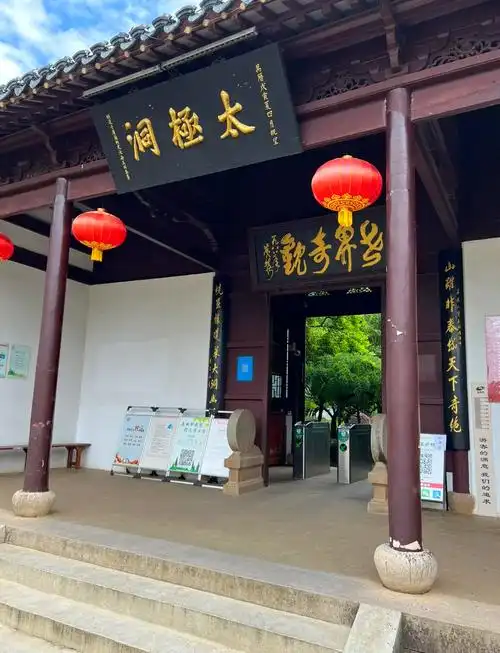 The cave's fame stretches back nearly four centuries, when Ming Dynasty polymath Feng Menglong—roughly contemporary with Shakespeare's era in Elizabethan England—declared it one of the "Four Wonders of the World" following his visit. Stone inscriptions attributed to Song Dynasty reformer Fan Zhongyan, the legendary Southern Song general Yue Fei, and Qing Emperor Qianlong (a contemporary of Mozart and Louis XVI) remain etched into the rock walls, lending the site a literary gravitas rivaling Italy's painted grottos or the inscribed chambers of ancient Mediterranean sanctuaries.
Geologically, Taiji Cave belongs to the same karst family as Slovenia's celebrated Postojna Cave or Hungary's Aggtelek stalactite labyrinth, formed over millions of years as limestone dissolved by groundwater. The four-tiered layout—Upper, Middle, Great, and Heaven Halls—unfolds like a subterranean cathedral, with formations such as the "Dragon Coiled Around Jade Pillar" and "Twin Towers Soaring to the Sky" evoking the soaring spires of Gothic cathedrals rendered in calcite. Some passages dip low enough to require crouching, while others open into vaulted chambers that recall the grandeur of natural wonders like Kentucky's Mammoth Cave.
Beyond its stone formations, the cave carries a profound cultural patina. Sites such as the Inkstone Washing Pool and the legendary Sword-Testing Stone anchor the visitor experience in narrative tradition, transforming a geological excursion into a journey through Chinese folk memory. The cave earned its present name from a natural ceiling pattern resembling the yin-yang taiji symbol—a fitting emblem for a place where nature and legend intertwine.
The underground river provides the experience's signature moment: visitors board small boats for a 15-to-20-minute glide through illuminated waterways, where reflected lights shimmer like a "subterranean galaxy." This rare combination of walking passages and boating through flooded chambers is uncommon in eastern China and offers an adventure comparable to drifting through Venice's lesser-known canals, but in total darkness save for theatrical illumination.
Practical planning is straightforward. Admission runs approximately 60–80 RMB, with boat tickets typically bundled or available as an add-on; cable cars and elevators incur separate fees. The site opens daily from 8:00 AM to 4:30 PM, with last entry around 4:00 PM, and visitors should allow two to three hours for a complete tour. Slippery, uneven surfaces demand sturdy anti-slip footwear, and a light jacket is advisable despite the pleasant 18°C interior. Public transit requires a transfer at Guangde South Station via infrequent rural buses, so self-driving with navigation to "Taiji Cave Scenic Area Visitor Center" remains the most reliable option.
For travelers seeking an accessible introduction to China's karst heritage beyond the more famous Guilin landscapes, Taiji Cave delivers striking scenery, literary resonance, and the rare thrill of an underground river journey—all within a manageable half-day excursion from the Yangtze Delta region.
The cave's fame stretches back nearly four centuries, when Ming Dynasty polymath Feng Menglong—roughly contemporary with Shakespeare's era in Elizabethan England—declared it one of the "Four Wonders of the World" following his visit. Stone inscriptions attributed to Song Dynasty reformer Fan Zhongyan, the legendary Southern Song general Yue Fei, and Qing Emperor Qianlong (a contemporary of Mozart and Louis XVI) remain etched into the rock walls, lending the site a literary gravitas rivaling Italy's painted grottos or the inscribed chambers of ancient Mediterranean sanctuaries.
Geologically, Taiji Cave belongs to the same karst family as Slovenia's celebrated Postojna Cave or Hungary's Aggtelek stalactite labyrinth, formed over millions of years as limestone dissolved by groundwater. The four-tiered layout—Upper, Middle, Great, and Heaven Halls—unfolds like a subterranean cathedral, with formations such as the "Dragon Coiled Around Jade Pillar" and "Twin Towers Soaring to the Sky" evoking the soaring spires of Gothic cathedrals rendered in calcite. Some passages dip low enough to require crouching, while others open into vaulted chambers that recall the grandeur of natural wonders like Kentucky's Mammoth Cave.
Beyond its stone formations, the cave carries a profound cultural patina. Sites such as the Inkstone Washing Pool and the legendary Sword-Testing Stone anchor the visitor experience in narrative tradition, transforming a geological excursion into a journey through Chinese folk memory. The cave earned its present name from a natural ceiling pattern resembling the yin-yang taiji symbol—a fitting emblem for a place where nature and legend intertwine.
The underground river provides the experience's signature moment: visitors board small boats for a 15-to-20-minute glide through illuminated waterways, where reflected lights shimmer like a "subterranean galaxy." This rare combination of walking passages and boating through flooded chambers is uncommon in eastern China and offers an adventure comparable to drifting through Venice's lesser-known canals, but in total darkness save for theatrical illumination.
Practical planning is straightforward. Admission runs approximately 60–80 RMB, with boat tickets typically bundled or available as an add-on; cable cars and elevators incur separate fees. The site opens daily from 8:00 AM to 4:30 PM, with last entry around 4:00 PM, and visitors should allow two to three hours for a complete tour. Slippery, uneven surfaces demand sturdy anti-slip footwear, and a light jacket is advisable despite the pleasant 18°C interior. Public transit requires a transfer at Guangde South Station via infrequent rural buses, so self-driving with navigation to "Taiji Cave Scenic Area Visitor Center" remains the most reliable option.
For travelers seeking an accessible introduction to China's karst heritage beyond the more famous Guilin landscapes, Taiji Cave delivers striking scenery, literary resonance, and the rare thrill of an underground river journey—all within a manageable half-day excursion from the Yangtze Delta region.