Mozi Memorial Hall
⭐ 3.80
Mozi Memorial Hall, Shencun Town, Xuanzhou District, Xuancheng City, Anhui Province, China
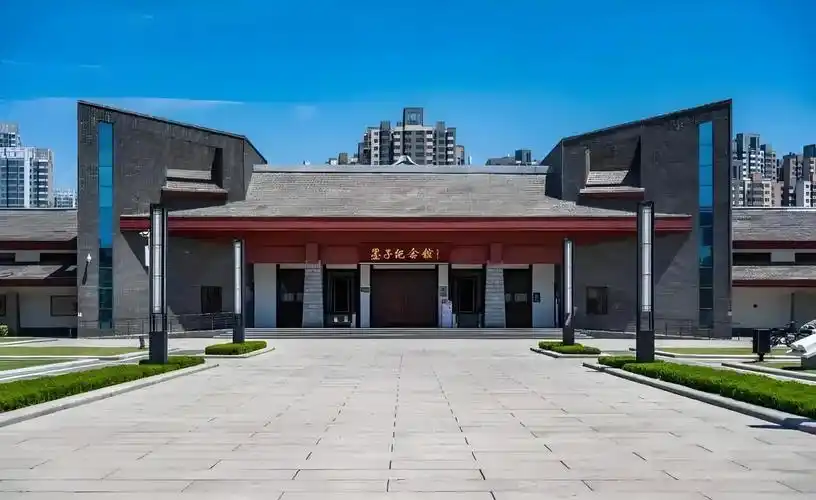 Mozi was among the most remarkable thinkers of the ancient world, a contemporary of Plato whose Mohist school rivaled Confucianism as China's dominant philosophy. While Plato was founding his Academy in Athens, Mozi was formalizing logic, championing pacifism, and conducting what may be humanity's earliest documented experiments with pinhole optics—nearly two millennia before European studies of light. His principles of "Universal Love" and "Non-Aggression" anticipated modern humanitarian ethics, while his treatises on defensive warfare stand alongside Sun Tzu's Art of War. This memorial honors a figure whose legacy deserves recognition beside Archimedes and Aristotle in any global canon of antiquity.
The memorial occupies a graceful corner of Longquan Square, its traditional garden design framing the adjacent Longquan Pagoda, a Tang-era Buddhist tower dating to the 8th century. The "two halls, four halls, one courtyard" layout unfolds across landscaped courtyards punctuated by lotus ponds that bloom spectacularly each summer. The Jian'ai (Universal Love) Hall and the Shengji (Sacred Traces) Hall introduce Mozi's life and ethics, while four thematic exhibition halls explore his humanistic, scientific, military, and contemporary legacy. A scholarly courtyard, the Mozi Academy, anchors the complex with quiet study spaces for visiting researchers and school groups.
As China's sole comprehensive museum devoted to Mozi, this institution fills a critical gap in preserving Mohist heritage—a tradition nearly lost for two millennia before its modern revival. The crown jewel is the handscroll "Scenic Map of Mozi's Sacred Traces," a painted narrative comprising 62 murals depicting key episodes from his life. Beyond static displays, the Science Hall recreates experiments from the Mojing (Mozi Canon), including the pinhole imaging principle that influenced Chinese and Arab optics, lever and pulley demonstrations, and working models of the legendary Mohist cloud-ladder and repeating crossbow used to defend city walls against besieging armies.
What distinguishes this museum from typical Chinese memorial halls is its hands-on philosophy—visitors don't merely view artifacts but actively engage with Mozi's inventions. Children and adults alike can peer through pinhole devices to invert the world, lift weights with reconstructed lever systems, and load bamboo bolts into a full-size crossbow replica. This interactive approach transforms abstract ancient texts into tangible discoveries, making the memorial a favorite destination for school field trips and family visits, particularly during summer when the lotus gardens reach their peak bloom.
The memorial sits at Fuqian Road in central Tengzhou, a small but historically rich city in southern Shandong. Opening hours run Tuesday through Sunday, 8:30 to 11:30 AM and 1:00 to 4:30 PM; the museum closes Mondays. Admission is free for Chinese citizens with ID; foreign visitors should bring passports for registration. Plan to arrive at 9:30 AM or 2:00 PM to avoid crowds, and allow two to three hours for a thorough visit. Free guided tours are available and highly recommended for proper context on Mohist philosophy and science.
Few places in China offer such direct engagement with the inventive spirit of antiquity. For travelers tracing the roots of Chinese philosophy, this stop is essential—Mozi's critiques of Confucian ritual and his proto-utilitarian ethics shaped two millennia of East Asian thought. Combine your visit with the adjacent Longquan Pagoda, the Tengzhou City Museum, and the Lu Ban Memorial (honoring the legendary master carpenter and Mozi's contemporary) to form a "Ban-Mo Culture" half-day circuit. Together, these sites illuminate the often-overlooked scientific and engineering genius of pre-imperial China, offering Western visitors a refreshing counterpoint to the better-known philosophical traditions of Greece and Rome.
Mozi was among the most remarkable thinkers of the ancient world, a contemporary of Plato whose Mohist school rivaled Confucianism as China's dominant philosophy. While Plato was founding his Academy in Athens, Mozi was formalizing logic, championing pacifism, and conducting what may be humanity's earliest documented experiments with pinhole optics—nearly two millennia before European studies of light. His principles of "Universal Love" and "Non-Aggression" anticipated modern humanitarian ethics, while his treatises on defensive warfare stand alongside Sun Tzu's Art of War. This memorial honors a figure whose legacy deserves recognition beside Archimedes and Aristotle in any global canon of antiquity.
The memorial occupies a graceful corner of Longquan Square, its traditional garden design framing the adjacent Longquan Pagoda, a Tang-era Buddhist tower dating to the 8th century. The "two halls, four halls, one courtyard" layout unfolds across landscaped courtyards punctuated by lotus ponds that bloom spectacularly each summer. The Jian'ai (Universal Love) Hall and the Shengji (Sacred Traces) Hall introduce Mozi's life and ethics, while four thematic exhibition halls explore his humanistic, scientific, military, and contemporary legacy. A scholarly courtyard, the Mozi Academy, anchors the complex with quiet study spaces for visiting researchers and school groups.
As China's sole comprehensive museum devoted to Mozi, this institution fills a critical gap in preserving Mohist heritage—a tradition nearly lost for two millennia before its modern revival. The crown jewel is the handscroll "Scenic Map of Mozi's Sacred Traces," a painted narrative comprising 62 murals depicting key episodes from his life. Beyond static displays, the Science Hall recreates experiments from the Mojing (Mozi Canon), including the pinhole imaging principle that influenced Chinese and Arab optics, lever and pulley demonstrations, and working models of the legendary Mohist cloud-ladder and repeating crossbow used to defend city walls against besieging armies.
What distinguishes this museum from typical Chinese memorial halls is its hands-on philosophy—visitors don't merely view artifacts but actively engage with Mozi's inventions. Children and adults alike can peer through pinhole devices to invert the world, lift weights with reconstructed lever systems, and load bamboo bolts into a full-size crossbow replica. This interactive approach transforms abstract ancient texts into tangible discoveries, making the memorial a favorite destination for school field trips and family visits, particularly during summer when the lotus gardens reach their peak bloom.
The memorial sits at Fuqian Road in central Tengzhou, a small but historically rich city in southern Shandong. Opening hours run Tuesday through Sunday, 8:30 to 11:30 AM and 1:00 to 4:30 PM; the museum closes Mondays. Admission is free for Chinese citizens with ID; foreign visitors should bring passports for registration. Plan to arrive at 9:30 AM or 2:00 PM to avoid crowds, and allow two to three hours for a thorough visit. Free guided tours are available and highly recommended for proper context on Mohist philosophy and science.
Few places in China offer such direct engagement with the inventive spirit of antiquity. For travelers tracing the roots of Chinese philosophy, this stop is essential—Mozi's critiques of Confucian ritual and his proto-utilitarian ethics shaped two millennia of East Asian thought. Combine your visit with the adjacent Longquan Pagoda, the Tengzhou City Museum, and the Lu Ban Memorial (honoring the legendary master carpenter and Mozi's contemporary) to form a "Ban-Mo Culture" half-day circuit. Together, these sites illuminate the often-overlooked scientific and engineering genius of pre-imperial China, offering Western visitors a refreshing counterpoint to the better-known philosophical traditions of Greece and Rome.