Taohuatan
⭐ 4.20
Taohuatan Scenic Area, Taohuatan Town, Jing County, Xuancheng City, Anhui Province, China
 **A Poet's Haven Through the Ages**
Peach Blossom Pool owes its worldwide renown to Li Bai (701–762), the Tang Dynasty poet whose verses rank alongside those of Petrarch or Shakespeare in shaping a national literary imagination. In 755 AD, a local admirer named Wang Lun hosted the poet at his riverside estate, and at parting Li Bai penned the famous lines: "Peach Blossom Pool is a thousand feet deep, yet not so deep as Wang Lun's love for me." The site thus became China's quintessential symbol of soul-friendship—a quiet counterpart to Lake Como's Romantic villas or England's Lake District haunts of Wordsworth. Over 700 relics survive, including Wang Lun's tomb and the elegant "Song-Stepping Pavilion" where the farewell reportedly took place.
**Architecture: Huizhou's Living Heritage**
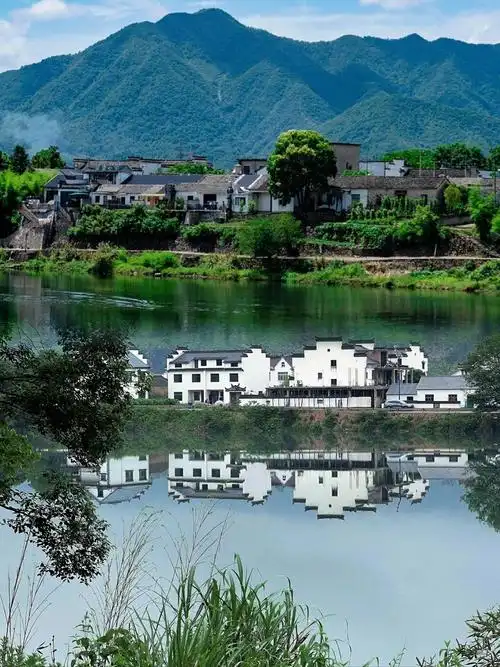
On the eastern bank rises the monumental Zhai Ancestral Hall, founded in the Ming Dynasty and hailed as "China's First Clan Temple." With its carved beams, painted rafters, and soaring ceremonial halls, it rivals the grandeur of any medieval European guild hall or Florentine palazzo, yet speaks a distinctly Jiangnan vernacular. Across the water, the village of Wancun preserves an organic maze of whitewashed walls, grey-tiled roofs, and stepped horse-head gables—the Huizhou architectural signature. A Qing-era Wen Chang Pavilion echoes the ancestral hall across the river, completing one of the most complete historic village ensembles still inhabited in southern Anhui.
**Landscape and the Famous Morning Mist**
The pool itself is a hushed expanse of jade-coloured water, perpetually cool at around 10°C, fed by mountain springs. From March through November, dawn between 6 and 8 am brings the celebrated mist—gossamer veils that drift across the surface as mountains dissolve and reappear, evoking a Chinese ink painting come alive. Visitors can glide across the water in traditional bamboo rafts, a serene experience comparable to punting on Oxford's Cherwell or drifting on Bled's emerald lake. Spring brings pink peach blossoms lining the banks, while autumn ignites the surrounding forests in crimson and gold.
**Cultural Significance and a Traveller's Reward**
This is the actual landscape behind a poem every Chinese schoolchild knows by heart—and visitors who recite "To Wang Lun" in full at the entrance gate are rewarded with complimentary admission. The pool thus functions as an open-air classroom for poetry lovers, students, and lovers of Chinese literature, while embodying the timeless Chinese ideal of friendship between cultivated souls. It belongs on the same pilgrimage list as Tintern Abbey for Anglophone Romantics or Goethe's Wetzlar for German literature devotees.
**Practical Visitor Information**
The park welcomes guests daily from 7:30 am to 5:30 pm (last entry 4:30 pm). Standard tickets cost around 70 RMB in peak season and 50 RMB in the low season; a combined pass covering both banks and the ferry crossing runs 110–130 RMB. High-speed rail arrives at Jingxian Station, followed by a 30–40 minute taxi or local bus ride; self-drivers should navigate directly to the "Peach Blossom Pool Tourist Centre." Allow four to six hours for the recommended loop: explore the eastern ancestral hall complex, ferry across the river, then wander the western Wancun village. Spring (March–May) and autumn (September–November) are ideal, and sunrise is non-negotiable for the mist spectacle.
**Why Visit and How to Extend Your Stay**
Few places in China reward the literary-minded traveller so richly: here you can stand where a Tang poem was born, trace the same waters Li Bai crossed, and watch history float by on a bamboo raft. For a deeper immersion into the Anhui watercolour landscape, pair your visit with the nearby Chaji Ancient Village—just a 20-minute drive further into the mountains—where 108 Ming-era bridges and untouched Huizhou courtyards await. Together they form one of eastern China's most evocative cultural circuits, a region where rivers, poetry, and architecture have remained in conversation for over a thousand years.
**A Poet's Haven Through the Ages**
Peach Blossom Pool owes its worldwide renown to Li Bai (701–762), the Tang Dynasty poet whose verses rank alongside those of Petrarch or Shakespeare in shaping a national literary imagination. In 755 AD, a local admirer named Wang Lun hosted the poet at his riverside estate, and at parting Li Bai penned the famous lines: "Peach Blossom Pool is a thousand feet deep, yet not so deep as Wang Lun's love for me." The site thus became China's quintessential symbol of soul-friendship—a quiet counterpart to Lake Como's Romantic villas or England's Lake District haunts of Wordsworth. Over 700 relics survive, including Wang Lun's tomb and the elegant "Song-Stepping Pavilion" where the farewell reportedly took place.
**Architecture: Huizhou's Living Heritage**
On the eastern bank rises the monumental Zhai Ancestral Hall, founded in the Ming Dynasty and hailed as "China's First Clan Temple." With its carved beams, painted rafters, and soaring ceremonial halls, it rivals the grandeur of any medieval European guild hall or Florentine palazzo, yet speaks a distinctly Jiangnan vernacular. Across the water, the village of Wancun preserves an organic maze of whitewashed walls, grey-tiled roofs, and stepped horse-head gables—the Huizhou architectural signature. A Qing-era Wen Chang Pavilion echoes the ancestral hall across the river, completing one of the most complete historic village ensembles still inhabited in southern Anhui.
**Landscape and the Famous Morning Mist**
The pool itself is a hushed expanse of jade-coloured water, perpetually cool at around 10°C, fed by mountain springs. From March through November, dawn between 6 and 8 am brings the celebrated mist—gossamer veils that drift across the surface as mountains dissolve and reappear, evoking a Chinese ink painting come alive. Visitors can glide across the water in traditional bamboo rafts, a serene experience comparable to punting on Oxford's Cherwell or drifting on Bled's emerald lake. Spring brings pink peach blossoms lining the banks, while autumn ignites the surrounding forests in crimson and gold.
**Cultural Significance and a Traveller's Reward**
This is the actual landscape behind a poem every Chinese schoolchild knows by heart—and visitors who recite "To Wang Lun" in full at the entrance gate are rewarded with complimentary admission. The pool thus functions as an open-air classroom for poetry lovers, students, and lovers of Chinese literature, while embodying the timeless Chinese ideal of friendship between cultivated souls. It belongs on the same pilgrimage list as Tintern Abbey for Anglophone Romantics or Goethe's Wetzlar for German literature devotees.
**Practical Visitor Information**
The park welcomes guests daily from 7:30 am to 5:30 pm (last entry 4:30 pm). Standard tickets cost around 70 RMB in peak season and 50 RMB in the low season; a combined pass covering both banks and the ferry crossing runs 110–130 RMB. High-speed rail arrives at Jingxian Station, followed by a 30–40 minute taxi or local bus ride; self-drivers should navigate directly to the "Peach Blossom Pool Tourist Centre." Allow four to six hours for the recommended loop: explore the eastern ancestral hall complex, ferry across the river, then wander the western Wancun village. Spring (March–May) and autumn (September–November) are ideal, and sunrise is non-negotiable for the mist spectacle.
**Why Visit and How to Extend Your Stay**
Few places in China reward the literary-minded traveller so richly: here you can stand where a Tang poem was born, trace the same waters Li Bai crossed, and watch history float by on a bamboo raft. For a deeper immersion into the Anhui watercolour landscape, pair your visit with the nearby Chaji Ancient Village—just a 20-minute drive further into the mountains—where 108 Ming-era bridges and untouched Huizhou courtyards await. Together they form one of eastern China's most evocative cultural circuits, a region where rivers, poetry, and architecture have remained in conversation for over a thousand years.