Xuanzhou Ancient City
⭐ 2.80
Xuanzhou Ancient City, Xuanzhou District, Xuancheng City, Anhui Province, China
 When Xuanzhou's first walls rose under the Eastern Wu kingdom in 239 CE, Rome was deep into its imperial heyday under the Severan dynasty. By the Northern Song, the city had been engineered into a remarkable "tortoise-shell" footprint—a rounded defensive layout that any visitor to Carcassonne will recognize, though the symbolism here was Chinese: the tortoise representing longevity and cosmic order. Today the walls are largely gone; Republic-era troops dismantled them during the 1930s and 1940s. Two poignant fragments survive: a 50-meter stretch of Southern Tang brickwork near the Zhuangyuan Mansion compound, and an earthen rampart remnant in Aofeng Park.
Perched atop Lingyang Hill, the reconstructed Xie Tiao Tower is Xuanzhou's answer to Siena's Torre del Mangia—a tall, contemplative belvedere dedicated less to defense than to literary pilgrimage. The original rose in the 5th century when the Southern Qi poet Xie Tiao served as prefect and used it to gaze upon the surrounding rivers and peaks. Centuries later, the Tang dynasty's most famous poet, Li Bai—China's closest analogue to Shakespeare or Petrarch—returned repeatedly to the site, immortalizing it with the line "the river city is like a painting." For photographers, the warm amber light just before sunset turns the tower's tiered eaves into a near-perfect silhouette against the modern skyline.
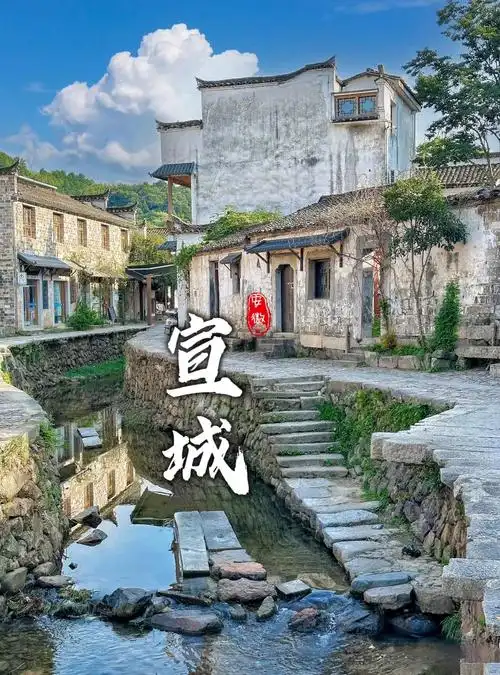
The "Nine Streets and Eighteen Alleys" grid preserves an urban logic that feels surprisingly intimate—closer in scale to Dubrovnik's Old Town lanes than to China's better-known ancient cities. Wander along Jincheng Road or Ying'en Street to see classic Huizhou architecture: whitewashed walls, dark timber frames, and distinctive stepped "horse-head" gables that animate rooflines much like the Flemish stepped facades of Ghent or Antwerp. Side alleys such as Tofu Lane remain genuinely lived-in, where residents hang laundry between lantern-strung doorways and vendors ladle out spicy vermicelli soup and crisp Ningguo flatbreads straight from the wok.
The Wanxi River threads through the city in a way that would feel familiar to visitors who know Bruges or Strasbourg—a slow waterway that has shaped commerce, transport, and identity for centuries. A continuous waterfront promenade now links Fenghuang Bridge in the south to Jichuan Bridge in the north. Tucked into the bamboo groves of Aofeng Park stands the Ming-dynasty Longshou Pagoda, a seven-story brick survivor that once shared grounds with a Confucian temple and a Wenchang Terrace. Today the park functions as the city's green lung, perfect for a quiet pause between historic sights.
Allow a relaxed half-day, ideally timed to catch three distinct moods. Begin mid-afternoon by drifting through the old lanes, sampling snacks—most dishes cost under 10 RMB. Late afternoon, taxi up to Xie Tiao Tower to watch the sun sink behind the rooftops; entrance is free or nominal. As dusk settles, stroll the Wanxi riverside path or join locals along Huancheng Road, where barbecue smoke mingles with mahjong clicks. Comfortable shoes are essential—the sights span a couple of kilometers. A taxi or rideshare helps reach outliers like Jingshan, the "Poetry Mountain," or the China Xuan Paper Museum, both essential companions to understanding Xuancheng's literati soul.
What makes Xuanzhou worth a detour is precisely what it is not: it is not a sanitized open-air museum like Lijiang's Old Town or the bundled tourist blocks of Pingyao. Instead, it is a working Chinese city whose residents still buy vegetables, walk children to school, and play chess under plane trees in the same lanes where Xie Tiao and Li Bai once composed verses. For travelers tracing a quieter, more authentic route through Anhui—a province better known for Huangshan's spectacular peaks—Xuanzhou offers something rarer: a chance to step into living, breathing history without paying an entrance fee, and to feel, as Li Bai did, that the river city truly is like a painting.
When Xuanzhou's first walls rose under the Eastern Wu kingdom in 239 CE, Rome was deep into its imperial heyday under the Severan dynasty. By the Northern Song, the city had been engineered into a remarkable "tortoise-shell" footprint—a rounded defensive layout that any visitor to Carcassonne will recognize, though the symbolism here was Chinese: the tortoise representing longevity and cosmic order. Today the walls are largely gone; Republic-era troops dismantled them during the 1930s and 1940s. Two poignant fragments survive: a 50-meter stretch of Southern Tang brickwork near the Zhuangyuan Mansion compound, and an earthen rampart remnant in Aofeng Park.
Perched atop Lingyang Hill, the reconstructed Xie Tiao Tower is Xuanzhou's answer to Siena's Torre del Mangia—a tall, contemplative belvedere dedicated less to defense than to literary pilgrimage. The original rose in the 5th century when the Southern Qi poet Xie Tiao served as prefect and used it to gaze upon the surrounding rivers and peaks. Centuries later, the Tang dynasty's most famous poet, Li Bai—China's closest analogue to Shakespeare or Petrarch—returned repeatedly to the site, immortalizing it with the line "the river city is like a painting." For photographers, the warm amber light just before sunset turns the tower's tiered eaves into a near-perfect silhouette against the modern skyline.
The "Nine Streets and Eighteen Alleys" grid preserves an urban logic that feels surprisingly intimate—closer in scale to Dubrovnik's Old Town lanes than to China's better-known ancient cities. Wander along Jincheng Road or Ying'en Street to see classic Huizhou architecture: whitewashed walls, dark timber frames, and distinctive stepped "horse-head" gables that animate rooflines much like the Flemish stepped facades of Ghent or Antwerp. Side alleys such as Tofu Lane remain genuinely lived-in, where residents hang laundry between lantern-strung doorways and vendors ladle out spicy vermicelli soup and crisp Ningguo flatbreads straight from the wok.
The Wanxi River threads through the city in a way that would feel familiar to visitors who know Bruges or Strasbourg—a slow waterway that has shaped commerce, transport, and identity for centuries. A continuous waterfront promenade now links Fenghuang Bridge in the south to Jichuan Bridge in the north. Tucked into the bamboo groves of Aofeng Park stands the Ming-dynasty Longshou Pagoda, a seven-story brick survivor that once shared grounds with a Confucian temple and a Wenchang Terrace. Today the park functions as the city's green lung, perfect for a quiet pause between historic sights.
Allow a relaxed half-day, ideally timed to catch three distinct moods. Begin mid-afternoon by drifting through the old lanes, sampling snacks—most dishes cost under 10 RMB. Late afternoon, taxi up to Xie Tiao Tower to watch the sun sink behind the rooftops; entrance is free or nominal. As dusk settles, stroll the Wanxi riverside path or join locals along Huancheng Road, where barbecue smoke mingles with mahjong clicks. Comfortable shoes are essential—the sights span a couple of kilometers. A taxi or rideshare helps reach outliers like Jingshan, the "Poetry Mountain," or the China Xuan Paper Museum, both essential companions to understanding Xuancheng's literati soul.
What makes Xuanzhou worth a detour is precisely what it is not: it is not a sanitized open-air museum like Lijiang's Old Town or the bundled tourist blocks of Pingyao. Instead, it is a working Chinese city whose residents still buy vegetables, walk children to school, and play chess under plane trees in the same lanes where Xie Tiao and Li Bai once composed verses. For travelers tracing a quieter, more authentic route through Anhui—a province better known for Huangshan's spectacular peaks—Xuanzhou offers something rarer: a chance to step into living, breathing history without paying an entrance fee, and to feel, as Li Bai did, that the river city truly is like a painting.