Sun Yat-sen Mausoleum
⭐ 4.20
Sun Yat-sen Mausoleum Scenic Area, Xuanwu District, Nanjing City, Jiangsu Province, China
 **A Monument to China's George Washington**
Sun Yat-sen (1866–1925) overthrew China's last imperial dynasty in 1911 and founded the Republic of China, earning comparisons to America's George Washington or India's Mahatma Gandhi. His mausoleum, completed in 1929, plays a role in Chinese memory similar to that of the Lincoln Memorial or Arlington National Cemetery in the United States—though here, the tribute is built directly into the mountainside, demanding that visitors climb toward the leader rather than gaze up at him from below. For Western travelers, it's a rare chance to stand inside the founding myth of modern China.
**Architecture That Speaks in Symbols**
The complex was designed by Lü Yanzhi, a self-taught architect who won the commission at just 31 and died of illness before construction finished. His fusion of traditional Chinese palatial design with Western neoclassical forms—blue-tiled roofs atop white marble halls—anticipates the national monuments built across Asia in the mid-20th century. The axis runs through nine structures, from the memorial archway (Bo'ai Fang) to the sacrificial hall containing a 4.6-meter white-marble seated statue of Sun Yat-sen, and finally to the burial chamber five meters below, where a bronze coffin rests beneath a marble effigy.
**The 392 Steps and Their Hidden Meaning**
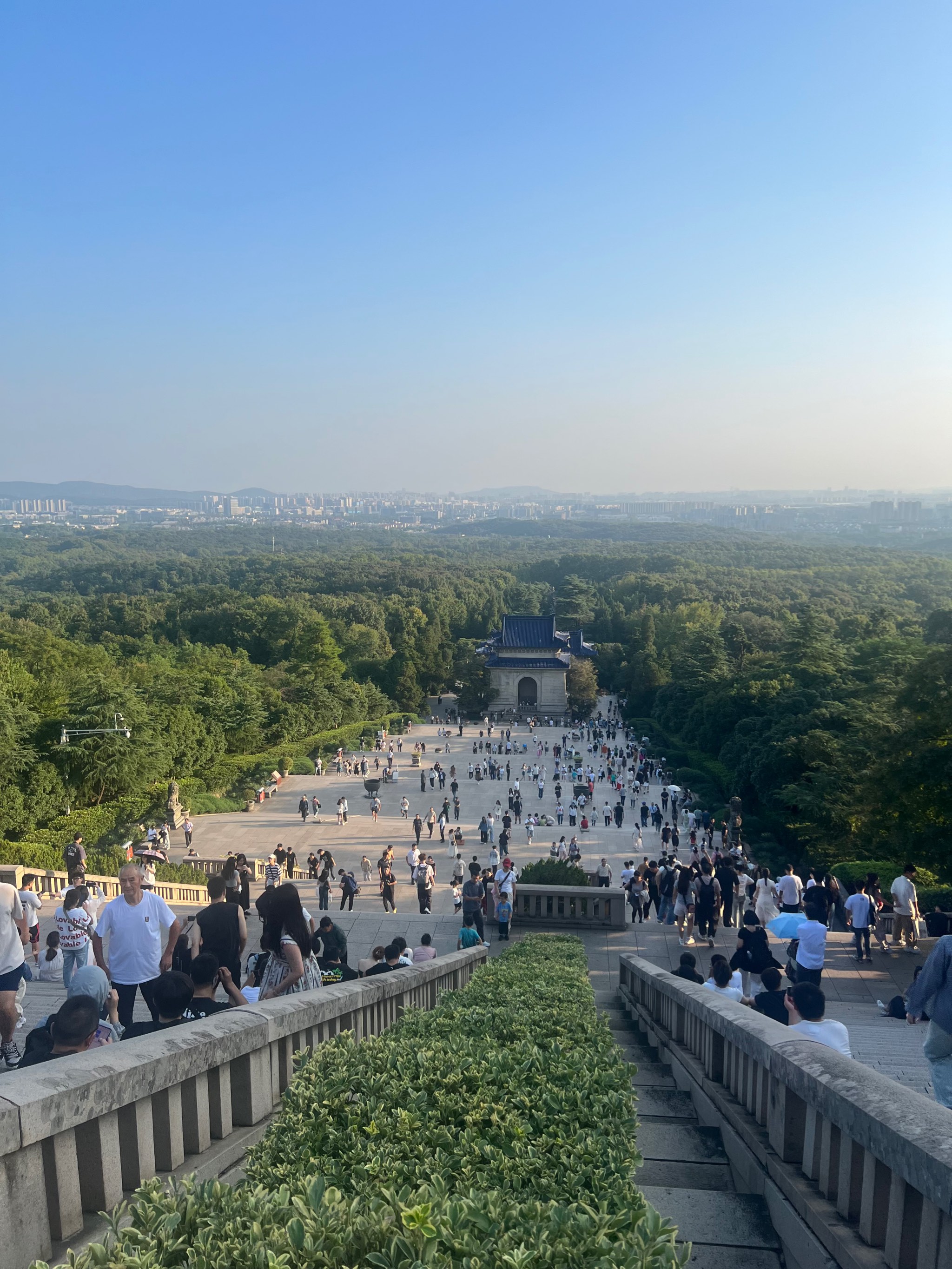
The famous staircase holds more than physical challenge. Each step represents one of the 39.2 million citizens of China at the time of Sun's death, and the design plays a clever visual trick: looking up, you see only steps and no landings; looking down, you see only landings and no steps. The whole layout, seen from the air, forms a giant Liberty Bell—a deliberate echo of American revolutionary symbolism that reflects Sun's own years of exile in Honolulu and on the U.S. mainland.
**Visitor Essentials**
Entry to the mausoleum area is free, but advance booking is required via the "Nanjing Zhongshan Scenic Area" WeChat mini-program, and the complex closes every Monday. The burial chamber itself is open only Tuesday through Friday, so plan accordingly. Take Metro Line 2 to Mùxu Garden or Xiàmafang station, then transfer to the sightseeing shuttle. Wear sturdy, non-slip shoes—the ascent covers about 70 meters of elevation—and skip the heels entirely. Photography and talking are forbidden inside the sacrificial hall; maintain a respectful hush.
**Plan Your Day**
Allow two to three hours for a full visit. If time allows, combine the mausoleum with the neighboring Ming Xiaoling Tomb (a UNESCO World Heritage site and resting place of the 14th-century Hongwu Emperor) and the charming Meiling Palace, where a combo ticket saves money. In summer, mosquitoes are aggressive—bring repellent. And ignore the popular myth that the tree-lined avenues were planted by Chiang Kai-shek and his wife; these plane trees are native Chinese species and far older than that story claims.
**Why It's Worth the Climb**
Beyond its stunning views over Nanjing's "Purple Mountain" landscape, the mausoleum offers something increasingly rare: a chance to experience a site where political memory, artistic ambition, and natural beauty converge. Whether you're drawn by architecture, modern Chinese history, or simply the satisfaction of reaching those final steps, the Sun Yat-sen Mausoleum rewards the effort with one of the country's most quietly powerful experiences.
**A Monument to China's George Washington**
Sun Yat-sen (1866–1925) overthrew China's last imperial dynasty in 1911 and founded the Republic of China, earning comparisons to America's George Washington or India's Mahatma Gandhi. His mausoleum, completed in 1929, plays a role in Chinese memory similar to that of the Lincoln Memorial or Arlington National Cemetery in the United States—though here, the tribute is built directly into the mountainside, demanding that visitors climb toward the leader rather than gaze up at him from below. For Western travelers, it's a rare chance to stand inside the founding myth of modern China.
**Architecture That Speaks in Symbols**
The complex was designed by Lü Yanzhi, a self-taught architect who won the commission at just 31 and died of illness before construction finished. His fusion of traditional Chinese palatial design with Western neoclassical forms—blue-tiled roofs atop white marble halls—anticipates the national monuments built across Asia in the mid-20th century. The axis runs through nine structures, from the memorial archway (Bo'ai Fang) to the sacrificial hall containing a 4.6-meter white-marble seated statue of Sun Yat-sen, and finally to the burial chamber five meters below, where a bronze coffin rests beneath a marble effigy.
**The 392 Steps and Their Hidden Meaning**
The famous staircase holds more than physical challenge. Each step represents one of the 39.2 million citizens of China at the time of Sun's death, and the design plays a clever visual trick: looking up, you see only steps and no landings; looking down, you see only landings and no steps. The whole layout, seen from the air, forms a giant Liberty Bell—a deliberate echo of American revolutionary symbolism that reflects Sun's own years of exile in Honolulu and on the U.S. mainland.
**Visitor Essentials**
Entry to the mausoleum area is free, but advance booking is required via the "Nanjing Zhongshan Scenic Area" WeChat mini-program, and the complex closes every Monday. The burial chamber itself is open only Tuesday through Friday, so plan accordingly. Take Metro Line 2 to Mùxu Garden or Xiàmafang station, then transfer to the sightseeing shuttle. Wear sturdy, non-slip shoes—the ascent covers about 70 meters of elevation—and skip the heels entirely. Photography and talking are forbidden inside the sacrificial hall; maintain a respectful hush.
**Plan Your Day**
Allow two to three hours for a full visit. If time allows, combine the mausoleum with the neighboring Ming Xiaoling Tomb (a UNESCO World Heritage site and resting place of the 14th-century Hongwu Emperor) and the charming Meiling Palace, where a combo ticket saves money. In summer, mosquitoes are aggressive—bring repellent. And ignore the popular myth that the tree-lined avenues were planted by Chiang Kai-shek and his wife; these plane trees are native Chinese species and far older than that story claims.
**Why It's Worth the Climb**
Beyond its stunning views over Nanjing's "Purple Mountain" landscape, the mausoleum offers something increasingly rare: a chance to experience a site where political memory, artistic ambition, and natural beauty converge. Whether you're drawn by architecture, modern Chinese history, or simply the satisfaction of reaching those final steps, the Sun Yat-sen Mausoleum rewards the effort with one of the country's most quietly powerful experiences.