Olympic Forest Park

⭐ 4.70

South Park, Olympic Forest Park, Chaoyang District, Beijing, China
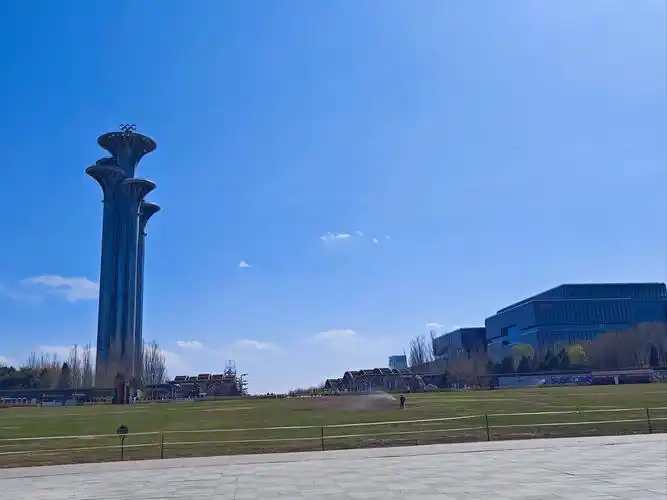
Olympic Forest Park
Born in the lead-up to the 2008 Beijing Olympics, the park was conceived as the green heart of the Olympic Center, sitting at the northern tip of the city's historic central axis—a fabled alignment stretching back to the Ming Dynasty and echoing grand imperial planning found in Versailles or St. Petersburg. Once the Games concluded, the site transformed seamlessly into a public ecological park, and in 2018 it earned China's top-tier 5A tourism rating, becoming a flagship showcase of the "Green Olympics" philosophy and modern Chinese environmental ambition. The southern park is the showpiece, built around the artificial Aohai Lake and its dramatic 80-meter musical fountain, reminiscent of Bellagio's spectacle but set against a backdrop of native Chinese flora. Across the water rises Yangshan Hill, whose summit rewards hikers with panoramic views of the Bird's Nest and Water Cube—iconic Olympic landmarks designed by Herzog & de Meuron and PTW Architects that have already joined the architectural canon alongside London's Millennium Dome or Barcelona's Montjuïc communications tower. In contrast, the northern park preserves a wilder character, with dense woodlands, meandering streams, tree groves, and flower-filled wetlands threaded by elevated boardwalks. Culturally, the park holds deep significance as the northern green terminus of Beijing's central axis—a line that has guided the city's layout for six centuries and now extends a unifying thread from the Forbidden City through Tiananmen Square to this verdant endpoint. The Olympic Declaration Plaza, inscribed with the Olympic Manifesto in both Chinese and English, anchors the park as a global symbol of athletic idealism and international exchange, much like Olympia in Greece stands as the birthplace of the Games. Visiting is refreshingly straightforward: located at 33 Kehui Road in Chaoyang District, the park is open daily and completely free, with no advance booking required. Peak season (March 15–November 15) hours run 6:00 a.m. to 10:00 p.m., while off-season hours are 7:00 a.m. to 7:00 p.m. The most convenient access is via Line 8 subway to the Forest Park South Gate station, while drivers can park at the South or West Gate lots for roughly 8 yuan per hour. The visitor hotline is 010-64529060. A recommended route begins at the South Gate, follows the lakeshore path toward the foot of Yangshan Hill, climbs to the summit for the Olympic skyline panorama, then crosses the ecological corridor into the wilder northern park—an easy 3-to-4-hour loop. Spring brings blossoms of mountain peach and magnolia, summer turns the lotus ponds into pink spectacles best enjoyed after 5 p.m. to escape the heat, autumn gilds the ginkgo trees and reeds in gold, and winter cloaks the quiet groves in pristine snow. With a 5-kilometer professional running track, children's playgrounds, accessible pathways, and bike rentals, the park welcomes families, joggers, and casual strollers alike.

Traveler reviews

Olympic Park, officially known as Beijing Olympic Park, is a national AAAAA-rated tourist attraction located in Chaoyang District, Beijing. As of 2023, the park covers a ...
⭐ 5 · Sam Park Expand
Beijing Olympic Park, located in Chaoyang District, Beijing, China. Construction began in 2003 and was completed in 2008, covering a total area of 11.59 square kilometers. It's a comprehensive civic activity center for the city, and also serves as a patriotic education base and a red tourism site in China. The park sits at the northern end of the city's central axis, right next to the North 4th Ring Road and Beichen Bridge. Total area is 1,135 hectares, divided into three zones. The northern end is the 680-hectare Forest Park; the central zone (Zone B) is 291 hectares and contains the main venues and supporting facilities; the southern end is 114 hectares of completed venue areas and reserved land. The Chinese Ethnic Culture Park is also included within Olympic Park's boundaries. Thanks to the Asian Games venues and all the supporting infrastructure, transport here is super convenient, the population is concentrated, municipal conditions are good, and commercial and cultural facilities are well-equipped. The planning looks at the city's long-term development and residents' material and cultural needs, aiming to make it a multi-functional public activity center combining sports competitions, conferences and exhibitions, cultural entertainment, and leisure shopping — open spaces, surrounded by greenery, with a pleasant environment. The Central Zone of Olympic Park is at the endpoint of Beijing's northern central axis, covering 315 hectares. It represents the extension of the city's traditional central axis, symbolizing the continuation of thousands of years of Chinese history and culture. It embodies three core concepts: "Technology, Green, Humanity," and is a new-type urban area integrating offices, commerce, hotels, culture, sports, conferences, and residential functi...
⭐ 5 · Phoenix Lane Expand