Huangling Temple
⭐ 3.20
Huangling Temple, Xiangxi Town, Zigui County, Yichang City, Hubei Province, China
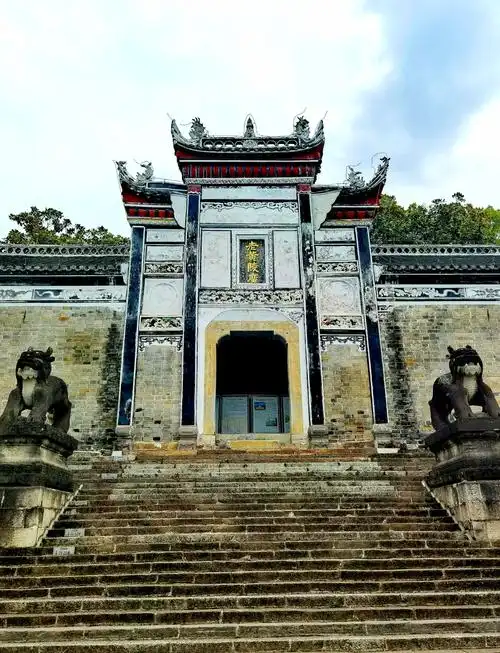 **A Temple Born from China's Great Flood Myth**
Huangling Temple's origins are rooted in one of humanity's oldest flood-control legends. The shrine was originally raised to honor a divine ox said to have helped the sage-emperor Yu the Great tame the Yangtze's torrents around 2000 BCE—a Chinese counterpart to the Mesopotamian Utnapishtim or the Greek Deucalion. While the current main hall was rebuilt in 1618 during the late Ming Dynasty (the same era as Shakespeare's London and Rembrandt's Leiden), the site's sacred pedigree stretches back nearly two and a half millennia, making it a living archive of the Chinese river civilization that pre-dates most of Europe's medieval cathedrals.
**Architecture That Rivals Europe's Wooden Wonders**
The 16-meter-high Yu Wang Hall is a showpiece of imperial Ming craftsmanship, its double-eaved hip-and-gable roof sheltered by ingenious iron tiles—a medieval fireproofing technique that mirrors the lead sheathing found on old European civic halls. Inside, 36 massive nanmu-wood pillars soar toward the ceiling, each spiraled with a vividly carved Ming-era dragon. The effect is every bit as awe-inspiring as the hammer-beam roof of Westminster Hall or the forested nave of a Norwegian stave church, yet uniquely Chinese in its symbolism and restraint.
**A Treasury of Poetry and Hydrology**
The temple's stone tablets read like a who's who of Chinese literary history: a memorial essay by Zhuge Liang, the legendary strategist of the Three Kingdoms, plus poems by Song Dynasty giants Su Shi and Lu You. Even Empress Dowager Cixi contributed a plaque inscribed "Stabilizing the River's Waves." Equally priceless for scholars are the carved flood marks on the courtyard balustrades, including the unmistakable trace of the catastrophic 1870 inundation—data that engineers still consult when modeling Yangtze flood risk today.
**Practicalities for the Independent Visitor**
Admission is free and opening hours typically run 09:00 to 17:00, though confirm on arrival. Reaching the temple requires a car or chartered taxi from Yichang East railway station, roughly 51 km and an hour's drive; public buses are infrequent. There are no shops, English signage, or guides on site, so bring water, an offline translation app, and comfortable shoes. Drone flights are strictly prohibited due to the temple's position within the Three Gorges Dam security zone.
**Why It Belongs on Your Three Gorges Itinerary**
Allow 1 to 1.5 hours to absorb the atmosphere at a contemplative pace. The most rewarding approach is to pair Huangling with the Three Gorges Dam, Tanzi Ridge viewpoint, and the 185 Platform—often marketed as the "Two Dams and One Gorge" route—where you can marvel at 21st-century engineering in the morning and 17th-century craftsmanship in the afternoon. If an evening light show is running (typically 18:00–21:30), arrive at dusk, but check official channels first. Speak softly near the incense areas, never touch the inscribed stones, and switch off your camera flash to help preserve this quietly magnificent survivor of China's riverine past.
**A Temple Born from China's Great Flood Myth**
Huangling Temple's origins are rooted in one of humanity's oldest flood-control legends. The shrine was originally raised to honor a divine ox said to have helped the sage-emperor Yu the Great tame the Yangtze's torrents around 2000 BCE—a Chinese counterpart to the Mesopotamian Utnapishtim or the Greek Deucalion. While the current main hall was rebuilt in 1618 during the late Ming Dynasty (the same era as Shakespeare's London and Rembrandt's Leiden), the site's sacred pedigree stretches back nearly two and a half millennia, making it a living archive of the Chinese river civilization that pre-dates most of Europe's medieval cathedrals.
**Architecture That Rivals Europe's Wooden Wonders**
The 16-meter-high Yu Wang Hall is a showpiece of imperial Ming craftsmanship, its double-eaved hip-and-gable roof sheltered by ingenious iron tiles—a medieval fireproofing technique that mirrors the lead sheathing found on old European civic halls. Inside, 36 massive nanmu-wood pillars soar toward the ceiling, each spiraled with a vividly carved Ming-era dragon. The effect is every bit as awe-inspiring as the hammer-beam roof of Westminster Hall or the forested nave of a Norwegian stave church, yet uniquely Chinese in its symbolism and restraint.
**A Treasury of Poetry and Hydrology**
The temple's stone tablets read like a who's who of Chinese literary history: a memorial essay by Zhuge Liang, the legendary strategist of the Three Kingdoms, plus poems by Song Dynasty giants Su Shi and Lu You. Even Empress Dowager Cixi contributed a plaque inscribed "Stabilizing the River's Waves." Equally priceless for scholars are the carved flood marks on the courtyard balustrades, including the unmistakable trace of the catastrophic 1870 inundation—data that engineers still consult when modeling Yangtze flood risk today.
**Practicalities for the Independent Visitor**
Admission is free and opening hours typically run 09:00 to 17:00, though confirm on arrival. Reaching the temple requires a car or chartered taxi from Yichang East railway station, roughly 51 km and an hour's drive; public buses are infrequent. There are no shops, English signage, or guides on site, so bring water, an offline translation app, and comfortable shoes. Drone flights are strictly prohibited due to the temple's position within the Three Gorges Dam security zone.
**Why It Belongs on Your Three Gorges Itinerary**
Allow 1 to 1.5 hours to absorb the atmosphere at a contemplative pace. The most rewarding approach is to pair Huangling with the Three Gorges Dam, Tanzi Ridge viewpoint, and the 185 Platform—often marketed as the "Two Dams and One Gorge" route—where you can marvel at 21st-century engineering in the morning and 17th-century craftsmanship in the afternoon. If an evening light show is running (typically 18:00–21:30), arrive at dusk, but check official channels first. Speak softly near the incense areas, never touch the inscribed stones, and switch off your camera flash to help preserve this quietly magnificent survivor of China's riverine past.