Three Gorges Tribe
⭐ 4.50
Shipai Village, Sandouping Town, Yiling District, Yichang City, Hubei Province, China
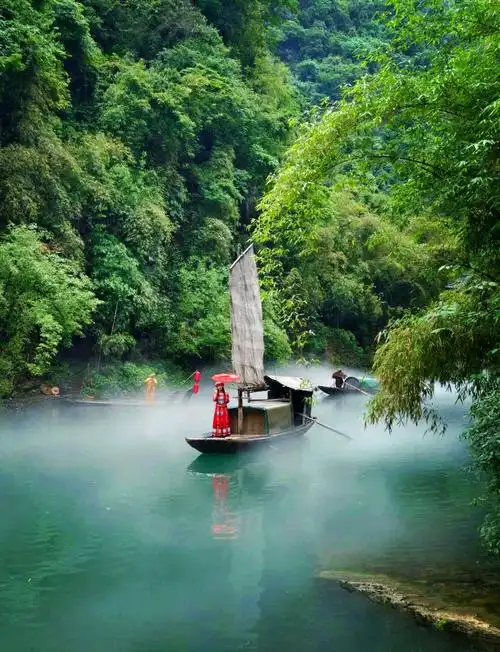 The geography here ranks among the most striking in all of China. The park hugs the southern bank of Xiling Gorge, where the Longjin Stream cuts through limestone cliffs in waters so clear they seem almost alpine. The Dengying Stone—a quartet of eroded peaks resembling human figures—has been sculpted by 400 million years of geological upheaval, evoking the same otherworldly quality as the hoodoos of Cappadocia or the chalk stacks of England's Isle of Wight. Just downstream, the Yangtze makes an abrupt U-turn at Mingyue Bay, a horseshoe bend that rivals the dramatic meanders of the Rhine or the Goosenecks of the San Juan River.
The cultural experience sets this park apart from typical scenic lookouts. Unlike museum displays, Three Gorges Family presents living folk traditions along the streamside stilted houses (diaojiaolou)—timber-frame cottages perched on poles, similar to Alpine chalets or Bornean longhouses in their adaptation to mountainous terrain. Visitors can participate in Tujia wedding rituals, where brides perform the mournful "crying marriage" ceremony, and watch the Ba King Village's daily performances of indigenous music, shadow puppetry, and the thunderous rhythmic chants of the gorge boatmen—songs that echo the same working-class maritime heritage as the sea shanties of 19th-century Liverpool.
The site's historical significance extends well beyond natural beauty. The on-site Shipai Fortress Memorial commemorates the 1943 Battle of Yichang, often called "China's Stalingrad," where Chinese forces halted the Japanese advance westward in a conflict that shaped the Pacific War's outcome. The reconstructed Ba King Village itself offers architectural insight into the ancient Ba people, whose stilt-building traditions predate similar Alpine, Southeast Asian, and even medieval European lake-dwelling constructions. Together, these elements create a layered narrative spanning deep geological time, ancient civilization, and 20th-century world history.
Practical planning is essential for a smooth visit. Allow four to five hours minimum, with a combined ticket around 210 RMB including the return ferry and shuttle bus. The park operates 8:00–17:30 from March through October, with final entry at 15:30. Note that the route requires a boat crossing, walking, and a cable car—mostly a loop but with some elevation changes. Foreign visitors must present their original passport at entry; booking an English-speaking guide or small-group tour in advance is highly recommended, and don't miss the last ferry, typically departing around 17:00.
For the best experience, follow this recommended route: board the ferry at Hujin Beach dock, walk through the waterside villages along Longjin Stream, catch the Tujia wedding performance at the Marriage Tower, then ride the cable car up to Ba King Village for folk shows. Continue to Mingyue Pavilion for panoramic views of the first great bend, then time your visit to Dengying Stone for sunset—a golden-hour moment photographers will treasure. Those with extra time can extend their trip by pairing this visit with a two-day "Two Dams and One Gorge" cruise, which adds the engineering spectacle of the Three Gorges Dam to the cultural immersion.
A few insider tips will save headaches. Peak season crowds mean performances fill up early—arrive 20 minutes before showtime to secure seats. Cable car and bamboo raft add-ons are sometimes priced separately, so verify inclusions when booking. Walkways can be slippery after rain, so sturdy non-slip shoes are essential; summer visitors should pack sunscreen and insect repellent. Park signage is almost entirely in Chinese, so downloading a translation app or booking a multilingual guide is strongly advised for those wanting deeper context rather than a purely visual experience.
The geography here ranks among the most striking in all of China. The park hugs the southern bank of Xiling Gorge, where the Longjin Stream cuts through limestone cliffs in waters so clear they seem almost alpine. The Dengying Stone—a quartet of eroded peaks resembling human figures—has been sculpted by 400 million years of geological upheaval, evoking the same otherworldly quality as the hoodoos of Cappadocia or the chalk stacks of England's Isle of Wight. Just downstream, the Yangtze makes an abrupt U-turn at Mingyue Bay, a horseshoe bend that rivals the dramatic meanders of the Rhine or the Goosenecks of the San Juan River.
The cultural experience sets this park apart from typical scenic lookouts. Unlike museum displays, Three Gorges Family presents living folk traditions along the streamside stilted houses (diaojiaolou)—timber-frame cottages perched on poles, similar to Alpine chalets or Bornean longhouses in their adaptation to mountainous terrain. Visitors can participate in Tujia wedding rituals, where brides perform the mournful "crying marriage" ceremony, and watch the Ba King Village's daily performances of indigenous music, shadow puppetry, and the thunderous rhythmic chants of the gorge boatmen—songs that echo the same working-class maritime heritage as the sea shanties of 19th-century Liverpool.
The site's historical significance extends well beyond natural beauty. The on-site Shipai Fortress Memorial commemorates the 1943 Battle of Yichang, often called "China's Stalingrad," where Chinese forces halted the Japanese advance westward in a conflict that shaped the Pacific War's outcome. The reconstructed Ba King Village itself offers architectural insight into the ancient Ba people, whose stilt-building traditions predate similar Alpine, Southeast Asian, and even medieval European lake-dwelling constructions. Together, these elements create a layered narrative spanning deep geological time, ancient civilization, and 20th-century world history.
Practical planning is essential for a smooth visit. Allow four to five hours minimum, with a combined ticket around 210 RMB including the return ferry and shuttle bus. The park operates 8:00–17:30 from March through October, with final entry at 15:30. Note that the route requires a boat crossing, walking, and a cable car—mostly a loop but with some elevation changes. Foreign visitors must present their original passport at entry; booking an English-speaking guide or small-group tour in advance is highly recommended, and don't miss the last ferry, typically departing around 17:00.
For the best experience, follow this recommended route: board the ferry at Hujin Beach dock, walk through the waterside villages along Longjin Stream, catch the Tujia wedding performance at the Marriage Tower, then ride the cable car up to Ba King Village for folk shows. Continue to Mingyue Pavilion for panoramic views of the first great bend, then time your visit to Dengying Stone for sunset—a golden-hour moment photographers will treasure. Those with extra time can extend their trip by pairing this visit with a two-day "Two Dams and One Gorge" cruise, which adds the engineering spectacle of the Three Gorges Dam to the cultural immersion.
A few insider tips will save headaches. Peak season crowds mean performances fill up early—arrive 20 minutes before showtime to secure seats. Cable car and bamboo raft add-ons are sometimes priced separately, so verify inclusions when booking. Walkways can be slippery after rain, so sturdy non-slip shoes are essential; summer visitors should pack sunscreen and insect repellent. Park signage is almost entirely in Chinese, so downloading a translation app or booking a multilingual guide is strongly advised for those wanting deeper context rather than a purely visual experience.