Nanjiang Grand Canyon
⭐ 4.20
Nanjiang Grand Canyon, Xixiu District, Anshun City, Guizhou Province, China
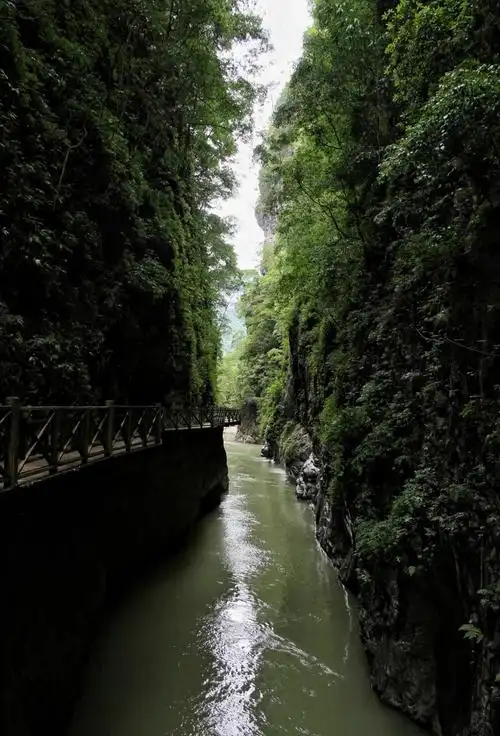 Carved over millions of years by the Nanjiang River, the canyon reveals ancient limestone strata that read like an open-air geology textbook of the Yunnan-Guizhou Plateau's tectonic history. Where the Colorado Canyon in Arizona exposes naked sandstone, Nanjiang showcases a denser, greener side of mountain incision—towering cliffs wrapped in subtropical forest with over 80% vegetation cover. Macaques and mandarin ducks roam the slopes, giving the site real scientific value beyond mere scenery, and explaining its nickname as a "karst ecological museum."
The headline attractions are the waterfalls. The Jinzhong Waterfall is reputedly China's largest travertine cascade, where calcium-rich waters have sculpted natural basins that visitors can wade into and tap like a stone chime. Nearby, the 150-meter Shexiang Falls recalls Alpine torrents in power, sending a perpetual mist into the gorge. A cantilevered plank path called the Feilong Skywalk traces the cliffsides, while the 300-meter-high glass-bottomed Yundu Suspension Bridge offers Colorado River-style vertigo in a far lusher setting.
Adventure is the main draw for active travelers. Two rafting tiers run from May through October: a gentle 5 km family float and a white-knuckle 7 km rapid run. For those wanting vertical thrills, a guided via ferrata route climbs the canyon walls, though participants must be at least 1.3 m tall and reasonably fit. Compared with the polished adventure parks of the Alps or New Zealand's Queenstown, Nanjiang feels rawer and less commercialized.
Cultural touches come from the surrounding Buyi and Miao villages. Visitors can sample local specialties such as selenium-rich little flower fish and smoked cured pork, while homestays and the on-site Tizhi Rock Resort allow stays ranging from a single day to a leisurely two-day itinerary. The best visiting window is May to October, when rafting operates and temperatures are pleasant; winter brings clearer views but reduced activities.
Getting there takes roughly 1.5 hours by car from Guiyang, or travelers can take the Gui-Kai Intercity Railway to Nanjiang Station and transfer by short shuttle. Signage is overwhelmingly in Chinese, so booking a half- or full-day tour with an English-speaking guide through a reputable operator is strongly recommended for foreign visitors. Always confirm operating status before arrival—rafting may be suspended during heavy summer storms, and glass-bridge and via ferrata activities require verbal acknowledgment of safety briefings since printed English instructions are not routinely provided.
Carved over millions of years by the Nanjiang River, the canyon reveals ancient limestone strata that read like an open-air geology textbook of the Yunnan-Guizhou Plateau's tectonic history. Where the Colorado Canyon in Arizona exposes naked sandstone, Nanjiang showcases a denser, greener side of mountain incision—towering cliffs wrapped in subtropical forest with over 80% vegetation cover. Macaques and mandarin ducks roam the slopes, giving the site real scientific value beyond mere scenery, and explaining its nickname as a "karst ecological museum."
The headline attractions are the waterfalls. The Jinzhong Waterfall is reputedly China's largest travertine cascade, where calcium-rich waters have sculpted natural basins that visitors can wade into and tap like a stone chime. Nearby, the 150-meter Shexiang Falls recalls Alpine torrents in power, sending a perpetual mist into the gorge. A cantilevered plank path called the Feilong Skywalk traces the cliffsides, while the 300-meter-high glass-bottomed Yundu Suspension Bridge offers Colorado River-style vertigo in a far lusher setting.
Adventure is the main draw for active travelers. Two rafting tiers run from May through October: a gentle 5 km family float and a white-knuckle 7 km rapid run. For those wanting vertical thrills, a guided via ferrata route climbs the canyon walls, though participants must be at least 1.3 m tall and reasonably fit. Compared with the polished adventure parks of the Alps or New Zealand's Queenstown, Nanjiang feels rawer and less commercialized.
Cultural touches come from the surrounding Buyi and Miao villages. Visitors can sample local specialties such as selenium-rich little flower fish and smoked cured pork, while homestays and the on-site Tizhi Rock Resort allow stays ranging from a single day to a leisurely two-day itinerary. The best visiting window is May to October, when rafting operates and temperatures are pleasant; winter brings clearer views but reduced activities.
Getting there takes roughly 1.5 hours by car from Guiyang, or travelers can take the Gui-Kai Intercity Railway to Nanjiang Station and transfer by short shuttle. Signage is overwhelmingly in Chinese, so booking a half- or full-day tour with an English-speaking guide through a reputable operator is strongly recommended for foreign visitors. Always confirm operating status before arrival—rafting may be suspended during heavy summer storms, and glass-bridge and via ferrata activities require verbal acknowledgment of safety briefings since printed English instructions are not routinely provided.