Jiaxiu Tower
⭐ 4.20
No. 8, Cuiwei Lane, Xinhu Road, Nanming District, Guiyang City, Guizhou Province, China
 Constructed in 1598 under the patronage of Jiang Dongzhi, the governor of Guizhou Province, Jiaxiu Tower emerged during the late Ming Dynasty—a period when Shakespeare's London was flourishing and the first English colonies were taking root in Virginia. The tower's name, drawn from the classical phrase "kejia tingxiu," meaning "examination champions standing tall," reflects the Ming-era reverence for scholarly achievement. While the original timber structure was rebuilt in 1909 during the late Qing Dynasty, the design remains faithful to its Ming origins, earning the tower designation as a Major National Historical and Cultural Relic in 2006.
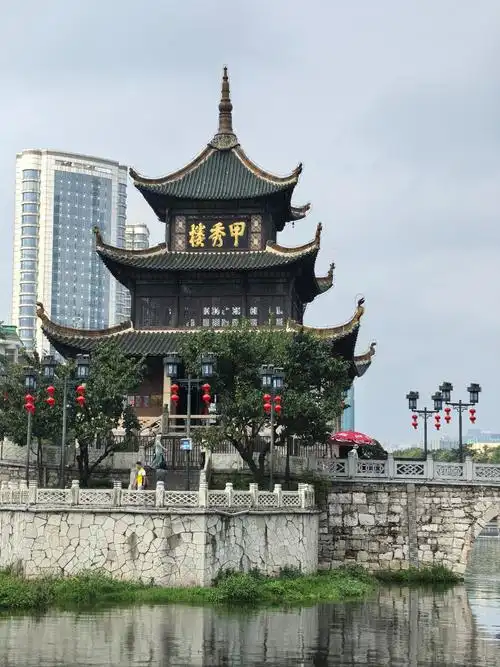
Rising approximately 20 meters above the river in three tiers with upturned eaves and a four-sided pyramidal roof, Jiaxiu Tower represents a distinctive variation of traditional Chinese pavilion architecture. White marble balustrades frame the wooden structure, while gracefully curved flying rafters echo the silhouette of a crane poised for flight. Inside, visitors can admire a remarkable 206-character couplet composed by Qing Dynasty scholar Liu Yushan—an exceptionally long literary work that symbolizes the enduring cultural vitality of southwestern China.
The scenic area encompasses three harmonious elements: the tower itself, the elegant Floating Jade Bridge (Fuyu Qiao) with its Hanbi Pavilion, and the ancient Cuiwei Garden, a Ming-era landscape of towering old trees, pavilions, and winding paths. Together these form what locals call "the finest scenery south of the city." The bridge arches across the river like a reclining rainbow, creating one of southwest China's most photographed vistas—a scene that rivals the intimacy of Florence's Ponte Vecchio, though rooted firmly in classical Chinese garden tradition.
For more than four centuries, Jiaxiu Tower has served as both a spiritual landmark and a stage for cultural life in Guiyang. Emperors, scholars, and wandering poets left inscriptions here celebrating Guizhou's transformation from remote frontier outpost to cultured province. Today the tower hosts calligraphy exhibitions and seasonal performances, continuing its legacy as a meeting point between history and contemporary urban life.
The scenic area welcomes visitors free of charge, though ascending the main tower requires advance reservation through the "One Code Tour Guizhou" mini-program—foreign travelers can register using their passport. Opening hours run Tuesday through Sunday, 9:00 AM to 5:00 PM, with the final ascent at 4:30 PM; the site closes on Mondays. Night illumination operates roughly from 7:30 to 10:00 PM, and viewing from the riverbank requires no reservation. Reach the site via Metro Line 3 to Jiaxiu Tower Station, Exit C, a five-minute walk, or take buses 15, 34, or 46. For the richest experience, arrive around 5:00 PM to capture afternoon light, sunset, and the illuminated night in a single visit. Pair your trip with strolls through nearby Huguo Road, Qingyun Market, and Cuiwei Alley, where you can sample Guiyang specialties like Changwang noodles and Siwabao rolls—delicious gateways into the everyday soul of old Guiyang.
Constructed in 1598 under the patronage of Jiang Dongzhi, the governor of Guizhou Province, Jiaxiu Tower emerged during the late Ming Dynasty—a period when Shakespeare's London was flourishing and the first English colonies were taking root in Virginia. The tower's name, drawn from the classical phrase "kejia tingxiu," meaning "examination champions standing tall," reflects the Ming-era reverence for scholarly achievement. While the original timber structure was rebuilt in 1909 during the late Qing Dynasty, the design remains faithful to its Ming origins, earning the tower designation as a Major National Historical and Cultural Relic in 2006.
Rising approximately 20 meters above the river in three tiers with upturned eaves and a four-sided pyramidal roof, Jiaxiu Tower represents a distinctive variation of traditional Chinese pavilion architecture. White marble balustrades frame the wooden structure, while gracefully curved flying rafters echo the silhouette of a crane poised for flight. Inside, visitors can admire a remarkable 206-character couplet composed by Qing Dynasty scholar Liu Yushan—an exceptionally long literary work that symbolizes the enduring cultural vitality of southwestern China.
The scenic area encompasses three harmonious elements: the tower itself, the elegant Floating Jade Bridge (Fuyu Qiao) with its Hanbi Pavilion, and the ancient Cuiwei Garden, a Ming-era landscape of towering old trees, pavilions, and winding paths. Together these form what locals call "the finest scenery south of the city." The bridge arches across the river like a reclining rainbow, creating one of southwest China's most photographed vistas—a scene that rivals the intimacy of Florence's Ponte Vecchio, though rooted firmly in classical Chinese garden tradition.
For more than four centuries, Jiaxiu Tower has served as both a spiritual landmark and a stage for cultural life in Guiyang. Emperors, scholars, and wandering poets left inscriptions here celebrating Guizhou's transformation from remote frontier outpost to cultured province. Today the tower hosts calligraphy exhibitions and seasonal performances, continuing its legacy as a meeting point between history and contemporary urban life.
The scenic area welcomes visitors free of charge, though ascending the main tower requires advance reservation through the "One Code Tour Guizhou" mini-program—foreign travelers can register using their passport. Opening hours run Tuesday through Sunday, 9:00 AM to 5:00 PM, with the final ascent at 4:30 PM; the site closes on Mondays. Night illumination operates roughly from 7:30 to 10:00 PM, and viewing from the riverbank requires no reservation. Reach the site via Metro Line 3 to Jiaxiu Tower Station, Exit C, a five-minute walk, or take buses 15, 34, or 46. For the richest experience, arrive around 5:00 PM to capture afternoon light, sunset, and the illuminated night in a single visit. Pair your trip with strolls through nearby Huguo Road, Qingyun Market, and Cuiwei Alley, where you can sample Guiyang specialties like Changwang noodles and Siwabao rolls—delicious gateways into the everyday soul of old Guiyang.