Tunpu Cultural Village
⭐ 4.20
Tunpu Cultural Village, Xixiu District, Anshun City, Guizhou Province, China
 The Tunpu story begins in 1381, the same year that the Hundred Years' War was ending in France and the late Ming consolidation of China was underway. After Emperor Zhu Yuanzhang's "Recruit the North to Pacify the South" campaign subdued southwestern Yunnan, he dispatched 200,000 Jianghuai soldiers to garrison frontier lands, marry local women, and till the soil. Over generations, these "half-soldiers, half-farmers" settlements sealed themselves off linguistically and culturally from surrounding ethnic groups, creating extraordinary cultural islands in the limestone highlands. Comparable to how Alpine villages preserved archaic dialects or how Carcassonne retains medieval French identity, Tunpu communities keep fifteenth-century Jiangnan culture alive far from its geographic origin.
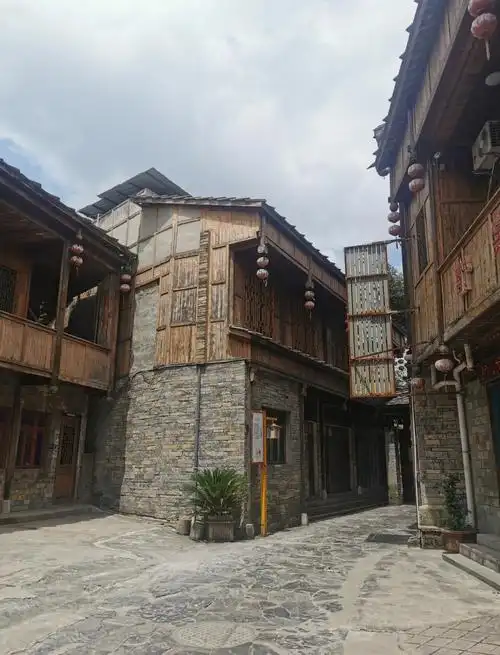
The architecture is the most striking feature. Builders quarried local bluestone to construct fortress walls, watchtowers, and courtyard houses with gun slits, hidden passages, and triple-layered defensive enclosures designed to repel tribal attacks and bandit raids. Scholars liken the ensemble to late-medieval European field fortifications such as those found in the Pyrenees, though Tunpu dwellings remain inhabited rather than museumized. Tianlong Tunpu is the most developed for tourism, while Yunfeng Benzhai and Yunshantun retain the most authentic village fabric. Baojia Tunpu, meanwhile, holds a Ming-era irrigation network sometimes called the "Mini-Dujiangyan," honored with an Asia-Pacific Heritage Conservation award.
Culturally, Tunpu women still don wide-sleeved, large-fronted Fengyang Han robes, hair coiled into distinctive buns, and pointed embroidered shoes identical to those worn by Jiangnan women half a millennium ago. Men perform Anshun Dixi, a rare form of open-air theater featuring carved wooden masks and tales of Ming warfare. Performed without raised stages, surrounded only by a fabric boundary, Dixi is often called "the living fossil of theater" and resonates with Europe's medieval mystery plays or Italian commedia dell'arte traditions. The local dialect preserves traces of Ming-era Mandarin, making it a priceless resource for linguistic historians studying the evolution of Chinese speech.
Practical visits center on Yunfeng Tunpu, where a combined ticket covering Benzhai, Yunshantun, and the museum runs about 50 yuan, though Dixi performances cost extra. Tianlong offers full tourist amenities including shops and teahouses. Self-driving from Anshun city takes 30 to 40 minutes, and boutique homestays near the scenic area allow immersive overnight stays. A full day is recommended: morning exploration of stone lanes in Benzhai, afternoon Dixi viewing, and tasting of regional specialties like duoduofen hotpot and blood tofu. Daily performances typically run at 10:00, 14:00, and 15:00, with grand festivals during lunar January and July.
The best seasons are March through May and September through November, when weather is mild; summer rains make stone paths slippery, so grippy footwear is essential. Beyond its historical draw, Tunpu rewards travelers seeking experiences beyond the Great Wall or Terracotta Warriors. Few sites in China so vividly combine living heritage, military history, and folk performance in one accessible location. For visitors drawn to cultural anthropology, architectural oddities, or simply authentic encounters far from mass tourism, Tunpu offers something genuinely rare: an entire community still practicing the customs of dynastic China.
The Tunpu story begins in 1381, the same year that the Hundred Years' War was ending in France and the late Ming consolidation of China was underway. After Emperor Zhu Yuanzhang's "Recruit the North to Pacify the South" campaign subdued southwestern Yunnan, he dispatched 200,000 Jianghuai soldiers to garrison frontier lands, marry local women, and till the soil. Over generations, these "half-soldiers, half-farmers" settlements sealed themselves off linguistically and culturally from surrounding ethnic groups, creating extraordinary cultural islands in the limestone highlands. Comparable to how Alpine villages preserved archaic dialects or how Carcassonne retains medieval French identity, Tunpu communities keep fifteenth-century Jiangnan culture alive far from its geographic origin.
The architecture is the most striking feature. Builders quarried local bluestone to construct fortress walls, watchtowers, and courtyard houses with gun slits, hidden passages, and triple-layered defensive enclosures designed to repel tribal attacks and bandit raids. Scholars liken the ensemble to late-medieval European field fortifications such as those found in the Pyrenees, though Tunpu dwellings remain inhabited rather than museumized. Tianlong Tunpu is the most developed for tourism, while Yunfeng Benzhai and Yunshantun retain the most authentic village fabric. Baojia Tunpu, meanwhile, holds a Ming-era irrigation network sometimes called the "Mini-Dujiangyan," honored with an Asia-Pacific Heritage Conservation award.
Culturally, Tunpu women still don wide-sleeved, large-fronted Fengyang Han robes, hair coiled into distinctive buns, and pointed embroidered shoes identical to those worn by Jiangnan women half a millennium ago. Men perform Anshun Dixi, a rare form of open-air theater featuring carved wooden masks and tales of Ming warfare. Performed without raised stages, surrounded only by a fabric boundary, Dixi is often called "the living fossil of theater" and resonates with Europe's medieval mystery plays or Italian commedia dell'arte traditions. The local dialect preserves traces of Ming-era Mandarin, making it a priceless resource for linguistic historians studying the evolution of Chinese speech.
Practical visits center on Yunfeng Tunpu, where a combined ticket covering Benzhai, Yunshantun, and the museum runs about 50 yuan, though Dixi performances cost extra. Tianlong offers full tourist amenities including shops and teahouses. Self-driving from Anshun city takes 30 to 40 minutes, and boutique homestays near the scenic area allow immersive overnight stays. A full day is recommended: morning exploration of stone lanes in Benzhai, afternoon Dixi viewing, and tasting of regional specialties like duoduofen hotpot and blood tofu. Daily performances typically run at 10:00, 14:00, and 15:00, with grand festivals during lunar January and July.
The best seasons are March through May and September through November, when weather is mild; summer rains make stone paths slippery, so grippy footwear is essential. Beyond its historical draw, Tunpu rewards travelers seeking experiences beyond the Great Wall or Terracotta Warriors. Few sites in China so vividly combine living heritage, military history, and folk performance in one accessible location. For visitors drawn to cultural anthropology, architectural oddities, or simply authentic encounters far from mass tourism, Tunpu offers something genuinely rare: an entire community still practicing the customs of dynastic China.