Qingyan Ancient Town
⭐ 4.30
South Gate Visitor Center, Qingyan Town, Huaxi District, Guiyang, Guizhou, China
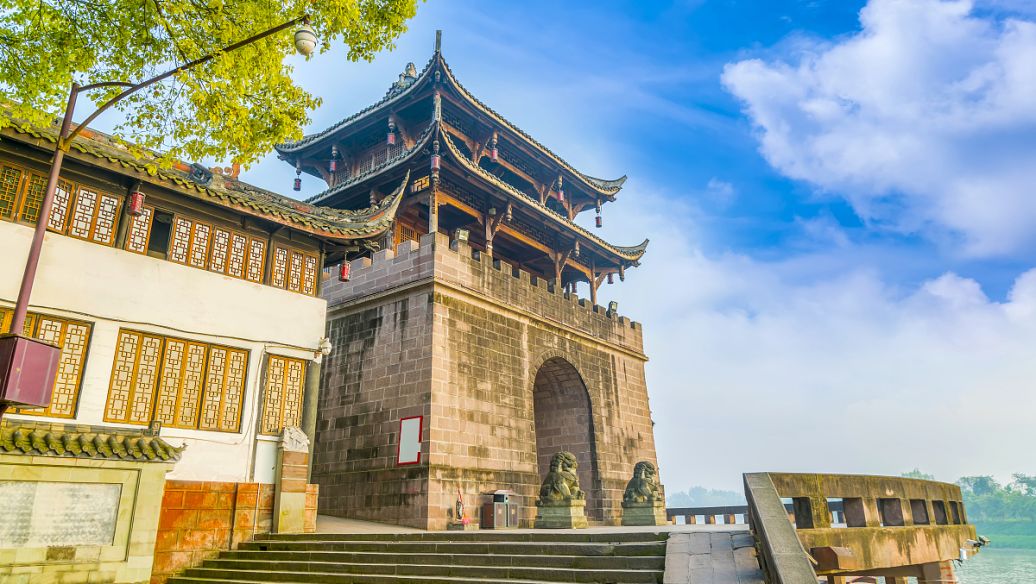 Qingyan's origins place it firmly in the late medieval period: established in 1378 under the Hongwu Emperor, when Ming armies pushed into the southwest to consolidate frontier control, the town served as a garrison and agricultural colony (tuntian). Comparable to Europe's contemporary bastide towns of southern France, it was repeatedly reinforced through the Qing era, evolving into a textbook example of a mountain military redoubt. Today it remains a tangible artifact for studying premodern Chinese defensive architecture.
The settlement's defining feature is its construction entirely of quarried stone slabs—walls, gate towers, memorial arches, homes, and even alley paving. Locals call it the "Symphony of Stone," an epithet that recalls the Cyclopean masonry of Mycenae or the dry-stone heritage of Tuscany's hill villages. Of the four surviving gates, the southern Dingguang Gate is the most imposing, offering sweeping views over farmland. The atmospheric Back Street (Bei Jie), where stacked stone walls frame dappled flagstone paths, gained cinematic fame through director Lu Chuan's "The Missing Gun."
Culturally, Qingyan is a remarkable crossroads. It is the hometown of Zhao Yijiong, Guizhou's first zhuangyuan (the top scorer in the imperial examinations), and his residence, the状元府 (Zhuangyuan Mansion), anchors a strong Confucian literary tradition alongside the elegant Wenchang Pavilion. Strikingly, the compact town hosts five religions in harmony: Confucian, Buddhist, Daoist, Catholic, and Protestant—each represented by finely crafted halls such as the Wanshou Palace and Ciyun Temple. The town also preserves a poignant red-culture legacy: Zhou Enlai's father resided here in the early twentieth century.
Practical access is straightforward. The town lies 30–40 minutes by car from central Guiyang; buses 203 and 210 terminate at the West Gate, and Longdongbao Airport is about 40 minutes away. A basic entry fee is just 10 RMB (free after 16:30), while a 60 RMB combo ticket covers the principal monuments and the costumed "Da Ming Zhi" open-air performance. Streets are open all day; ticketed sites run 08:10–17:40, and night tours operate 16:00–22:00. Most travelers find a half to full day sufficient.
Beyond sightseeing, Qingyan is a culinary destination. Do not leave without sampling the famed braised pig trotter (Zhuangyuan Ti, said to fortify scholars), cooling rose-flavored ice jelly, and crisp tofu balls. Photographers should aim for late afternoon, when soft golden light grazes the Back Street and illuminates Dingguang Gate at sunset. One practical note: the entire town is paved in irregular flagstones, so sturdy non-slip walking shoes are strongly advised—your ankles will thank you.
Qingyan's origins place it firmly in the late medieval period: established in 1378 under the Hongwu Emperor, when Ming armies pushed into the southwest to consolidate frontier control, the town served as a garrison and agricultural colony (tuntian). Comparable to Europe's contemporary bastide towns of southern France, it was repeatedly reinforced through the Qing era, evolving into a textbook example of a mountain military redoubt. Today it remains a tangible artifact for studying premodern Chinese defensive architecture.
The settlement's defining feature is its construction entirely of quarried stone slabs—walls, gate towers, memorial arches, homes, and even alley paving. Locals call it the "Symphony of Stone," an epithet that recalls the Cyclopean masonry of Mycenae or the dry-stone heritage of Tuscany's hill villages. Of the four surviving gates, the southern Dingguang Gate is the most imposing, offering sweeping views over farmland. The atmospheric Back Street (Bei Jie), where stacked stone walls frame dappled flagstone paths, gained cinematic fame through director Lu Chuan's "The Missing Gun."
Culturally, Qingyan is a remarkable crossroads. It is the hometown of Zhao Yijiong, Guizhou's first zhuangyuan (the top scorer in the imperial examinations), and his residence, the状元府 (Zhuangyuan Mansion), anchors a strong Confucian literary tradition alongside the elegant Wenchang Pavilion. Strikingly, the compact town hosts five religions in harmony: Confucian, Buddhist, Daoist, Catholic, and Protestant—each represented by finely crafted halls such as the Wanshou Palace and Ciyun Temple. The town also preserves a poignant red-culture legacy: Zhou Enlai's father resided here in the early twentieth century.
Practical access is straightforward. The town lies 30–40 minutes by car from central Guiyang; buses 203 and 210 terminate at the West Gate, and Longdongbao Airport is about 40 minutes away. A basic entry fee is just 10 RMB (free after 16:30), while a 60 RMB combo ticket covers the principal monuments and the costumed "Da Ming Zhi" open-air performance. Streets are open all day; ticketed sites run 08:10–17:40, and night tours operate 16:00–22:00. Most travelers find a half to full day sufficient.
Beyond sightseeing, Qingyan is a culinary destination. Do not leave without sampling the famed braised pig trotter (Zhuangyuan Ti, said to fortify scholars), cooling rose-flavored ice jelly, and crisp tofu balls. Photographers should aim for late afternoon, when soft golden light grazes the Back Street and illuminates Dingguang Gate at sunset. One practical note: the entire town is paved in irregular flagstones, so sturdy non-slip walking shoes are strongly advised—your ankles will thank you.