Tomb of Li Guang
⭐ 2.50
Li Guang Tomb, Qinzhou District, Tianshui City, Gansu Province, China
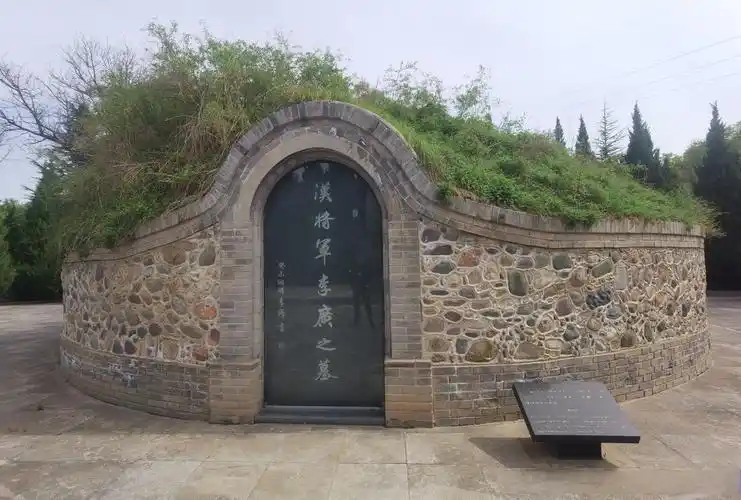 Li Guang (d. 119 BC) was a general of the early Western Han Dynasty whose military career spanned the reigns of emperors Wen and Wu—the same era when Rome was consolidating its Mediterranean empire after the Punic Wars. Known as the "Flying General" for his prowess against the Xiongnu nomads of the steppe, he earned immortality not through triumph but through tragic injustice: despite a lifetime of battlefield heroics, he was never granted the marquisate that custom promised accomplished commanders. The lament "Feng Tang ages, Li Guang never sealed" entered Chinese literature as an expression of wasted merit—a sentiment Western readers may recognize in Homer's Ajax or Shakespeare's disgraced warriors. Local tradition places his birthplace in this corner of Gansu.
The tomb itself is a cenotaph, or burial mound for garments, symbolizing the interment of Li Guang's sword and uniform rather than his physical remains. Its hemispheric form, rising about ten meters with a twenty-five-meter circumference, is encircled by weathered blue brick laid in orderly courses—simpler than Rome's Pantheon yet echoing the same ancient Mediterranean tradition of earthen tumuli raised over heroes, like Mycenae's beehive tombs. A three-bay ceremonial pavilion with the distinctive Chinese suspended-roof style shelters the entrance, its upturned eaves a quieter cousin to the flying buttresses of a Gothic chapel.
The site's most artistically significant features are two Han-dynasty stone horses, hewn in the 2nd century BC and now standing weather-rounded in the courtyard. Their massive proportions and simplified, almost abstract musculature capture the rugged spirit of early imperial sculpture—comparable in raw vitality to the damaged equine figures of Italian Renaissance tombs. Centuries of Gansu wind have softened their edges, yet they retain a stoic power that gives Stone Horse Slope its very name.
In the pavilion stands a stele tower roughly six meters tall, crowned with a 1945 inscription by Chiang Kai-shek reading "Tomb of Han General Li Guang"—an unusual wartime gesture linking Nationalist China's modern struggle to an ancient frontier defender. Earlier stelae from the Qianlong Emperor's 18th-century restorations record the site's continuous veneration through the centuries. Together these layered inscriptions function like a memorial's geological sediment, comparable to the overlapping dedications on Rome's Arch of Titus, each generation adding its testimony to a shared hero.
Located at No. 88 Shima Ping Village, Yuquan Town, in Qinzhou District, the site is open daily from 8:00 a.m. to 5:00 p.m., with admission between five and twenty yuan—little more than a museum entry in Western capitals. The grounds cover roughly twenty mu (about 1.3 hectares) without commercial facilities, and a thoughtful visit requires only thirty to sixty minutes. Reaching it by public transport is awkward; a taxi from central Tianshui takes ten to fifteen minutes and costs ten to fifteen yuan. Calling ahead to confirm opening hours is wise outside peak season.
Though modest in scale, the tomb pairs naturally with Tianshui's signature attractions, the Fuxi Temple and Nanguo Temple, whose grander halls frame Li Guang's humble mound as a counterweight of pathos. Travelers should approach it as one would a European war memorial—silent, somber, dressed in muted colors, never climbing the mound itself. To pause here, surrounded by ancient stone horses and echoing inscriptions, is to confront a universal truth about heroism: that valor alone seldom guarantees recognition, and that some reputations are honored most deeply precisely where they were once denied.
Li Guang (d. 119 BC) was a general of the early Western Han Dynasty whose military career spanned the reigns of emperors Wen and Wu—the same era when Rome was consolidating its Mediterranean empire after the Punic Wars. Known as the "Flying General" for his prowess against the Xiongnu nomads of the steppe, he earned immortality not through triumph but through tragic injustice: despite a lifetime of battlefield heroics, he was never granted the marquisate that custom promised accomplished commanders. The lament "Feng Tang ages, Li Guang never sealed" entered Chinese literature as an expression of wasted merit—a sentiment Western readers may recognize in Homer's Ajax or Shakespeare's disgraced warriors. Local tradition places his birthplace in this corner of Gansu.
The tomb itself is a cenotaph, or burial mound for garments, symbolizing the interment of Li Guang's sword and uniform rather than his physical remains. Its hemispheric form, rising about ten meters with a twenty-five-meter circumference, is encircled by weathered blue brick laid in orderly courses—simpler than Rome's Pantheon yet echoing the same ancient Mediterranean tradition of earthen tumuli raised over heroes, like Mycenae's beehive tombs. A three-bay ceremonial pavilion with the distinctive Chinese suspended-roof style shelters the entrance, its upturned eaves a quieter cousin to the flying buttresses of a Gothic chapel.
The site's most artistically significant features are two Han-dynasty stone horses, hewn in the 2nd century BC and now standing weather-rounded in the courtyard. Their massive proportions and simplified, almost abstract musculature capture the rugged spirit of early imperial sculpture—comparable in raw vitality to the damaged equine figures of Italian Renaissance tombs. Centuries of Gansu wind have softened their edges, yet they retain a stoic power that gives Stone Horse Slope its very name.
In the pavilion stands a stele tower roughly six meters tall, crowned with a 1945 inscription by Chiang Kai-shek reading "Tomb of Han General Li Guang"—an unusual wartime gesture linking Nationalist China's modern struggle to an ancient frontier defender. Earlier stelae from the Qianlong Emperor's 18th-century restorations record the site's continuous veneration through the centuries. Together these layered inscriptions function like a memorial's geological sediment, comparable to the overlapping dedications on Rome's Arch of Titus, each generation adding its testimony to a shared hero.
Located at No. 88 Shima Ping Village, Yuquan Town, in Qinzhou District, the site is open daily from 8:00 a.m. to 5:00 p.m., with admission between five and twenty yuan—little more than a museum entry in Western capitals. The grounds cover roughly twenty mu (about 1.3 hectares) without commercial facilities, and a thoughtful visit requires only thirty to sixty minutes. Reaching it by public transport is awkward; a taxi from central Tianshui takes ten to fifteen minutes and costs ten to fifteen yuan. Calling ahead to confirm opening hours is wise outside peak season.
Though modest in scale, the tomb pairs naturally with Tianshui's signature attractions, the Fuxi Temple and Nanguo Temple, whose grander halls frame Li Guang's humble mound as a counterweight of pathos. Travelers should approach it as one would a European war memorial—silent, somber, dressed in muted colors, never climbing the mound itself. To pause here, surrounded by ancient stone horses and echoing inscriptions, is to confront a universal truth about heroism: that valor alone seldom guarantees recognition, and that some reputations are honored most deeply precisely where they were once denied.