Tianshui Night Market
⭐ 4.20
Zhongshan Road, Qinzhou District, Tianshui City, Gansu Province, China
 Tianshui holds a singular place in Chinese mythology as the birthplace of Fuxi, the half-human, half-serpent culture hero credited with inventing marriage, music, and the eight trigrams that later influenced philosophy from the I Ching to the Korean flag. Comparable in cultural weight to Athens' association with Western philosophy or Rome's with law, Tianshui is often called the cradle of Chinese civilization. The night market grounds itself in this legacy by clustering around the Fuxi Temple complex, a Ming-dynasty sanctuary where locals still come to honor their legendary ancestor, much as pilgrims might visit Canterbury Cathedral.
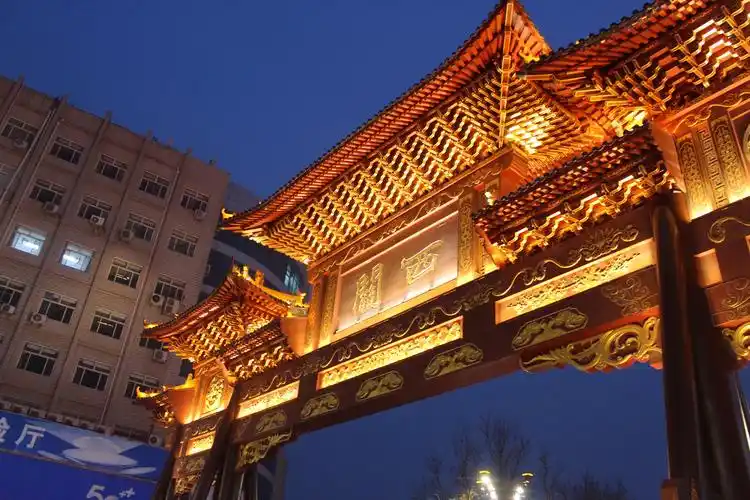
The architectural backdrop is one of the market's greatest charms. The ancient city quarter features restored Ming and Qing-era timber-frame buildings with upturned eaves and carved brackets reminiscent of Beijing's older hutong neighborhoods, though on a more intimate scale. The lantern corridor along Guangming Lane transforms at dusk into a glowing tunnel of red silk and gold tassels, while the Han-style Xianyue Pavilion serves as a stage for evening performances. Across town, the modern Maiji Sleepless City stretches some 800 meters along Shangbu Road, housing roughly 200 stalls in clearly defined zones, a scale and ambition rivaling Taipei or Bangkok's famous night markets.
Cultural programming elevates the experience beyond simple dining. The nightly Xianyue Pavilion performance, beginning around 20:00 and lasting approximately 45 minutes, fuses the raw vocal power of Qinqiang, Shaanxi's signature operatic style, with cutting-edge projection mapping and live actors moving through the courtyard. It is a rare chance for foreign visitors to witness intangible cultural heritage in an accessible format, similar to Italy's outdoor historical reenactments but with distinctly northwestern Chinese flavor.
The culinary offerings deserve their own pilgrimage. Tianshui Guguaggua, a chewy buckwheat porridge eaten by hand and mixed with chili oil and garlic, has no true Western equivalent, though adventurous eaters might compare it to polenta reimagined. The local malatang differs sharply from Sichuan versions, relying on bone broth, sesame paste, and the smoky depth of Gangu chili oil. Sweet fermented wheat drinks, warm rice wine with egg, and crispy pig-fat pastries round out a menu designed to balance and complement the region's bold spices.
Practical planning matters here. Visit between 19:30 and 22:30 in summer, or 18:30 to 21:30 in winter, with weekends offering the richest programming. Note that the Fuxi Temple itself closes at night, so daytime visits require a separate trip. Foreign travelers should arrive at the Qinzhou ancient city core around 18:30, install Alipay or WeChat Pay in advance as cash is rarely accepted, and carry registration documents for any non-foreign-booking hotel within 24 hours of arrival. Specify mild spice levels when ordering, choose busy stalls with high turnover, and confirm whether prices are per skewer, per plate, or per jin (500 grams) to avoid surprises.
Tianshui holds a singular place in Chinese mythology as the birthplace of Fuxi, the half-human, half-serpent culture hero credited with inventing marriage, music, and the eight trigrams that later influenced philosophy from the I Ching to the Korean flag. Comparable in cultural weight to Athens' association with Western philosophy or Rome's with law, Tianshui is often called the cradle of Chinese civilization. The night market grounds itself in this legacy by clustering around the Fuxi Temple complex, a Ming-dynasty sanctuary where locals still come to honor their legendary ancestor, much as pilgrims might visit Canterbury Cathedral.
The architectural backdrop is one of the market's greatest charms. The ancient city quarter features restored Ming and Qing-era timber-frame buildings with upturned eaves and carved brackets reminiscent of Beijing's older hutong neighborhoods, though on a more intimate scale. The lantern corridor along Guangming Lane transforms at dusk into a glowing tunnel of red silk and gold tassels, while the Han-style Xianyue Pavilion serves as a stage for evening performances. Across town, the modern Maiji Sleepless City stretches some 800 meters along Shangbu Road, housing roughly 200 stalls in clearly defined zones, a scale and ambition rivaling Taipei or Bangkok's famous night markets.
Cultural programming elevates the experience beyond simple dining. The nightly Xianyue Pavilion performance, beginning around 20:00 and lasting approximately 45 minutes, fuses the raw vocal power of Qinqiang, Shaanxi's signature operatic style, with cutting-edge projection mapping and live actors moving through the courtyard. It is a rare chance for foreign visitors to witness intangible cultural heritage in an accessible format, similar to Italy's outdoor historical reenactments but with distinctly northwestern Chinese flavor.
The culinary offerings deserve their own pilgrimage. Tianshui Guguaggua, a chewy buckwheat porridge eaten by hand and mixed with chili oil and garlic, has no true Western equivalent, though adventurous eaters might compare it to polenta reimagined. The local malatang differs sharply from Sichuan versions, relying on bone broth, sesame paste, and the smoky depth of Gangu chili oil. Sweet fermented wheat drinks, warm rice wine with egg, and crispy pig-fat pastries round out a menu designed to balance and complement the region's bold spices.
Practical planning matters here. Visit between 19:30 and 22:30 in summer, or 18:30 to 21:30 in winter, with weekends offering the richest programming. Note that the Fuxi Temple itself closes at night, so daytime visits require a separate trip. Foreign travelers should arrive at the Qinzhou ancient city core around 18:30, install Alipay or WeChat Pay in advance as cash is rarely accepted, and carry registration documents for any non-foreign-booking hotel within 24 hours of arrival. Specify mild spice levels when ordering, choose busy stalls with high turnover, and confirm whether prices are per skewer, per plate, or per jin (500 grams) to avoid surprises.