Yuquan Temple
⭐ 4.50
Yuquan Temple, Qinzhou District, Tianshui, Gansu, China
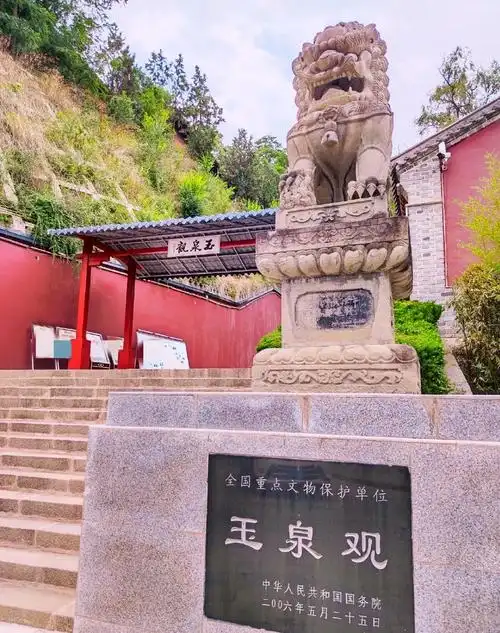 **Historical Context**
Yuquan Temple's origins stretch back to the Tang dynasty, but its current layout was largely set in the 13th century when the Quanzhen Daoist master Liang Zhitong rebuilt it during the early Yuan. This places its flourishing just a generation after Kublai Khan unified China under Mongol rule, when Tianshui sat along the strategic corridor linking the imperial capitals of Chang'an and the Western Xia territories. Often called the "Premier Daoist Temple of Southeast Gansu," it ranks among northwest China's most consequential religious sites, designated a nationally protected monument and a 4A-rated scenic area.
**The Jade Spring and Ancient Trees**
The temple's name derives from its crystal-clear spring, which has flowed continuously for centuries and still draws local residents who come to fill bottles with its reportedly sweet water. Equally striking is the grove of ancient cypresses, including the celebrated "braided cypress," whose gnarled branches twist together like plaits of hair. Estimated at over a millennium old, it is a rarity in China and lends the courtyard a hauntingly primeval atmosphere reminiscent of the weathered yews in English cathedral close.
**Steles and Architecture**
A long stone gallery houses more than forty inscribed tablets from the Yuan, Ming, and Qing dynasties. Among the most prized is a wild-cursive poem by Zhao Mengfu, the Yuan dynasty's supreme calligrapher and cultural heir to the Mongol court, alongside the "Record of the Yuan-Era Reconstruction of Jade Spring Temple." The building complex climbs the hillside along a central axis, from the Gate of Mt. Hua through the Jade Spring Hall and Three Pure Ones Hall up to the towering Jade Emperor Hall, marrying Yuan-era heft with Ming-Qing ornamental finesse, much like a Chinese counterpart to a Spanish monastery complex perched above a provincial town.
**Cultural Significance**
The temple remains an active place of worship and pilgrimage, a rare combination in China where most historic sites have been fully museumized. Its tranquil, lightly commercialized atmosphere offers an authentic window into living Daoist tradition rather than a sanitized heritage exhibit, appealing especially to travelers interested in comparative religion, classical calligraphy, and the lesser-visited cultural corridors of the Silk Road's eastern approaches.
**Practical Visitor Information**
Admission is just 20 yuan, with opening hours from 8:00 a.m. to 6:00 p.m. (last entry 5:30). Plan for 1.5 to 2.5 hours; gentle stone steps and abundant tree cover keep the climb comfortable even in midsummer. The temple sits at 69 Yuquan Road at the foot of Tianjing Mountain, roughly a ten-minute drive from the city center, and pairs beautifully with the nearby Fuxi Temple, Dai Temple, and Guan Yu Temple for a half-day cultural circuit through Tianshui's layered history.
**Why Visit**
For travelers who have already ticked off Beijing's Daoist temples or Xi'an's grand monuments, Yuquan offers something rarer: an unpolished, hilltop sanctuary where Mongol-era grandeur, Ming-Qing craftsmanship, a living sacred spring, and a sunset panorama over a provincial Chinese capital converge in a single, contemplative afternoon well off the standard tourist trail.
**Historical Context**
Yuquan Temple's origins stretch back to the Tang dynasty, but its current layout was largely set in the 13th century when the Quanzhen Daoist master Liang Zhitong rebuilt it during the early Yuan. This places its flourishing just a generation after Kublai Khan unified China under Mongol rule, when Tianshui sat along the strategic corridor linking the imperial capitals of Chang'an and the Western Xia territories. Often called the "Premier Daoist Temple of Southeast Gansu," it ranks among northwest China's most consequential religious sites, designated a nationally protected monument and a 4A-rated scenic area.
**The Jade Spring and Ancient Trees**
The temple's name derives from its crystal-clear spring, which has flowed continuously for centuries and still draws local residents who come to fill bottles with its reportedly sweet water. Equally striking is the grove of ancient cypresses, including the celebrated "braided cypress," whose gnarled branches twist together like plaits of hair. Estimated at over a millennium old, it is a rarity in China and lends the courtyard a hauntingly primeval atmosphere reminiscent of the weathered yews in English cathedral close.
**Steles and Architecture**
A long stone gallery houses more than forty inscribed tablets from the Yuan, Ming, and Qing dynasties. Among the most prized is a wild-cursive poem by Zhao Mengfu, the Yuan dynasty's supreme calligrapher and cultural heir to the Mongol court, alongside the "Record of the Yuan-Era Reconstruction of Jade Spring Temple." The building complex climbs the hillside along a central axis, from the Gate of Mt. Hua through the Jade Spring Hall and Three Pure Ones Hall up to the towering Jade Emperor Hall, marrying Yuan-era heft with Ming-Qing ornamental finesse, much like a Chinese counterpart to a Spanish monastery complex perched above a provincial town.
**Cultural Significance**
The temple remains an active place of worship and pilgrimage, a rare combination in China where most historic sites have been fully museumized. Its tranquil, lightly commercialized atmosphere offers an authentic window into living Daoist tradition rather than a sanitized heritage exhibit, appealing especially to travelers interested in comparative religion, classical calligraphy, and the lesser-visited cultural corridors of the Silk Road's eastern approaches.
**Practical Visitor Information**
Admission is just 20 yuan, with opening hours from 8:00 a.m. to 6:00 p.m. (last entry 5:30). Plan for 1.5 to 2.5 hours; gentle stone steps and abundant tree cover keep the climb comfortable even in midsummer. The temple sits at 69 Yuquan Road at the foot of Tianjing Mountain, roughly a ten-minute drive from the city center, and pairs beautifully with the nearby Fuxi Temple, Dai Temple, and Guan Yu Temple for a half-day cultural circuit through Tianshui's layered history.
**Why Visit**
For travelers who have already ticked off Beijing's Daoist temples or Xi'an's grand monuments, Yuquan offers something rarer: an unpolished, hilltop sanctuary where Mongol-era grandeur, Ming-Qing craftsmanship, a living sacred spring, and a sunset panorama over a provincial Chinese capital converge in a single, contemplative afternoon well off the standard tourist trail.