Dadiwan Site
⭐ 3.80
Dadiwan Site Scenic Area, Wuying Town, Qin'an County, Tianshui City, Gansu Province, China
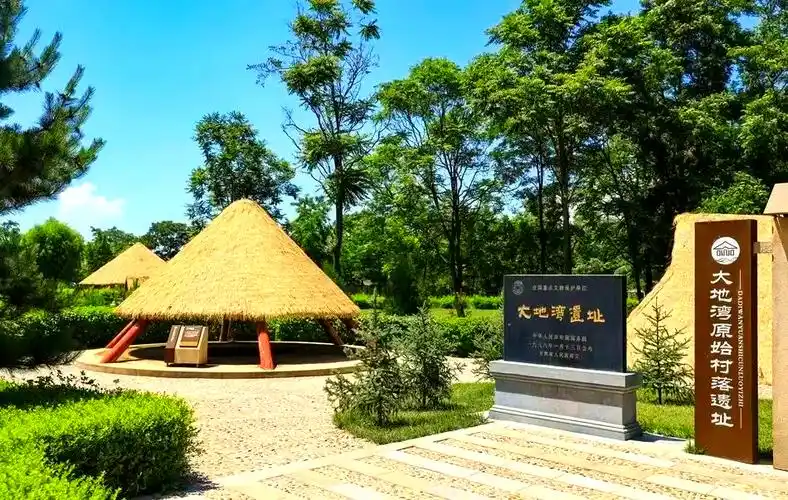 Set against the upper Yellow River, Dadiwan flourished between roughly 5800 and 2800 BCE, with cultural layers revealing sporadic human activity stretching back some 60,000 years. The settlement was occupied continuously from the Pre-Yangshao era through the Changshan Lower Culture, making it roughly contemporary with Turkey's Çatalhöyük in its early phases and overlapping with Stone Age monuments like Stonehenge and Skara Brae during its later millennia. It documents the full arc of prehistoric society on the Loess Plateau, from the first stirrings of agriculture to the birth of proto-urban life, and is a cornerstone of China's Origins of Civilization research project.
The site's architectural crown jewel is F901, a 420-square-meter palace foundation that remains the largest single Neolithic building known anywhere in the world. Laid out along a strict central axis, the structure predates anything comparable in Europe or the Near East by more than a millennium. Equally astonishing is its floor: a hardened mix of burnt stone (a local iron-rich mineral) that archaeologists describe as the world's earliest known "concrete," achieving a compressive strength approaching that of modern Portland cement some 5,000 years before the Romans famously formulated theirs.
Just as the wall paintings at Çatalhöyük reveal Neolithic spirituality, the F411 ground painting at Dadiwan—carbon-dated to roughly 5000 years ago—is the oldest surviving independent painting in China, opening a rare window onto the inner lives and ritual imagination of prehistoric Yellow River communities. The site museum houses the celebrated human-head-shaped painted pottery bottle, revered as the "King of Painted Pottery," alongside carbonized grains of millet (the world's earliest known dryland crop remains) and a full chronological sequence of painted ceramics spanning every cultural phase.
Entry is free, though visitors must register with valid identification at the gate. The park opens Tuesday through Sunday from 9:30 a.m. to 5 p.m. and is closed on Mondays. Allow three to four hours and follow the suggested route: museum first, then the F301 reconstructed village, finishing at the F901 palace hall. Because most of what you see consists of foundations and reconstructions, booking a professional guide or renting a smart audio device in advance is strongly recommended—without context, the bare earthworks can feel surprisingly quiet.
Dadiwan sits in the countryside roughly 102 kilometers northeast of Tianshui city, with no convenient public transport; renting a car or hiring a private driver is essential. Dining and lodging options nearby are modest, so most travelers base themselves in Tianshui. The site pairs beautifully with Fuxi Temple (honoring the mythical founder of Chinese culture) and the Buddhist marvel of Maijishan Grottoes for a compelling two-day "origins of civilization" itinerary. Summer visitors can also pick fresh peaches in the surrounding orchards.
Few places on earth let you stand on a floor laid before the Egyptian pyramids were built, and Dadiwan is precisely such a place. In recent years the park has expanded its hands-on programming with fire-drilling demonstrations and mock excavation pits, making the deep past unusually tangible. For travelers weary of crowded imperial sites, Dadiwan offers something rarer: a quiet, sun-drenched encounter with the very first sparks of organized life in China.
Set against the upper Yellow River, Dadiwan flourished between roughly 5800 and 2800 BCE, with cultural layers revealing sporadic human activity stretching back some 60,000 years. The settlement was occupied continuously from the Pre-Yangshao era through the Changshan Lower Culture, making it roughly contemporary with Turkey's Çatalhöyük in its early phases and overlapping with Stone Age monuments like Stonehenge and Skara Brae during its later millennia. It documents the full arc of prehistoric society on the Loess Plateau, from the first stirrings of agriculture to the birth of proto-urban life, and is a cornerstone of China's Origins of Civilization research project.
The site's architectural crown jewel is F901, a 420-square-meter palace foundation that remains the largest single Neolithic building known anywhere in the world. Laid out along a strict central axis, the structure predates anything comparable in Europe or the Near East by more than a millennium. Equally astonishing is its floor: a hardened mix of burnt stone (a local iron-rich mineral) that archaeologists describe as the world's earliest known "concrete," achieving a compressive strength approaching that of modern Portland cement some 5,000 years before the Romans famously formulated theirs.
Just as the wall paintings at Çatalhöyük reveal Neolithic spirituality, the F411 ground painting at Dadiwan—carbon-dated to roughly 5000 years ago—is the oldest surviving independent painting in China, opening a rare window onto the inner lives and ritual imagination of prehistoric Yellow River communities. The site museum houses the celebrated human-head-shaped painted pottery bottle, revered as the "King of Painted Pottery," alongside carbonized grains of millet (the world's earliest known dryland crop remains) and a full chronological sequence of painted ceramics spanning every cultural phase.
Entry is free, though visitors must register with valid identification at the gate. The park opens Tuesday through Sunday from 9:30 a.m. to 5 p.m. and is closed on Mondays. Allow three to four hours and follow the suggested route: museum first, then the F301 reconstructed village, finishing at the F901 palace hall. Because most of what you see consists of foundations and reconstructions, booking a professional guide or renting a smart audio device in advance is strongly recommended—without context, the bare earthworks can feel surprisingly quiet.
Dadiwan sits in the countryside roughly 102 kilometers northeast of Tianshui city, with no convenient public transport; renting a car or hiring a private driver is essential. Dining and lodging options nearby are modest, so most travelers base themselves in Tianshui. The site pairs beautifully with Fuxi Temple (honoring the mythical founder of Chinese culture) and the Buddhist marvel of Maijishan Grottoes for a compelling two-day "origins of civilization" itinerary. Summer visitors can also pick fresh peaches in the surrounding orchards.
Few places on earth let you stand on a floor laid before the Egyptian pyramids were built, and Dadiwan is precisely such a place. In recent years the park has expanded its hands-on programming with fire-drilling demonstrations and mock excavation pits, making the deep past unusually tangible. For travelers weary of crowded imperial sites, Dadiwan offers something rarer: a quiet, sun-drenched encounter with the very first sparks of organized life in China.