Xianren Cliff
⭐ 3.80
Xianren Cliff Scenic Area, Qinzhou District, Tianshui City, Gansu Province, China
 **Ancient Origins in a Turbulent Era**
Xianren Cliff was first established during the Northern and Southern Dynasties (420–589 CE), roughly contemporary with the fall of the Western Roman Empire and the rise of Byzantium. Over the following centuries, emperors of the Northern Wei, Tang, Song, Ming, and Qing dynasties all left their mark, creating a living timeline of Chinese religious art. Today, 27 halls and 197 statues survive, including rare Northern Wei clay sculptures and over 80 square meters of murals—offering scholars and travelers alike a continuous record of Chinese cave-temple aesthetics rarely matched outside Dunhuang.
**Architecture Carved from the Cliffs**
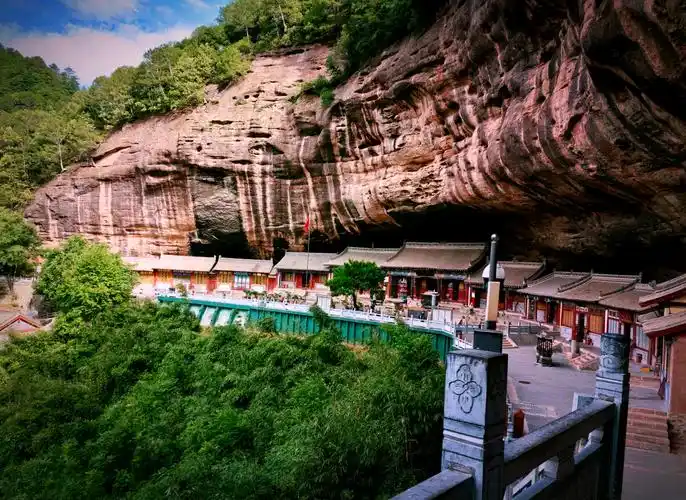
The complex follows the poetic layout of "Three Cliffs, Five Peaks, and Six Temples," with structures ingeniously wedged into natural rock shelters or cantilevered above sheer drops. The western cliff is the heart of the site, where a crescent-shaped stone overhang shelters a dense cluster of halls, much like the troglodyte monasteries of Cappadocia in Turkey or the cliff-built villages of southern France. The interplay between crimson Danxia stonework and vermilion temple eaves creates a visual harmony that feels both ancient and improbable.
**Where Three Faiths Meet**
Perhaps the site's most fascinating feature is its rare trinitarian harmony: Confucian, Buddhist, and Taoist deities share the same sacred precincts, a syncretic arrangement rarely seen even in cosmopolitan China. In a region historically dominated by Buddhist cave temples, this peaceful coexistence feels as remarkable as finding a church, mosque, and synagogue sharing one Italian hillside. On clear summer and autumn nights, an atmospheric phenomenon known as "Immortals Sending Lanterns" occurs, when natural phosphorescence and temple lights blend into ghostly will-o'-the-wisps—one of the celebrated "Eight Scenes of Qinzhou."
**Practical Information for Visitors**
Entry costs around 40 yuan, with a sightseeing shuttle adding 10 yuan for the round trip. The site opens daily from 7:30 AM to 6:00 PM, with last admission at 5:30. Driving from Tianshui city takes about 40 minutes, while the Maijishan Grottoes are only 15 minutes further—a perfect pairing. Public transit is infrequent, so renting a car or hiring a driver is strongly recommended. Take the shuttle to the core area to save energy for exploring on foot.
**Why It Belongs on Your Itinerary**
The best time to visit is between May and October, when August temperatures hover around a pleasant 22°C. Allow two and a half to three hours for the loop trail linking Fairy Lake, the South Cliff, East Cliff, and West Cliff—sturdy non-slip shoes are essential, as steps can be steep and damp after rain. Travelers with an extra day should absolutely combine Xianren Cliff with Maijishan Grottoes; together they offer a profound journey through China's spiritual and artistic heritage, far from the tour-bus crowds of more famous landmarks.
**Ancient Origins in a Turbulent Era**
Xianren Cliff was first established during the Northern and Southern Dynasties (420–589 CE), roughly contemporary with the fall of the Western Roman Empire and the rise of Byzantium. Over the following centuries, emperors of the Northern Wei, Tang, Song, Ming, and Qing dynasties all left their mark, creating a living timeline of Chinese religious art. Today, 27 halls and 197 statues survive, including rare Northern Wei clay sculptures and over 80 square meters of murals—offering scholars and travelers alike a continuous record of Chinese cave-temple aesthetics rarely matched outside Dunhuang.
**Architecture Carved from the Cliffs**
The complex follows the poetic layout of "Three Cliffs, Five Peaks, and Six Temples," with structures ingeniously wedged into natural rock shelters or cantilevered above sheer drops. The western cliff is the heart of the site, where a crescent-shaped stone overhang shelters a dense cluster of halls, much like the troglodyte monasteries of Cappadocia in Turkey or the cliff-built villages of southern France. The interplay between crimson Danxia stonework and vermilion temple eaves creates a visual harmony that feels both ancient and improbable.
**Where Three Faiths Meet**
Perhaps the site's most fascinating feature is its rare trinitarian harmony: Confucian, Buddhist, and Taoist deities share the same sacred precincts, a syncretic arrangement rarely seen even in cosmopolitan China. In a region historically dominated by Buddhist cave temples, this peaceful coexistence feels as remarkable as finding a church, mosque, and synagogue sharing one Italian hillside. On clear summer and autumn nights, an atmospheric phenomenon known as "Immortals Sending Lanterns" occurs, when natural phosphorescence and temple lights blend into ghostly will-o'-the-wisps—one of the celebrated "Eight Scenes of Qinzhou."
**Practical Information for Visitors**
Entry costs around 40 yuan, with a sightseeing shuttle adding 10 yuan for the round trip. The site opens daily from 7:30 AM to 6:00 PM, with last admission at 5:30. Driving from Tianshui city takes about 40 minutes, while the Maijishan Grottoes are only 15 minutes further—a perfect pairing. Public transit is infrequent, so renting a car or hiring a driver is strongly recommended. Take the shuttle to the core area to save energy for exploring on foot.
**Why It Belongs on Your Itinerary**
The best time to visit is between May and October, when August temperatures hover around a pleasant 22°C. Allow two and a half to three hours for the loop trail linking Fairy Lake, the South Cliff, East Cliff, and West Cliff—sturdy non-slip shoes are essential, as steps can be steep and damp after rain. Travelers with an extra day should absolutely combine Xianren Cliff with Maijishan Grottoes; together they offer a profound journey through China's spiritual and artistic heritage, far from the tour-bus crowds of more famous landmarks.