Fuxi Temple
⭐ 4.20
No. 110, Fuxi Road, Qinzhou District, Tianshui City, Gansu Province, China
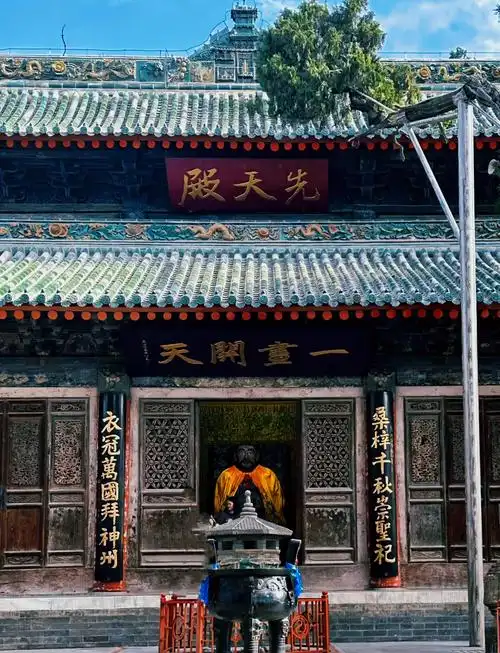 Fuxi Temple, built in 1483 during Emperor Chenghua's reign, is the most complete surviving Ming-era sacrificial complex dedicated to Fuxi—a culture-bringer figure as foundational to Chinese identity as Prometheus is to Greek myth or Romulus to Rome. While Lorenzo de' Medici was patronizing Botticelli in Florence, Ming craftsmen here were carving dragon-and-phoenix doors and painting cosmological diagrams overhead. The temple survived late-Ming upheaval and Qing-era renovations with its original layout largely intact, earning designation as a Major National Historical Site. Today it remains the official venue for the annual state ceremony honoring Fuxi.
The complex unfolds along a strict north-south axis in the manner of an imperial palace, with four courtyards stepping inward through ceremonial gates, a theater stage, and finally the grand Xiantian Hall at the heart. This main hall, seven bays wide and five deep, rises beneath a sweeping green-glazed tile roof—a chromatic signature reserved for sacred architecture in imperial China. Its interlocking wooden beams have supported the structure for over five centuries without nails, a feat paralleled in Europe's great medieval tithe barns and the soaring roof spans of Gothic cathedrals.
Inside Xiantian Hall stands a three-meter-tall painted clay statue of Fuxi himself, original to the Ming dynasty, gazing serenely from beneath a soaring caisson ceiling. That ceiling is the temple's masterwork: the I Ching's 64 hexagrams radiate from a central Hetu diagram in colors still vivid after half a millennium—a cosmological map made architecture. Outside, 64 ancient cypresses, some centuries old, are planted in the same eight-trigram pattern, transforming the courtyard into a three-dimensional diagram of cosmic order.
Located at 110 Fuxi Road in Tianshui's Qinzhou District, the temple is easily reached by Tram Line 1 (Fuxi Temple Station) or a short ride from Tianshui South high-speed rail station. Admission is just 20 yuan for adults, with discounts for students and seniors. The site opens daily from 8:00 a.m. to 6:00 p.m., though the ticket office closes at 5:30. Photography is not permitted inside the halls, so visitors should arrive ready to look rather than shoot. Allow 1 to 1.5 hours, and consider hiring a guide for around 50 yuan per small group to decode the symbols.
What sets Fuxi Temple apart from China's better-known monuments is its role as a touchstone for the very idea of Chinese civilization—a place where schoolchildren come to learn where their culture begins. For Western travelers who have walked Rome's Forum or Athens' Acropolis, the temple offers a parallel experience: standing in a working shrine where the foundational myths of an entire civilization remain alive. Pair the visit with the adjacent Tianshui Museum (free with temple ticket, closed Mondays) and the nearby Ming-era Hu Family Residence for a half-day immersion in this overlooked Silk Road gateway city.
Fuxi Temple, built in 1483 during Emperor Chenghua's reign, is the most complete surviving Ming-era sacrificial complex dedicated to Fuxi—a culture-bringer figure as foundational to Chinese identity as Prometheus is to Greek myth or Romulus to Rome. While Lorenzo de' Medici was patronizing Botticelli in Florence, Ming craftsmen here were carving dragon-and-phoenix doors and painting cosmological diagrams overhead. The temple survived late-Ming upheaval and Qing-era renovations with its original layout largely intact, earning designation as a Major National Historical Site. Today it remains the official venue for the annual state ceremony honoring Fuxi.
The complex unfolds along a strict north-south axis in the manner of an imperial palace, with four courtyards stepping inward through ceremonial gates, a theater stage, and finally the grand Xiantian Hall at the heart. This main hall, seven bays wide and five deep, rises beneath a sweeping green-glazed tile roof—a chromatic signature reserved for sacred architecture in imperial China. Its interlocking wooden beams have supported the structure for over five centuries without nails, a feat paralleled in Europe's great medieval tithe barns and the soaring roof spans of Gothic cathedrals.
Inside Xiantian Hall stands a three-meter-tall painted clay statue of Fuxi himself, original to the Ming dynasty, gazing serenely from beneath a soaring caisson ceiling. That ceiling is the temple's masterwork: the I Ching's 64 hexagrams radiate from a central Hetu diagram in colors still vivid after half a millennium—a cosmological map made architecture. Outside, 64 ancient cypresses, some centuries old, are planted in the same eight-trigram pattern, transforming the courtyard into a three-dimensional diagram of cosmic order.
Located at 110 Fuxi Road in Tianshui's Qinzhou District, the temple is easily reached by Tram Line 1 (Fuxi Temple Station) or a short ride from Tianshui South high-speed rail station. Admission is just 20 yuan for adults, with discounts for students and seniors. The site opens daily from 8:00 a.m. to 6:00 p.m., though the ticket office closes at 5:30. Photography is not permitted inside the halls, so visitors should arrive ready to look rather than shoot. Allow 1 to 1.5 hours, and consider hiring a guide for around 50 yuan per small group to decode the symbols.
What sets Fuxi Temple apart from China's better-known monuments is its role as a touchstone for the very idea of Chinese civilization—a place where schoolchildren come to learn where their culture begins. For Western travelers who have walked Rome's Forum or Athens' Acropolis, the temple offers a parallel experience: standing in a working shrine where the foundational myths of an entire civilization remain alive. Pair the visit with the adjacent Tianshui Museum (free with temple ticket, closed Mondays) and the nearby Ming-era Hu Family Residence for a half-day immersion in this overlooked Silk Road gateway city.