Maijishan Grottoes
⭐ 4.50
Maijishan Town, Maiji District, Tianshui, Gansu, China
 Founded during the Later Qin dynasty of the Sixteen Kingdoms period (around 384-417 CE), Maijishan was continuously expanded through the Northern Wei, Western Wei, Northern Zhou, Sui, Tang, and later dynasties. Situated at a strategic Silk Road crossroads, the grottoes document the eastward transmission of Buddhist art from Central Asia and its gradual fusion with Chinese aesthetics. Comparable to how medieval pilgrimage routes carried Byzantine icons across Europe, Maijishan captures a parallel cultural exchange that shaped religious art across Eurasia for sixteen centuries.
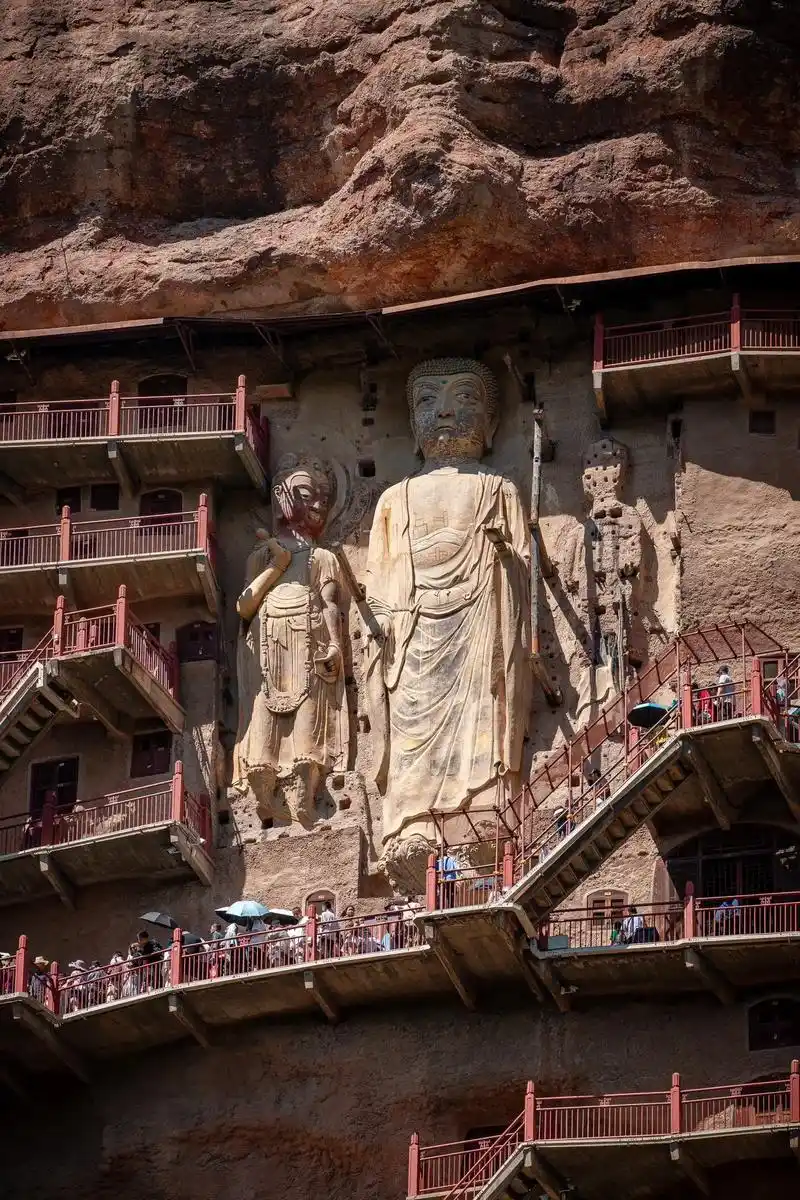
Because the mountain consists of soft conglomerate rock unsuitable for fine carving, craftsmen pioneered a distinctive clay-sculpture tradition, building Buddhist figures directly over stone foundations. This technique sets Maijishan apart from its stone-carved siblings at Yungang and Longmen. The 221 surviving caves cling to cliffs between 20 and 80 meters above the valley floor, connected by over 1,300 meters of cantilevered wooden plank walkways. The vertiginous pathways evoke comparisons to Spain's Caminito del Rey, offering breathtaking yet sometimes heart-stopping access to chambers that seem to float against the cliff face.
The grottoes preserve more than 10,600 clay figures alongside nearly 1,000 square meters of murals, presenting an unbroken sculptural sequence from the Northern Dynasties through the Song era. Standouts include the serene "Eastern smile" of a Western Wei bodhisattva in Cave 44, the innocent charm of a novice monk in Cave 133, and the dignified majesty of a Sui-period Buddha in Cave 13. These works rival the emotional depth of Donatello or early Bernini, bridging sacred symbolism with human warmth centuries before Western Baroque sculpture achieved similar expressiveness.
The scenic area lies in Maiji District, roughly 28 kilometers from central Tianshui, with forest coverage exceeding 90 percent. Summers are pleasantly cool, and misty "wheat-stack rain" scenery often appears after showers. Visitors must reserve in advance through the official WeChat account with real-name registration; combo tickets including shuttle buses are recommended. April through October is peak season, so arrive early to avoid crowds. Several special caves require additional paid reservations, and photography and touching the statues are strictly prohibited inside the grottoes.
Maijishan's cultural depth demands more than casual viewing, so hiring a professional guide or renting an AI audio device is strongly advised to grasp the iconographic layers behind each figure. Casual visitors will find the gentle Route 2 sufficient for appreciating the highlights in about 40 minutes, while the more adventurous should tackle Route 1, which threads through the most dramatic plank walkways. Sturdy non-slip shoes are essential, and allow three to four hours for the full experience to truly absorb this living museum of Buddhist art.
Founded during the Later Qin dynasty of the Sixteen Kingdoms period (around 384-417 CE), Maijishan was continuously expanded through the Northern Wei, Western Wei, Northern Zhou, Sui, Tang, and later dynasties. Situated at a strategic Silk Road crossroads, the grottoes document the eastward transmission of Buddhist art from Central Asia and its gradual fusion with Chinese aesthetics. Comparable to how medieval pilgrimage routes carried Byzantine icons across Europe, Maijishan captures a parallel cultural exchange that shaped religious art across Eurasia for sixteen centuries.
Because the mountain consists of soft conglomerate rock unsuitable for fine carving, craftsmen pioneered a distinctive clay-sculpture tradition, building Buddhist figures directly over stone foundations. This technique sets Maijishan apart from its stone-carved siblings at Yungang and Longmen. The 221 surviving caves cling to cliffs between 20 and 80 meters above the valley floor, connected by over 1,300 meters of cantilevered wooden plank walkways. The vertiginous pathways evoke comparisons to Spain's Caminito del Rey, offering breathtaking yet sometimes heart-stopping access to chambers that seem to float against the cliff face.
The grottoes preserve more than 10,600 clay figures alongside nearly 1,000 square meters of murals, presenting an unbroken sculptural sequence from the Northern Dynasties through the Song era. Standouts include the serene "Eastern smile" of a Western Wei bodhisattva in Cave 44, the innocent charm of a novice monk in Cave 133, and the dignified majesty of a Sui-period Buddha in Cave 13. These works rival the emotional depth of Donatello or early Bernini, bridging sacred symbolism with human warmth centuries before Western Baroque sculpture achieved similar expressiveness.
The scenic area lies in Maiji District, roughly 28 kilometers from central Tianshui, with forest coverage exceeding 90 percent. Summers are pleasantly cool, and misty "wheat-stack rain" scenery often appears after showers. Visitors must reserve in advance through the official WeChat account with real-name registration; combo tickets including shuttle buses are recommended. April through October is peak season, so arrive early to avoid crowds. Several special caves require additional paid reservations, and photography and touching the statues are strictly prohibited inside the grottoes.
Maijishan's cultural depth demands more than casual viewing, so hiring a professional guide or renting an AI audio device is strongly advised to grasp the iconographic layers behind each figure. Casual visitors will find the gentle Route 2 sufficient for appreciating the highlights in about 40 minutes, while the more adventurous should tackle Route 1, which threads through the most dramatic plank walkways. Sturdy non-slip shoes are essential, and allow three to four hours for the full experience to truly absorb this living museum of Buddhist art.