Dalian Natural History Museum
⭐ 4.60
Dalian Natural History Museum, Dalian City, Liaoning Province, China
 The Dalian Natural History Museum traces its origins to 1907, making it one of Asia's earliest institutions of natural history—contemporary with the great European museums of the late Victorian and Edwardian era. Founded when Dalian was developing under Russian and Japanese influence, the museum reflects a period when natural history museums were springing up across major port cities worldwide, from London's Natural History Museum (1881) to Vienna's Naturhistorisches Museum. The current seaside building opened in 1998, seamlessly blending historic Russian classical architecture with contemporary exhibition design.
The museum's architecture is itself a cultural artifact. The Russian classical structure, designated a protected heritage site, evokes the grandeur of late Tsarist-era civic buildings comparable to Saint Petersburg's neoclassical ensembles along the Neva embankment. Its three-tiered observation terrace offers panoramic views of the Black Reef coastline and the sweeping Xinghai Bay Bridge—an engineering marvel connecting Dalian's downtown to its outlying districts. This fusion of imperial European styling with a modern Chinese coastal setting creates a uniquely layered architectural experience.
The museum's crown jewel is a fully articulated 66.7-ton North Pacific right whale specimen, measuring 17.1 meters long—one of the largest whale displays in Asia. Paleontology enthusiasts will marvel at the world's only complete fossil group of juvenile Psittacosaurus dinosaurs: 35 hatchlings preserved together, providing unprecedented evidence of dinosaur parenting behavior. Fossils from the renowned Jehol Biota, including the celebrated Sinosauropteryx (feathered dinosaur) specimens, offer crucial evidence supporting the theory that modern birds descended from theropod dinosaurs—a research breakthrough comparable to the Archaeopteryx discoveries that revolutionized nineteenth-century European paleontology.
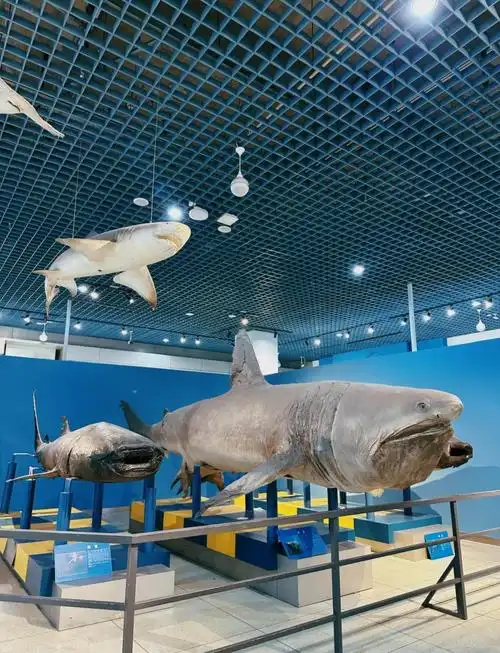
Twelve themed galleries transform static specimens into immersive narratives. The Marine Mammals Hall features suspended whale shark skeletons alongside a 40-meter panoramic mural and ecological dioramas that recreate oceanic habitats. Other halls explore Northeast China's forest wildlife, Mesozoic dinosaurs, and wetland ecosystems. Diorama-style displays—reminiscent of those pioneered at New York's American Museum of Natural History—bring ancient creatures and living species vividly to life, making evolution's grand sweep tangible to visitors of all ages.
Located at 40 Heishijiao West Village Street in Shahekou District, the museum is easily reached via Metro Line 1 (Heishijiao Station, Exit B, a five-minute walk) or buses 23, 28, 202, and 523. Admission is free year-round; visitors need only present an ID card or passport. The museum opens Tuesday through Friday from 9:00 to 16:30, with extended hours until 18:30 on weekends and during summer (last entry at 18:00). Closed Mondays. Plan for two to three hours for a thorough visit.
A suggested route begins on the second floor with the Marine Biology Hall and its spectacular whale display, continues through the paleontology and dinosaur galleries, and concludes on the first floor with Northeast Forest and Wetland exhibits. Air conditioning keeps interiors refreshingly cool—pack a light jacket. Flash photography and tripods are prohibited, and no food or drink is allowed inside the galleries. Afterwards, stroll to the adjacent Heishijiao Geological Park to feed seagulls along the rocky coastline, perfectly pairing scientific discovery with Dalian's signature seaside charm.
The Dalian Natural History Museum traces its origins to 1907, making it one of Asia's earliest institutions of natural history—contemporary with the great European museums of the late Victorian and Edwardian era. Founded when Dalian was developing under Russian and Japanese influence, the museum reflects a period when natural history museums were springing up across major port cities worldwide, from London's Natural History Museum (1881) to Vienna's Naturhistorisches Museum. The current seaside building opened in 1998, seamlessly blending historic Russian classical architecture with contemporary exhibition design.
The museum's architecture is itself a cultural artifact. The Russian classical structure, designated a protected heritage site, evokes the grandeur of late Tsarist-era civic buildings comparable to Saint Petersburg's neoclassical ensembles along the Neva embankment. Its three-tiered observation terrace offers panoramic views of the Black Reef coastline and the sweeping Xinghai Bay Bridge—an engineering marvel connecting Dalian's downtown to its outlying districts. This fusion of imperial European styling with a modern Chinese coastal setting creates a uniquely layered architectural experience.
The museum's crown jewel is a fully articulated 66.7-ton North Pacific right whale specimen, measuring 17.1 meters long—one of the largest whale displays in Asia. Paleontology enthusiasts will marvel at the world's only complete fossil group of juvenile Psittacosaurus dinosaurs: 35 hatchlings preserved together, providing unprecedented evidence of dinosaur parenting behavior. Fossils from the renowned Jehol Biota, including the celebrated Sinosauropteryx (feathered dinosaur) specimens, offer crucial evidence supporting the theory that modern birds descended from theropod dinosaurs—a research breakthrough comparable to the Archaeopteryx discoveries that revolutionized nineteenth-century European paleontology.
Twelve themed galleries transform static specimens into immersive narratives. The Marine Mammals Hall features suspended whale shark skeletons alongside a 40-meter panoramic mural and ecological dioramas that recreate oceanic habitats. Other halls explore Northeast China's forest wildlife, Mesozoic dinosaurs, and wetland ecosystems. Diorama-style displays—reminiscent of those pioneered at New York's American Museum of Natural History—bring ancient creatures and living species vividly to life, making evolution's grand sweep tangible to visitors of all ages.
Located at 40 Heishijiao West Village Street in Shahekou District, the museum is easily reached via Metro Line 1 (Heishijiao Station, Exit B, a five-minute walk) or buses 23, 28, 202, and 523. Admission is free year-round; visitors need only present an ID card or passport. The museum opens Tuesday through Friday from 9:00 to 16:30, with extended hours until 18:30 on weekends and during summer (last entry at 18:00). Closed Mondays. Plan for two to three hours for a thorough visit.
A suggested route begins on the second floor with the Marine Biology Hall and its spectacular whale display, continues through the paleontology and dinosaur galleries, and concludes on the first floor with Northeast Forest and Wetland exhibits. Air conditioning keeps interiors refreshingly cool—pack a light jacket. Flash photography and tripods are prohibited, and no food or drink is allowed inside the galleries. Afterwards, stroll to the adjacent Heishijiao Geological Park to feed seagulls along the rocky coastline, perfectly pairing scientific discovery with Dalian's signature seaside charm.