Binhai Road
⭐ 4.70
Binhai Road, Shahekou District, Dalian City, Liaoning Province, China
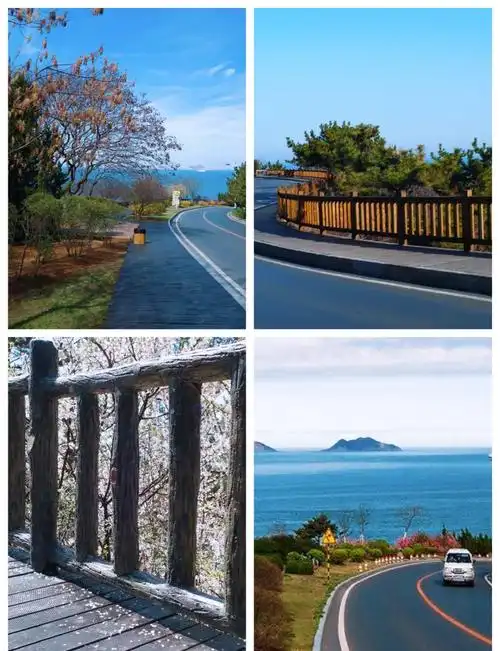 Dalian's coastal road began life in the 1990s as scattered military patrol routes and modest walking paths, then merged into a unified scenic corridor after 2000. The most ambitious chapter, completed in 2024, added 9 kilometers of wooden boardwalk that finally lets visitors step directly above the waves. The project recalls grand European coastal roads like Italy's Amalfi Drive or the French Riviera's Corniches—engineered ribbons that tame wild shoreline for public enjoyment. Like Brighton's Victorian seafront or Nice's Promenade des Anglais, Binhai Road belongs to everyone, open without charge around the clock.
The road's defining feature is its "mountain-sea-city" trinity: forested hills cascade on one side, the Yellow Sea stretches endlessly on the other, and Dalian's skyline often glimmers in between. Distinctive suspension bridges—most famously the elegant Bei Da Bridge arching over a wooded bay—punctuate the route at dramatic intervals. Wooden boardwalks weave between sculpted rocks including the popular "Dinosaur Gazing at the Sea" formation, while sandy stretches such as Jinyin Beach offer gentler terrain. Each of the twelve linked scenic zones has its own personality, so the 32 kilometers feel less like one continuous road and more like a curated gallery of coastal moods.
Binhai Road embodies Dalian's modern identity as a relaxed seaside metropolis. The route passes the prestigious Bangchui Island State Guesthouse, which has hosted visiting heads of state, and the Tiger Beach Ocean Park, the city's showcase for marine education. Locals treat the road as an extension of their living room: retirees practice tai chi at dawn, couples pose for wedding portraits at sunset, and families cycle the flat western section on weekends. In spring, azaleas blanket the hillsides; in autumn and winter, low sun paints the bay in fire-orange light—a reminder that the sea rewards visitors in every season.
The road is free and accessible 24 hours a day. Most visitors split it into three sections: the western stretch from Xinghai Square to Fujiazhuang is flat and ideal for cycling or strolling with children; the central section around Yanwo Ridge, Bei Da Bridge, and Tiger Beach concentrates the most dramatic cliffs and photo opportunities; the eastern section from Bangchui Island to Hai Zhi Yun Square feels wild and undeveloped. During peak season (July through October) a hop-on-hop-off tourist bus runs the full route for roughly 20 RMB. Allow six to eight hours to walk it end to end, or sample a section in two or three.
For the best light and cool air, visit between 9 and 11 a.m. or 4 and 6 p.m.; the evening brings sunset views across Xinghai Bay and the illuminated cross-sea bridge. Summer sun is strong, so pack sunscreen and water; winter brings bitter sea winds, requiring a windproof layer. On holiday weekends the western section enforces alternating odd-even license-plate restrictions, frustrating drivers—public transit or rental bicycles sidestep the problem entirely. The reward for any effort is one of China's most photogenic urban coastlines, a place where mountains, sea, and city coexist in a single sweeping glance.
Dalian's coastal road began life in the 1990s as scattered military patrol routes and modest walking paths, then merged into a unified scenic corridor after 2000. The most ambitious chapter, completed in 2024, added 9 kilometers of wooden boardwalk that finally lets visitors step directly above the waves. The project recalls grand European coastal roads like Italy's Amalfi Drive or the French Riviera's Corniches—engineered ribbons that tame wild shoreline for public enjoyment. Like Brighton's Victorian seafront or Nice's Promenade des Anglais, Binhai Road belongs to everyone, open without charge around the clock.
The road's defining feature is its "mountain-sea-city" trinity: forested hills cascade on one side, the Yellow Sea stretches endlessly on the other, and Dalian's skyline often glimmers in between. Distinctive suspension bridges—most famously the elegant Bei Da Bridge arching over a wooded bay—punctuate the route at dramatic intervals. Wooden boardwalks weave between sculpted rocks including the popular "Dinosaur Gazing at the Sea" formation, while sandy stretches such as Jinyin Beach offer gentler terrain. Each of the twelve linked scenic zones has its own personality, so the 32 kilometers feel less like one continuous road and more like a curated gallery of coastal moods.
Binhai Road embodies Dalian's modern identity as a relaxed seaside metropolis. The route passes the prestigious Bangchui Island State Guesthouse, which has hosted visiting heads of state, and the Tiger Beach Ocean Park, the city's showcase for marine education. Locals treat the road as an extension of their living room: retirees practice tai chi at dawn, couples pose for wedding portraits at sunset, and families cycle the flat western section on weekends. In spring, azaleas blanket the hillsides; in autumn and winter, low sun paints the bay in fire-orange light—a reminder that the sea rewards visitors in every season.
The road is free and accessible 24 hours a day. Most visitors split it into three sections: the western stretch from Xinghai Square to Fujiazhuang is flat and ideal for cycling or strolling with children; the central section around Yanwo Ridge, Bei Da Bridge, and Tiger Beach concentrates the most dramatic cliffs and photo opportunities; the eastern section from Bangchui Island to Hai Zhi Yun Square feels wild and undeveloped. During peak season (July through October) a hop-on-hop-off tourist bus runs the full route for roughly 20 RMB. Allow six to eight hours to walk it end to end, or sample a section in two or three.
For the best light and cool air, visit between 9 and 11 a.m. or 4 and 6 p.m.; the evening brings sunset views across Xinghai Bay and the illuminated cross-sea bridge. Summer sun is strong, so pack sunscreen and water; winter brings bitter sea winds, requiring a windproof layer. On holiday weekends the western section enforces alternating odd-even license-plate restrictions, frustrating drivers—public transit or rental bicycles sidestep the problem entirely. The reward for any effort is one of China's most photogenic urban coastlines, a place where mountains, sea, and city coexist in a single sweeping glance.