Three Pagodas of Chongsheng Temple
⭐ 4.20
Chongsheng Temple Three Pagodas Scenic Area, Dali City, Dali Bai Autonomous Prefecture, Yunnan Province, China
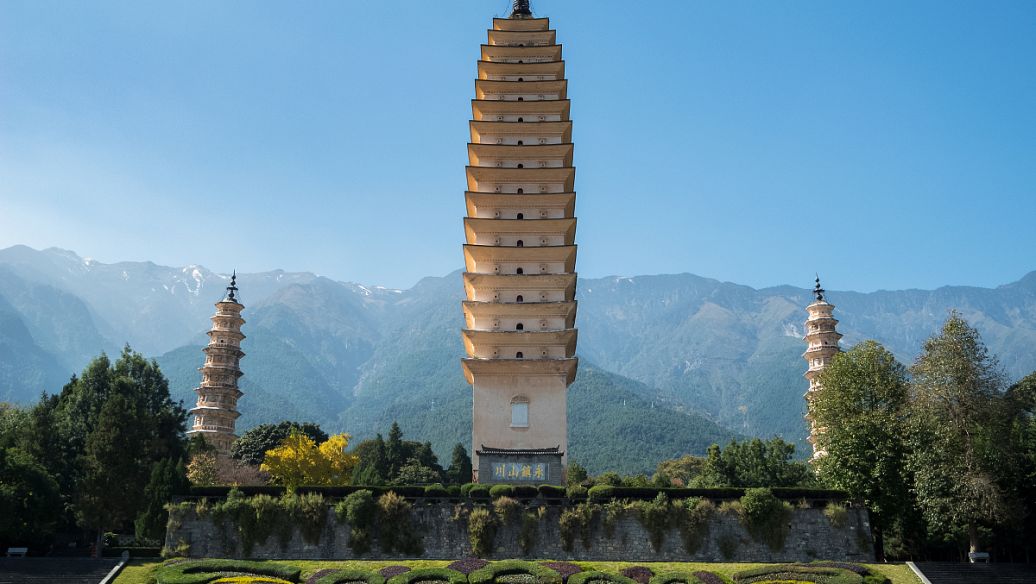 The Three Pagodas are the surviving heart of Chongsheng Temple, once the royal monastery of two successive Buddhist kingdoms that ruled Yunnan from the 8th to 13th centuries—contemporaneous with the Carolingian Empire in Western Europe. Founded during the Nanzhao Kingdom around 840 CE, the complex was revered as a "Buddhist Capital" so sacred that nine kings of Dali renounced their crowns to take monastic vows here. Although fires and earthquakes leveled the original halls over the centuries, the pagodas endured, gaining protected status in 1961 as one of China's earliest nationally designated heritage sites—a recognition that parallels how Italy would soon begin safeguarding its medieval centers through similar preservation programs.
The Thousand-Seeking Pagoda stands 69 meters tall—a Tang Dynasty marvel of brick construction that rivals the bell tower of St. Mark's Basilica in Venice. Built during the same era as Charlemagne's Palatine Chapel at Aachen, its 16 square tiers exemplify the bold, masculine geometry of Tang architecture. Two smaller companion pagodas, added during the Song-era Dali Kingdom some 300 years later, mirror the main tower in graceful octagonal form, each rising 42 meters across ten tiers. Together they form an isosceles triangle that has withstood major earthquakes with only minor damage, prompting Ming Dynasty chronicles to record a miraculous self-healing after a severe quake—a striking parallel to the resilience, and occasional collapse, of Italy's medieval campaniles.
Though the original temple halls were lost to war and time, the rebuilt complex houses an exceptional collection of Buddhist art. The Rain-Copper Guanyin Hall shelters an 8.6-meter bronze Guanyin statue of remarkable serenity, while the bell tower displays a recast of the great Nanzhao-era bronze bell. A carved wooden reproduction of the 12th-century Zhang Shengwen Scroll—one of China's most important medieval Buddhist painting cycles—lines the central axis, tracing Yunnan's Buddhist artistic evolution. The on-site museum displays artifacts unearthed during restorations, much as cathedral treasuries across Europe preserve relics from medieval Christendom, offering tangible links to Dali's standing as a southwestern Buddhist powerhouse comparable to the pilgrimage capitals of Canterbury or Santiago de Compostela.
The most photographed view of the pagodas is not at ground level but reflected in water. The Juying Pool and Reflection Park south of the towers offer the classic mirror-image shot: on windless mornings, the three towers float impossibly above a still pool framed by Cangshan Mountain and the distant crescent of Erhai Lake. Late afternoon bathes the brick spires in golden light—conditions that rival any golden-hour view of the Taj Mahal or the haunting reflections of Notre-Dame before the 2019 fire. Photography enthusiasts should target clear days and arrive at sunrise or sunset, when soft light and smaller crowds converge for the most memorable shots.
Tickets cost around 75 yuan with online discounts often available; an electric shuttle add-on is recommended since the grounds span 5–7 km. Opening hours run 07:10–19:00 in summer, with shorter winter hours. From Dali Old Town, a 10–15 minute taxi ride reaches the gates inexpensively. Plan three to four hours for the full circuit, moving counter-clockwise from the pagodas core, through the rebuilt temple axis, to the Wanghai Pavilion overlooking Erhai. Wear sturdy non-slip footwear—Yunnan's polished marble paths turn treacherous in rain—and pack sunscreen, a hat, and a foldable umbrella, since mountain weather shifts quickly from brilliant sun to brief showers.
The Three Pagodas are the surviving heart of Chongsheng Temple, once the royal monastery of two successive Buddhist kingdoms that ruled Yunnan from the 8th to 13th centuries—contemporaneous with the Carolingian Empire in Western Europe. Founded during the Nanzhao Kingdom around 840 CE, the complex was revered as a "Buddhist Capital" so sacred that nine kings of Dali renounced their crowns to take monastic vows here. Although fires and earthquakes leveled the original halls over the centuries, the pagodas endured, gaining protected status in 1961 as one of China's earliest nationally designated heritage sites—a recognition that parallels how Italy would soon begin safeguarding its medieval centers through similar preservation programs.
The Thousand-Seeking Pagoda stands 69 meters tall—a Tang Dynasty marvel of brick construction that rivals the bell tower of St. Mark's Basilica in Venice. Built during the same era as Charlemagne's Palatine Chapel at Aachen, its 16 square tiers exemplify the bold, masculine geometry of Tang architecture. Two smaller companion pagodas, added during the Song-era Dali Kingdom some 300 years later, mirror the main tower in graceful octagonal form, each rising 42 meters across ten tiers. Together they form an isosceles triangle that has withstood major earthquakes with only minor damage, prompting Ming Dynasty chronicles to record a miraculous self-healing after a severe quake—a striking parallel to the resilience, and occasional collapse, of Italy's medieval campaniles.
Though the original temple halls were lost to war and time, the rebuilt complex houses an exceptional collection of Buddhist art. The Rain-Copper Guanyin Hall shelters an 8.6-meter bronze Guanyin statue of remarkable serenity, while the bell tower displays a recast of the great Nanzhao-era bronze bell. A carved wooden reproduction of the 12th-century Zhang Shengwen Scroll—one of China's most important medieval Buddhist painting cycles—lines the central axis, tracing Yunnan's Buddhist artistic evolution. The on-site museum displays artifacts unearthed during restorations, much as cathedral treasuries across Europe preserve relics from medieval Christendom, offering tangible links to Dali's standing as a southwestern Buddhist powerhouse comparable to the pilgrimage capitals of Canterbury or Santiago de Compostela.
The most photographed view of the pagodas is not at ground level but reflected in water. The Juying Pool and Reflection Park south of the towers offer the classic mirror-image shot: on windless mornings, the three towers float impossibly above a still pool framed by Cangshan Mountain and the distant crescent of Erhai Lake. Late afternoon bathes the brick spires in golden light—conditions that rival any golden-hour view of the Taj Mahal or the haunting reflections of Notre-Dame before the 2019 fire. Photography enthusiasts should target clear days and arrive at sunrise or sunset, when soft light and smaller crowds converge for the most memorable shots.
Tickets cost around 75 yuan with online discounts often available; an electric shuttle add-on is recommended since the grounds span 5–7 km. Opening hours run 07:10–19:00 in summer, with shorter winter hours. From Dali Old Town, a 10–15 minute taxi ride reaches the gates inexpensively. Plan three to four hours for the full circuit, moving counter-clockwise from the pagodas core, through the rebuilt temple axis, to the Wanghai Pavilion overlooking Erhai. Wear sturdy non-slip footwear—Yunnan's polished marble paths turn treacherous in rain—and pack sunscreen, a hat, and a foldable umbrella, since mountain weather shifts quickly from brilliant sun to brief showers.