Dali Ancient City
⭐ 4.20
Dali Ancient City Scenic Area, Dali Prefecture, Yunnan Province, China
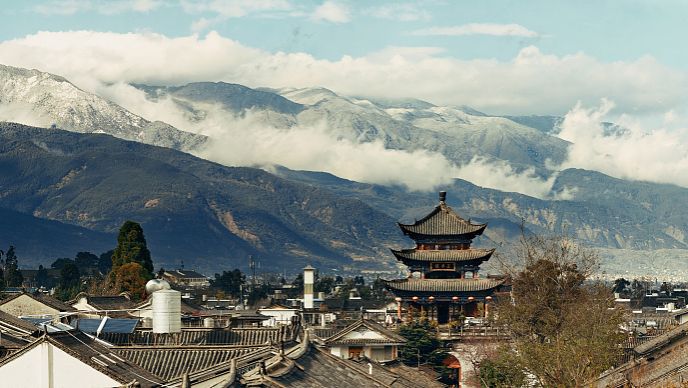 Dali Ancient Town traces its urban grid to 1382, when Ming Dynasty engineers laid out its fortified walls and orderly streets, yet the site itself has served as a regional capital since the Nanzhao Kingdom ruled here from 738 to 902 during the Tang era—a contemporary of Charlemagne's Europe. Designated a protected historic city in 1982 alongside imperial Beijing and ancient Xi'an, it remains one of Southwest China's finest examples of a "living" walled town, complete with 14 officially protected heritage sites still embedded in daily life rather than roped off as museum relics. Think of it as a smaller, warmer cousin to medieval Carcassonne, but where locals still hang laundry in the courtyards.
The architectural character is unmistakably Bai ethnic, defined by the classic compound plan of "three bays and one screen wall, four sides and five courtyards." Curved tiled roofs, painted beam-ends, and chalk-white walls washed with pale grey frescoes recall the restrained elegance of Greek island villages, while wooden lattice windows and carved gates add a distinctly East Asian ornamentation. The South Gate, also called Double Crane Tower, is the oldest surviving gateway and rewards climbers with sweeping views over the rooftops to Erhai Lake beyond. Wuhua Tower, perched at the town's highest point, served historically as a banquet hall for visiting dignitaries, much like a Renaissance palazzo's belvedere.
Bai culture is not preserved behind glass here—it spills into the streets. On Fuxing Road, vendors sell grilled rushan cheese and walnut cakes beside souvenir stalls. Foreigners' Street (Huguo Road) earned its nickname in the 1980s backpacker era and still channels a Kathmandu-meets-Provence vibe with espresso bars and bookshops. Renmin Road transforms after dusk into an open-air concert of acoustic guitars and street poetry, while the Red Dragon Well lane channels spring water past doorways, embodying the Bai proverb "water in every home, flowers in every courtyard." Scattered workshops invite visitors to try indigo tie-dye and silversmithing, traditional crafts passed down through generations.
Entry to the old town itself is free and open 24 hours, though small fees apply to climb the towers or enter the museum; allow six to eight hours to wander properly. Spring (March–May) and autumn (September–November) bring the most pleasant weather, while August brings lush greenery, vibrant nightlife, and the celebrated wild mushroom season that draws food lovers nationwide. Early risers should arrive before 8 a.m. for quiet lanes and authentic market scenes; night owls should linger past 10 p.m. when Renmin Road fills with musicians. The nearby Three Pagodas of Chongsheng Temple lie just 1.5 km away and pair naturally with a morning or afternoon visit.
Reaching the town is straightforward: from Dali High-Speed Railway Station, taxis and buses cover the 20–30 minute journey inexpensively. Once inside the walled core, motor vehicles are banned—explore entirely on foot along smooth stone-paved lanes. Cards are widely accepted and mobile payment is universal, though carrying a few renminbi helps with small vendors. Summer sunshine is intense at this elevation, so sunscreen, a hat, and a compact umbrella are essentials. Stay hydrated, wear comfortable shoes, and surrender to the town's unhurried rhythm—Dali rewards those who resist the urge to rush.
Dali Ancient Town traces its urban grid to 1382, when Ming Dynasty engineers laid out its fortified walls and orderly streets, yet the site itself has served as a regional capital since the Nanzhao Kingdom ruled here from 738 to 902 during the Tang era—a contemporary of Charlemagne's Europe. Designated a protected historic city in 1982 alongside imperial Beijing and ancient Xi'an, it remains one of Southwest China's finest examples of a "living" walled town, complete with 14 officially protected heritage sites still embedded in daily life rather than roped off as museum relics. Think of it as a smaller, warmer cousin to medieval Carcassonne, but where locals still hang laundry in the courtyards.
The architectural character is unmistakably Bai ethnic, defined by the classic compound plan of "three bays and one screen wall, four sides and five courtyards." Curved tiled roofs, painted beam-ends, and chalk-white walls washed with pale grey frescoes recall the restrained elegance of Greek island villages, while wooden lattice windows and carved gates add a distinctly East Asian ornamentation. The South Gate, also called Double Crane Tower, is the oldest surviving gateway and rewards climbers with sweeping views over the rooftops to Erhai Lake beyond. Wuhua Tower, perched at the town's highest point, served historically as a banquet hall for visiting dignitaries, much like a Renaissance palazzo's belvedere.
Bai culture is not preserved behind glass here—it spills into the streets. On Fuxing Road, vendors sell grilled rushan cheese and walnut cakes beside souvenir stalls. Foreigners' Street (Huguo Road) earned its nickname in the 1980s backpacker era and still channels a Kathmandu-meets-Provence vibe with espresso bars and bookshops. Renmin Road transforms after dusk into an open-air concert of acoustic guitars and street poetry, while the Red Dragon Well lane channels spring water past doorways, embodying the Bai proverb "water in every home, flowers in every courtyard." Scattered workshops invite visitors to try indigo tie-dye and silversmithing, traditional crafts passed down through generations.
Entry to the old town itself is free and open 24 hours, though small fees apply to climb the towers or enter the museum; allow six to eight hours to wander properly. Spring (March–May) and autumn (September–November) bring the most pleasant weather, while August brings lush greenery, vibrant nightlife, and the celebrated wild mushroom season that draws food lovers nationwide. Early risers should arrive before 8 a.m. for quiet lanes and authentic market scenes; night owls should linger past 10 p.m. when Renmin Road fills with musicians. The nearby Three Pagodas of Chongsheng Temple lie just 1.5 km away and pair naturally with a morning or afternoon visit.
Reaching the town is straightforward: from Dali High-Speed Railway Station, taxis and buses cover the 20–30 minute journey inexpensively. Once inside the walled core, motor vehicles are banned—explore entirely on foot along smooth stone-paved lanes. Cards are widely accepted and mobile payment is universal, though carrying a few renminbi helps with small vendors. Summer sunshine is intense at this elevation, so sunscreen, a hat, and a compact umbrella are essentials. Stay hydrated, wear comfortable shoes, and surrender to the town's unhurried rhythm—Dali rewards those who resist the urge to rush.