Nine Dragon Wall
⭐ 4.50
Jiulongbi, Pingcheng District, Datong City, Shanxi Province, China
 **Historical Context**
Constructed in 1392 during the reign of the Hongwu Emperor, this screen wall once guarded the entrance to the princely mansion of Zhu Gui, the first Prince of Dai. Its 600-year survival makes it the only original Ming dragon wall among China's "Three Great Nine Dragon Walls," predating the better-known examples in Beijing's Forbidden City and Beihai Park by more than 300 years. To put its age in Western perspective, it was erected around the time of Chaucer's Canterbury Tales and stands as a remarkable testament to early Ming imperial architecture—contemporary with Europe's late medieval period yet displaying an artistic sophistication that rivals the finest European Gothic decorative work.
**Architecture and Craftsmanship**
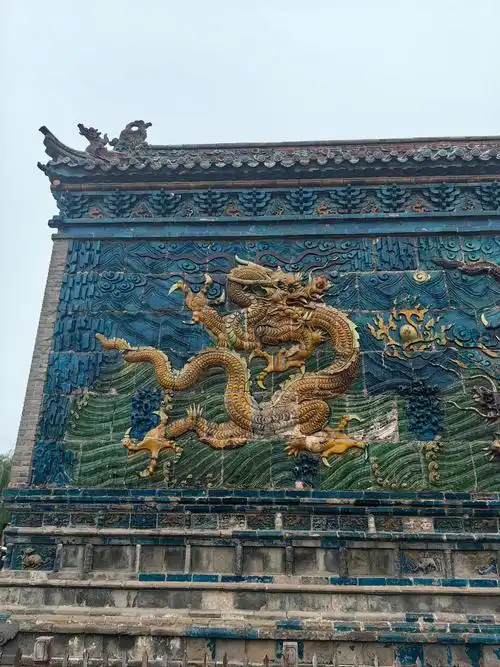
The wall measures 45.5 meters long, 8 meters high, and over 2 meters thick, assembled from 426 glazed ceramic components fired in seven distinct colors: yellow, green, blue, purple, brown, white, and black. Nine four-clawed dragons, each unique in posture, are arranged in a strictly symmetrical composition with a central seated dragon flanked by diving, ascending, soaring, and leaping forms. The structure is crowned by a miniature traditional Chinese roof supported by 62 pairs of glazed bracket sets, while the base features 75 sculpted mythical beasts along its lotus pedestal. The sculptural relief remains crisp and the colors astonishingly vivid after six centuries.
**Cultural Significance**
The nine dragons symbolize the Confucian ideal of the cultivated gentleman ascending through life's stages—from hidden potential to triumphant mastery—reflecting the philosophical worldview of the early Ming court. Crucially, the dragons bear only four claws rather than the five permitted to the emperor, strictly adhering to Ming sumptuary codes governing imperial princes. This makes the wall an invaluable physical document for understanding Ming hierarchy and ritual culture. The unusual 34.9-meter reflection pool, found at no other dragon wall, creates a poetic dialogue between solid form and shimmering image.
**Practical Visit Information**
The attraction sits at 18 Dadong Street in Datong's Pingcheng District, within easy walking distance of both Huayan and Shanhua Temples—two other Ming-era masterpieces—allowing visitors to combine them into a rewarding half-day itinerary. Admission is just 10 yuan, with half-price tickets for students and minors and free entry for seniors and military personnel. Opening hours typically run from 8:00 a.m. to 9:30 p.m. Signs are predominantly in Chinese, so bringing a translation app or renting an audio guide is highly recommended for appreciating the symbolic depth of the dragon motifs.
**Why Visit**
Beyond its sheer visual splendor, the Datong Nine Dragon Wall offers something the Beijing dragon walls cannot: the chance to experience Ming princely architecture in its original urban setting, relatively uncrowded and authentically preserved. The interplay of morning or late-afternoon light across the glazed surface, mirrored in the still pool below, creates one of China's most photogenic architectural moments. For travelers exploring the Silk Road legacy of Datong—an ancient capital that once rivaled Rome and Constantinople in regional importance—this monument provides an essential and accessible window into the grandeur of Ming imperial China.
**Historical Context**
Constructed in 1392 during the reign of the Hongwu Emperor, this screen wall once guarded the entrance to the princely mansion of Zhu Gui, the first Prince of Dai. Its 600-year survival makes it the only original Ming dragon wall among China's "Three Great Nine Dragon Walls," predating the better-known examples in Beijing's Forbidden City and Beihai Park by more than 300 years. To put its age in Western perspective, it was erected around the time of Chaucer's Canterbury Tales and stands as a remarkable testament to early Ming imperial architecture—contemporary with Europe's late medieval period yet displaying an artistic sophistication that rivals the finest European Gothic decorative work.
**Architecture and Craftsmanship**
The wall measures 45.5 meters long, 8 meters high, and over 2 meters thick, assembled from 426 glazed ceramic components fired in seven distinct colors: yellow, green, blue, purple, brown, white, and black. Nine four-clawed dragons, each unique in posture, are arranged in a strictly symmetrical composition with a central seated dragon flanked by diving, ascending, soaring, and leaping forms. The structure is crowned by a miniature traditional Chinese roof supported by 62 pairs of glazed bracket sets, while the base features 75 sculpted mythical beasts along its lotus pedestal. The sculptural relief remains crisp and the colors astonishingly vivid after six centuries.
**Cultural Significance**
The nine dragons symbolize the Confucian ideal of the cultivated gentleman ascending through life's stages—from hidden potential to triumphant mastery—reflecting the philosophical worldview of the early Ming court. Crucially, the dragons bear only four claws rather than the five permitted to the emperor, strictly adhering to Ming sumptuary codes governing imperial princes. This makes the wall an invaluable physical document for understanding Ming hierarchy and ritual culture. The unusual 34.9-meter reflection pool, found at no other dragon wall, creates a poetic dialogue between solid form and shimmering image.
**Practical Visit Information**
The attraction sits at 18 Dadong Street in Datong's Pingcheng District, within easy walking distance of both Huayan and Shanhua Temples—two other Ming-era masterpieces—allowing visitors to combine them into a rewarding half-day itinerary. Admission is just 10 yuan, with half-price tickets for students and minors and free entry for seniors and military personnel. Opening hours typically run from 8:00 a.m. to 9:30 p.m. Signs are predominantly in Chinese, so bringing a translation app or renting an audio guide is highly recommended for appreciating the symbolic depth of the dragon motifs.
**Why Visit**
Beyond its sheer visual splendor, the Datong Nine Dragon Wall offers something the Beijing dragon walls cannot: the chance to experience Ming princely architecture in its original urban setting, relatively uncrowded and authentically preserved. The interplay of morning or late-afternoon light across the glazed surface, mirrored in the still pool below, creates one of China's most photogenic architectural moments. For travelers exploring the Silk Road legacy of Datong—an ancient capital that once rivaled Rome and Constantinople in regional importance—this monument provides an essential and accessible window into the grandeur of Ming imperial China.