Datong Volcanic Group
⭐ 4.20
Datong Volcanic Group Scenic Area, Yunzhou District, Datong, Shanxi, China
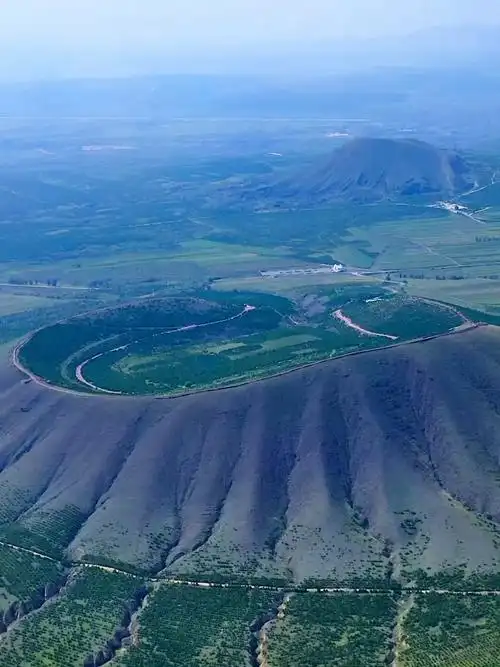 The Datong volcanic field took shape during the Quaternary period, between roughly 200,000 and 740,000 years ago — recent in geological terms, an era that in Europe overlaps with the late Middle Paleolithic and the last Neanderthal camps. The thirty-odd cones dotting the plateau are survivors of basalt magma rising through the deep sediments of the Loess Plateau. Travelers familiar with France's Chaîne des Puys in Auvergne, a UNESCO-listed chain of dormant volcanoes, will recognize the same gentle conical silhouettes, though here they are dramatically juxtaposed against yellow loess rather than green pastureland.
The park's centerpiece is Langwo Mountain, whose crater measures roughly 500 meters across and drops 30 to 50 meters below the rim. A 2.1-kilometer wooden boardwalk, similar to those threading through Yellowstone or Iceland's volcanic reserves, circles the rim and lets visitors gaze safely down into the well-preserved bowl. Geologists treat it as an open-air textbook; photographers love the way afternoon shadows fall across the hollow. From this elevated ring, the surrounding sea of smaller cones rolls toward the horizon in every direction.
Just a short drive away sits Jinshan, or Golden Mountain, named because late sun turns its black basalt slopes into a shimmering sheet of bronze. There are no stairs or railings — just the original lava surface climbing to a flat summit. Photographers arrive at golden hour to capture a surreal, moon-like texture comparable to the volcanic terrain of Spain's Timanfaya National Park in Lanzarote. From the top, the rest of the field stretches away like a sleeping herd of dark domes.
At Haotian Mountain, geology meets Ming dynasty architecture in one of the park's most unexpected sights. A red-walled temple built in the late sixteenth century perches directly on the lip of an ancient crater, recalling the way medieval monasteries in Turkey's Cappadocia rise from volcanic tuff. Vermilion walls and grey roof tiles glow against black basalt, while the empty bowl of the crater drops away beneath the temple courtyards. The juxtaposition feels almost mythological, as if a Ming dynasty monastery guards the gates of a volcanic underworld.
The park is rated AAAA by China's tourist authority and free to enter, with no advance booking needed. Hours run from 8:30 a.m. to 6:00 p.m. Self-driving is strongly recommended: from downtown Datong, the journey takes forty to sixty minutes on good roads, while public transport is sparse and requires multiple transfers. There are no shops or restrooms inside the park, so bring plenty of water, snacks, sun protection, and sturdy hiking shoes. Tiger Mountain is the easiest option for those short on time or traveling with children, as the road reaches the summit directly.
Aim to arrive between 3 p.m. and sunset to avoid midday glare and catch the warm slanting light that makes the basalt glow. Spring and autumn offer the clearest air, and the hours after rain bring the most saturated colors. Winter snow transforms the black cones into stark graphic shapes that are surprisingly photogenic. Visitors are asked to follow Leave No Trace principles: no collecting or hammering at rock specimens, no straying off the marked paths. The cones may look eternal, but erosion and human pressure can damage this irreplaceable landscape.
The Datong volcanic field took shape during the Quaternary period, between roughly 200,000 and 740,000 years ago — recent in geological terms, an era that in Europe overlaps with the late Middle Paleolithic and the last Neanderthal camps. The thirty-odd cones dotting the plateau are survivors of basalt magma rising through the deep sediments of the Loess Plateau. Travelers familiar with France's Chaîne des Puys in Auvergne, a UNESCO-listed chain of dormant volcanoes, will recognize the same gentle conical silhouettes, though here they are dramatically juxtaposed against yellow loess rather than green pastureland.
The park's centerpiece is Langwo Mountain, whose crater measures roughly 500 meters across and drops 30 to 50 meters below the rim. A 2.1-kilometer wooden boardwalk, similar to those threading through Yellowstone or Iceland's volcanic reserves, circles the rim and lets visitors gaze safely down into the well-preserved bowl. Geologists treat it as an open-air textbook; photographers love the way afternoon shadows fall across the hollow. From this elevated ring, the surrounding sea of smaller cones rolls toward the horizon in every direction.
Just a short drive away sits Jinshan, or Golden Mountain, named because late sun turns its black basalt slopes into a shimmering sheet of bronze. There are no stairs or railings — just the original lava surface climbing to a flat summit. Photographers arrive at golden hour to capture a surreal, moon-like texture comparable to the volcanic terrain of Spain's Timanfaya National Park in Lanzarote. From the top, the rest of the field stretches away like a sleeping herd of dark domes.
At Haotian Mountain, geology meets Ming dynasty architecture in one of the park's most unexpected sights. A red-walled temple built in the late sixteenth century perches directly on the lip of an ancient crater, recalling the way medieval monasteries in Turkey's Cappadocia rise from volcanic tuff. Vermilion walls and grey roof tiles glow against black basalt, while the empty bowl of the crater drops away beneath the temple courtyards. The juxtaposition feels almost mythological, as if a Ming dynasty monastery guards the gates of a volcanic underworld.
The park is rated AAAA by China's tourist authority and free to enter, with no advance booking needed. Hours run from 8:30 a.m. to 6:00 p.m. Self-driving is strongly recommended: from downtown Datong, the journey takes forty to sixty minutes on good roads, while public transport is sparse and requires multiple transfers. There are no shops or restrooms inside the park, so bring plenty of water, snacks, sun protection, and sturdy hiking shoes. Tiger Mountain is the easiest option for those short on time or traveling with children, as the road reaches the summit directly.
Aim to arrive between 3 p.m. and sunset to avoid midday glare and catch the warm slanting light that makes the basalt glow. Spring and autumn offer the clearest air, and the hours after rain bring the most saturated colors. Winter snow transforms the black cones into stark graphic shapes that are surprisingly photogenic. Visitors are asked to follow Leave No Trace principles: no collecting or hammering at rock specimens, no straying off the marked paths. The cones may look eternal, but erosion and human pressure can damage this irreplaceable landscape.