Sima Guang Ancestral Hall
⭐ 4.50
Sima Guang Ancestral Hall Scenic Area, Xia County, Yuncheng, Shanxi, China
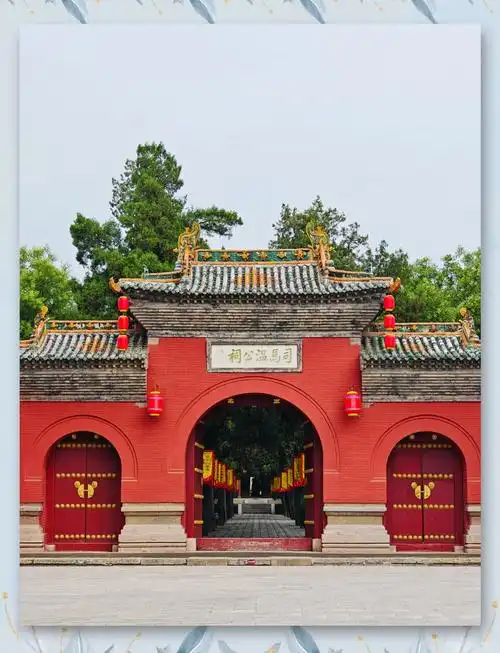 Sima Guang (1019–1086), a towering figure of the Northern Song dynasty comparable to Lord Bacon in his dual role as political counselor and scholarly polymath, served as chief minister and spent nineteen years compiling the *Zizhi Tongjian*, a 294-volume universal chronicle covering 1,362 years of Chinese history. The memorial complex, begun in 1065 on the rolling Mingtiao Ridge of Xia County, blends his ancestral cemetery with a series of memorial halls and a former Buddhist academy. The site encompasses roughly 12 hectares, structured as five interconnected zones that unfold like a textbook of medieval Chinese elite culture.
The architectural crown is the Grand Hall of Yuqing Chan Yuan, a single-eaved hip-and-gable structure from the original Northern Song construction—an astonishing survival, given that few timber buildings of comparable age exist even in Europe, where Romanesque churches of the same era have largely been rebuilt. Inside stand three painted clay Buddhas from the Jin dynasty, each about three meters tall and featuring distinctive mustachioed features reflecting Central Asian artistic influence, flanked by twelve vivid arhat figures. This combination makes the hall a unique witness to Song-Jin Buddhist sculpture, an artistic bridge between Tang classicism and later Chinese styles.
Stele culture forms the site's other great treasure. The famed "Apricot Blossom Stele" preserves a Jin-dynasty rubbing of Su Shi's original inscription for Sima Guang's tomb—one of only a handful of works in the legendary calligrapher's hand. Even more imposing is the Zhongqing Cuide Stele Pavilion, soaring over eight meters tall and crowned by an imperial inscription from Emperor Zhe Zong; its massive tortoise-borne base has earned it the title "First Stele of China." The adjacent Su River Academy displays editions of the *Zizhi Tongjian* alongside family precepts that shaped Sima Guang's famously frugal character.
Practical information: the site sits about 15 kilometers from Yuncheng city center and a 20-minute drive from Yuncheng Zhanghu Airport, with no direct public transit. Admission is 30 RMB, with free guided tours at set times and audio guides available. Summer hours run 08:00–18:00, winter 09:00–17:00. Allow 1.5 to 2.5 hours, and visit in the morning when soft light flatters the ancient timber structures. Wear soft-soled shoes, and please refrain from flash photography inside the halls.
This is a contemplative destination rather than an entertaining one—ideal for visitors who appreciate medieval European cathedrals and manuscripts will find similar rewards here in Song-dynasty timber halls and Song-Jin sculpture. Combine your trip with the Yuan-dynasty Duoyun Cave Taoist complex nearby for a memorable day pairing Song elegance with Yuan mystique. Spring brings pear blossoms, autumn offers crisp skies—bring a selected passage from the *Zizhi Tongjian* to enrich your visit.
Sima Guang (1019–1086), a towering figure of the Northern Song dynasty comparable to Lord Bacon in his dual role as political counselor and scholarly polymath, served as chief minister and spent nineteen years compiling the *Zizhi Tongjian*, a 294-volume universal chronicle covering 1,362 years of Chinese history. The memorial complex, begun in 1065 on the rolling Mingtiao Ridge of Xia County, blends his ancestral cemetery with a series of memorial halls and a former Buddhist academy. The site encompasses roughly 12 hectares, structured as five interconnected zones that unfold like a textbook of medieval Chinese elite culture.
The architectural crown is the Grand Hall of Yuqing Chan Yuan, a single-eaved hip-and-gable structure from the original Northern Song construction—an astonishing survival, given that few timber buildings of comparable age exist even in Europe, where Romanesque churches of the same era have largely been rebuilt. Inside stand three painted clay Buddhas from the Jin dynasty, each about three meters tall and featuring distinctive mustachioed features reflecting Central Asian artistic influence, flanked by twelve vivid arhat figures. This combination makes the hall a unique witness to Song-Jin Buddhist sculpture, an artistic bridge between Tang classicism and later Chinese styles.
Stele culture forms the site's other great treasure. The famed "Apricot Blossom Stele" preserves a Jin-dynasty rubbing of Su Shi's original inscription for Sima Guang's tomb—one of only a handful of works in the legendary calligrapher's hand. Even more imposing is the Zhongqing Cuide Stele Pavilion, soaring over eight meters tall and crowned by an imperial inscription from Emperor Zhe Zong; its massive tortoise-borne base has earned it the title "First Stele of China." The adjacent Su River Academy displays editions of the *Zizhi Tongjian* alongside family precepts that shaped Sima Guang's famously frugal character.
Practical information: the site sits about 15 kilometers from Yuncheng city center and a 20-minute drive from Yuncheng Zhanghu Airport, with no direct public transit. Admission is 30 RMB, with free guided tours at set times and audio guides available. Summer hours run 08:00–18:00, winter 09:00–17:00. Allow 1.5 to 2.5 hours, and visit in the morning when soft light flatters the ancient timber structures. Wear soft-soled shoes, and please refrain from flash photography inside the halls.
This is a contemplative destination rather than an entertaining one—ideal for visitors who appreciate medieval European cathedrals and manuscripts will find similar rewards here in Song-dynasty timber halls and Song-Jin sculpture. Combine your trip with the Yuan-dynasty Duoyun Cave Taoist complex nearby for a memorable day pairing Song elegance with Yuan mystique. Spring brings pear blossoms, autumn offers crisp skies—bring a selected passage from the *Zizhi Tongjian* to enrich your visit.