Yingxian Wooden Pagoda
⭐ 4.20
Yingxian Wooden Pagoda Scenic Area, Ying County, Shuozhou, Shanxi Province, China
 [Historical Context]
Imagine a tower rising from the steppes of northern China just four years before the Norman Conquest transformed English history—the Yingxian Wooden Pagoda was already standing in 1056, commissioned by Liao Emperor Xingzong during a period when China's Khitan-ruled dynasty rivaled the Song in cultural sophistication. A contemporary to Europe's Romanesque cathedrals, this pagoda predates the Leaning Tower of Pisa's completion by more than a century and has outlived every wooden structure of its scale anywhere on Earth. Repaired through the Jin, Ming, and Qing dynasties, it remains a living testament to nearly a thousand years of Buddhist devotion, imperial ambition, and architectural continuity.
[Architecture]
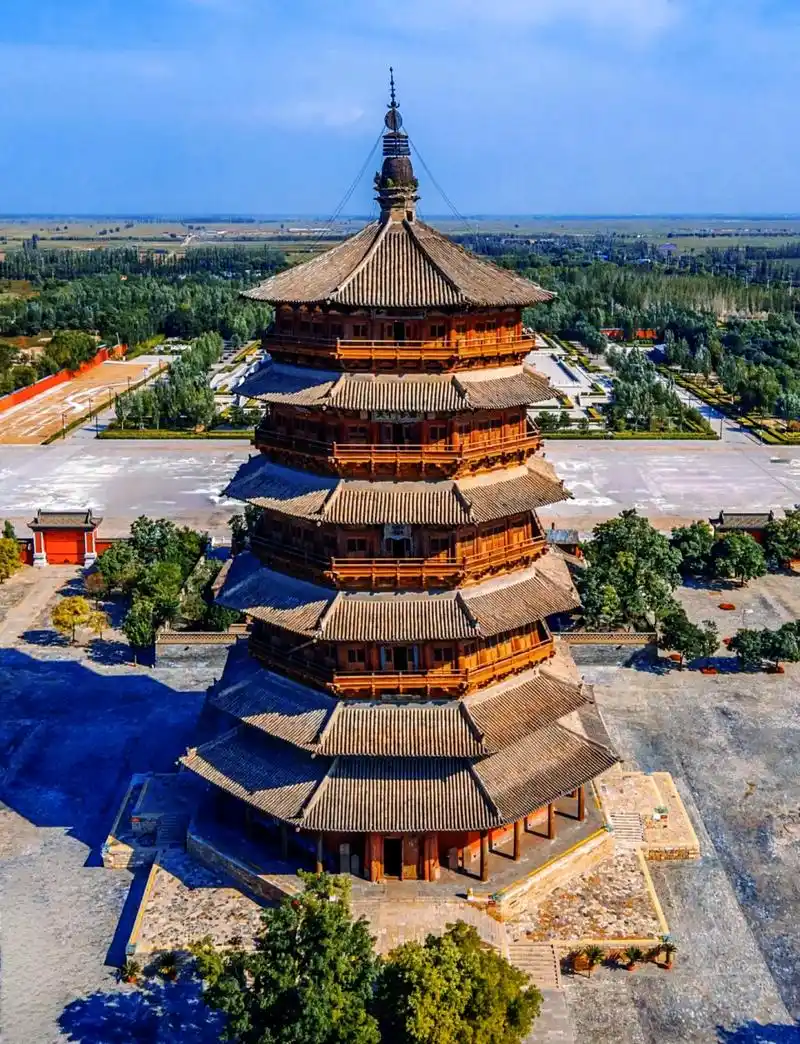
The pagoda's genius lies in a sophisticated system of 54 distinct types of wooden brackets—roughly 480 sets in all—that distribute the entire structure's 2,600-ton weight evenly into the earth without a single iron nail. Rising through five visible tiers (which cleverly conceal four additional interior levels), the octagonal form channels the same "flexibility overcomes rigidity" engineering philosophy that has allowed it to survive devastating earthquakes and wartime bombardment. For Western visitors familiar with half-timbered European churches, picture that craftsmanship multiplied a hundredfold and stretched skyward—a masterclass in what pre-industrial builders could achieve with timber alone.
[Cultural Significance]
More than an architectural marvel, the pagoda functions as a vertical museum of Chinese civilization. Its ground floor houses an 8-meter-tall Shakyamuni Buddha flanked by intricate Buddhist murals, while 54 inscribed plaques hang throughout the structure, including the celebrated Ming-dynasty inscription "Wonder of the World" brushed by Emperor Wuzong. Scholars prize the tower as an irreplaceable "living fossil" for studying Liao-era politics, religious art, and construction techniques—a structure where Buddhist sanctuary meets imperial propaganda meets engineering manual.
[Practical Visit Info]
Tickets run about 50 RMB and include access to the ground floor plus a new digital immersive experience opening in May 2026, which uses glasses-free 3D technology to virtually transport visitors through the upper floors climbing is no longer permitted. Allow roughly 1.5 hours, and book a multilingual guide or rent an audio device in advance to fully appreciate the bracket systems and Liao Buddhist symbolism. Summer hours extend to 6:00 PM, with morning light offering the best photography; foreign visitors should bring passports and small cash. Photography restrictions apply—no drones, no flash.
[Conservation & Related Sites]
Sadly, centuries of load-bearing and natural settling have left the tower tilting slightly northeast, which is why climbing has been banned since the 2010s to preserve this irreplaceable monument. Visitors seeking complementary wonders should walk just a few hundred meters to Jingtu Temple, renowned for its dazzling Jin-dynasty "Celestial Pavilion" caisson ceiling—a carved wooden masterpiece that often steals the show from even the pagoda itself. More ambitious travelers can extend into the "Liao-Jin Heritage Route," linking the pagoda with the Yungang Grottoes and the gravity-defying Hanging Temple for a week-long journey through northern China's medieval Buddhist heartland.
[Historical Context]
Imagine a tower rising from the steppes of northern China just four years before the Norman Conquest transformed English history—the Yingxian Wooden Pagoda was already standing in 1056, commissioned by Liao Emperor Xingzong during a period when China's Khitan-ruled dynasty rivaled the Song in cultural sophistication. A contemporary to Europe's Romanesque cathedrals, this pagoda predates the Leaning Tower of Pisa's completion by more than a century and has outlived every wooden structure of its scale anywhere on Earth. Repaired through the Jin, Ming, and Qing dynasties, it remains a living testament to nearly a thousand years of Buddhist devotion, imperial ambition, and architectural continuity.
[Architecture]
The pagoda's genius lies in a sophisticated system of 54 distinct types of wooden brackets—roughly 480 sets in all—that distribute the entire structure's 2,600-ton weight evenly into the earth without a single iron nail. Rising through five visible tiers (which cleverly conceal four additional interior levels), the octagonal form channels the same "flexibility overcomes rigidity" engineering philosophy that has allowed it to survive devastating earthquakes and wartime bombardment. For Western visitors familiar with half-timbered European churches, picture that craftsmanship multiplied a hundredfold and stretched skyward—a masterclass in what pre-industrial builders could achieve with timber alone.
[Cultural Significance]
More than an architectural marvel, the pagoda functions as a vertical museum of Chinese civilization. Its ground floor houses an 8-meter-tall Shakyamuni Buddha flanked by intricate Buddhist murals, while 54 inscribed plaques hang throughout the structure, including the celebrated Ming-dynasty inscription "Wonder of the World" brushed by Emperor Wuzong. Scholars prize the tower as an irreplaceable "living fossil" for studying Liao-era politics, religious art, and construction techniques—a structure where Buddhist sanctuary meets imperial propaganda meets engineering manual.
[Practical Visit Info]
Tickets run about 50 RMB and include access to the ground floor plus a new digital immersive experience opening in May 2026, which uses glasses-free 3D technology to virtually transport visitors through the upper floors climbing is no longer permitted. Allow roughly 1.5 hours, and book a multilingual guide or rent an audio device in advance to fully appreciate the bracket systems and Liao Buddhist symbolism. Summer hours extend to 6:00 PM, with morning light offering the best photography; foreign visitors should bring passports and small cash. Photography restrictions apply—no drones, no flash.
[Conservation & Related Sites]
Sadly, centuries of load-bearing and natural settling have left the tower tilting slightly northeast, which is why climbing has been banned since the 2010s to preserve this irreplaceable monument. Visitors seeking complementary wonders should walk just a few hundred meters to Jingtu Temple, renowned for its dazzling Jin-dynasty "Celestial Pavilion" caisson ceiling—a carved wooden masterpiece that often steals the show from even the pagoda itself. More ambitious travelers can extend into the "Liao-Jin Heritage Route," linking the pagoda with the Yungang Grottoes and the gravity-defying Hanging Temple for a week-long journey through northern China's medieval Buddhist heartland.