Longpan Park
⭐ 4.20
Longpan Park, Longpan Village, Hengchun Township, Pingtung County, Taiwan Province
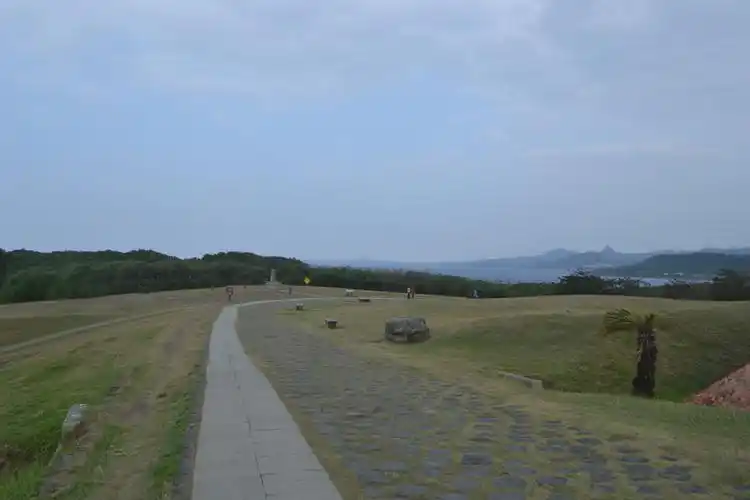 The plateau you stand upon at Longpan Park was forged tens of thousands of years ago, when coral reefs that had grown in warm Pacific waters were thrust skyward by tectonic forces—the same restless geological activity that continues to build the island of Taiwan today. Think of it as Taiwan's answer to the White Cliffs of Dover, though here the limestone has been carved not by the English Channel but by tropical rains, sea spray, and the relentless northeast monsoon. The resulting terrain—riddled with crevices, sinkholes, and hidden caves—offers geologists a living laboratory for studying the arc-continent collision that lifts Taiwan millimeter by millimeter each year.
Spread across the windswept tableland, a thin carpet of red soil nurtures low shrubs and an expansive grassland that rolls toward sheer cliffs dropping into the Pacific. The visual drama recalls the windswept headlands of Cornwall or the chalk cliffs of Étretat on France's Normandy coast, but with a distinctly tropical twist—instead of gorse and sheep pastures, you'll find pandanus and subtropical grasses swaying beneath a fierce sun. From this exposed promontory, the ocean stretches uninterrupted to the horizon in every direction, and on clear mornings the sunrise seems to erupt directly from the sea itself, painting the entire prairie in shades of gold and crimson.
What truly sets Longpan apart is its night sky. Far from the light pollution of any major city, and blessed with remarkably transparent air, the park has earned a reputation as one of Taiwan's premier stargazing destinations—comparable to the celebrated dark-sky reserves of New Zealand's Aoraki Mackenzie or the remote volcanic plateaus of the Canary Islands. Between April and June, patient observers can even spot the Southern Cross, a constellation invisible from most of Europe and North America. The Milky Way arches overhead in such clarity that first-time viewers often gasp aloud, and the silence is broken only by wind and distant waves.
Reaching Longpan takes some effort but rewards the persistent traveler. From Kaohsiung, the most common route is via National Highway 3 to Route 1, then south along Highway 26—a drive of roughly 2.5 to 3 hours. Public transport is limited: the Kenting Express bus reaches Hengchun, from where a taxi covers the final stretch, so renting a car or hiring a driver remains the practical choice. Within the park itself, expect absolutely no facilities—no toilets, no shops, no shelters, and no shade. Bring plenty of water, sunscreen, a rain jacket, and a red-light torch if you plan to stay after dark.
Arrive about an hour before sunset to catch the day's finale before the stars take over—budget at least 90 minutes for the full experience, longer if astrophotography beckons. A word of caution: the wind here is legendary, with winter gusts (locally called the "fall-mountain wind") capable of whipping a hat off your head in seconds. There are no guardrails along the crumbling cliffs, so keep a respectful distance. Because Longpan sits within a protected national park, visitors should carry out all rubbish, stick to designated paths, and leave this wild and silent place exactly as they found it—for the corals, the plants, and the next traveler all depend on it.
The plateau you stand upon at Longpan Park was forged tens of thousands of years ago, when coral reefs that had grown in warm Pacific waters were thrust skyward by tectonic forces—the same restless geological activity that continues to build the island of Taiwan today. Think of it as Taiwan's answer to the White Cliffs of Dover, though here the limestone has been carved not by the English Channel but by tropical rains, sea spray, and the relentless northeast monsoon. The resulting terrain—riddled with crevices, sinkholes, and hidden caves—offers geologists a living laboratory for studying the arc-continent collision that lifts Taiwan millimeter by millimeter each year.
Spread across the windswept tableland, a thin carpet of red soil nurtures low shrubs and an expansive grassland that rolls toward sheer cliffs dropping into the Pacific. The visual drama recalls the windswept headlands of Cornwall or the chalk cliffs of Étretat on France's Normandy coast, but with a distinctly tropical twist—instead of gorse and sheep pastures, you'll find pandanus and subtropical grasses swaying beneath a fierce sun. From this exposed promontory, the ocean stretches uninterrupted to the horizon in every direction, and on clear mornings the sunrise seems to erupt directly from the sea itself, painting the entire prairie in shades of gold and crimson.
What truly sets Longpan apart is its night sky. Far from the light pollution of any major city, and blessed with remarkably transparent air, the park has earned a reputation as one of Taiwan's premier stargazing destinations—comparable to the celebrated dark-sky reserves of New Zealand's Aoraki Mackenzie or the remote volcanic plateaus of the Canary Islands. Between April and June, patient observers can even spot the Southern Cross, a constellation invisible from most of Europe and North America. The Milky Way arches overhead in such clarity that first-time viewers often gasp aloud, and the silence is broken only by wind and distant waves.
Reaching Longpan takes some effort but rewards the persistent traveler. From Kaohsiung, the most common route is via National Highway 3 to Route 1, then south along Highway 26—a drive of roughly 2.5 to 3 hours. Public transport is limited: the Kenting Express bus reaches Hengchun, from where a taxi covers the final stretch, so renting a car or hiring a driver remains the practical choice. Within the park itself, expect absolutely no facilities—no toilets, no shops, no shelters, and no shade. Bring plenty of water, sunscreen, a rain jacket, and a red-light torch if you plan to stay after dark.
Arrive about an hour before sunset to catch the day's finale before the stars take over—budget at least 90 minutes for the full experience, longer if astrophotography beckons. A word of caution: the wind here is legendary, with winter gusts (locally called the "fall-mountain wind") capable of whipping a hat off your head in seconds. There are no guardrails along the crumbling cliffs, so keep a respectful distance. Because Longpan sits within a protected national park, visitors should carry out all rubbish, stick to designated paths, and leave this wild and silent place exactly as they found it—for the corals, the plants, and the next traveler all depend on it.