Pengyang Eco-Tourism Area
⭐ 4.00
Pengyang Eco-Tourism Area, Pengyang County, Guyuan City, Ningxia Hui Autonomous Region, China
 Once plagued by severe soil erosion and entrenched poverty, Pengyang rose from one of China's poorest counties to become a celebrated model of environmental transformation. Through decades of reforestation and terrace construction, the region has reclaimed vast hillsides, turning barren loess into a living tapestry of green. For travelers familiar with the dramatic steppes of Central Asia or the terraced vineyards of the Mediterranean, Pengyang offers a comparable yet distinctly Chinese vision: sweeping curves that resemble "giant fingerprints of the earth," stretching endlessly toward the horizon.
The heart of the scenic area lies in the Jinjiiping Terraced Park, a national AAAA-rated site where geometric ribbons of farmland cascade down the mountainsides. Nearby, the "Rainbow Road 77" winds 7.7 kilometers through the Malaman Valley, linking three viewing platforms perfect for capturing long-exposure shots of cloud-wrapped slopes. Early mornings and late afternoons transform the Qingyun Bay terraces into atmospheric ink-wash paintings, offering photographers a serene alternative to the more crowded landscapes of China's southern rice terraces.
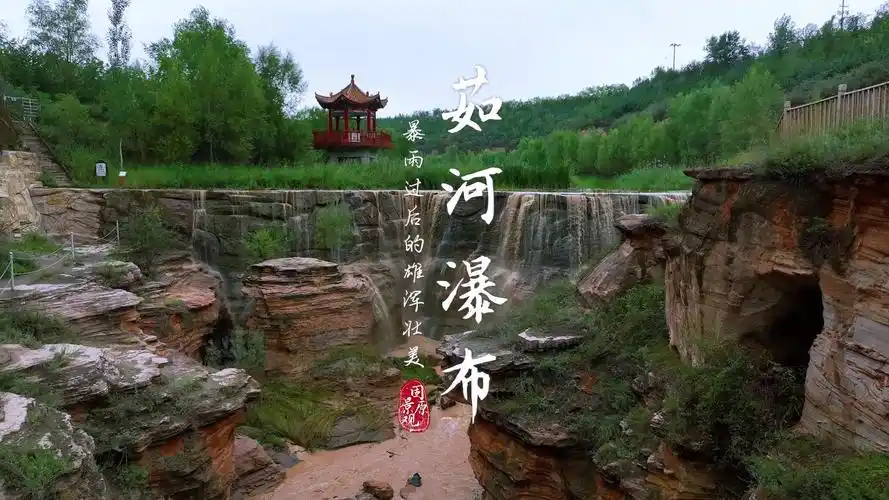
Beyond the cultivated fields, the Ruhe River Waterfall Scenic Area reveals a different geological drama. Here, a nine-meter cascade plunges through a three-kilometer stone gorge—an unusual formation for the arid northwest. Visitors can follow cliffside boardwalks through the spray, comparing the experience to walking through a miniature version of Norway's fjords or Spain's Garganta de Chorros. The canyon's rugged rock walls and misty summer flows create a refreshing contrast to the sun-baked plateaus above.
History lives alongside nature at the Qiaojaqu Long March campsite, where seven preserved cave dwellings recall Mao Zedong's troops' grueling 1935 march across the Loess Plateau. The Pengyang County Museum, housing over 6,700 artifacts, illuminates the region's role along ancient Silk Road trade routes and its enduring agricultural traditions—rivaling smaller provincial museums in Florence or Kraków in terms of intimate, deeply local insight.
Practical access requires planning. The area sits roughly 65 kilometers from Guyuan city, about a 50-minute drive, and public transit is virtually nonexistent—rental cars or hired drivers are essential. The "Terrace Night Market" in the county seat serves regional specialties like lamb hotpot and handmade noodles, similar in spirit to a rustic Italian sagra. August temperatures hover between 20–28°C with cool evenings, so light jackets and sturdy shoes are recommended. English is rarely spoken, so offline maps, translation apps, and sufficient cash will ensure a smooth adventure.
Once plagued by severe soil erosion and entrenched poverty, Pengyang rose from one of China's poorest counties to become a celebrated model of environmental transformation. Through decades of reforestation and terrace construction, the region has reclaimed vast hillsides, turning barren loess into a living tapestry of green. For travelers familiar with the dramatic steppes of Central Asia or the terraced vineyards of the Mediterranean, Pengyang offers a comparable yet distinctly Chinese vision: sweeping curves that resemble "giant fingerprints of the earth," stretching endlessly toward the horizon.
The heart of the scenic area lies in the Jinjiiping Terraced Park, a national AAAA-rated site where geometric ribbons of farmland cascade down the mountainsides. Nearby, the "Rainbow Road 77" winds 7.7 kilometers through the Malaman Valley, linking three viewing platforms perfect for capturing long-exposure shots of cloud-wrapped slopes. Early mornings and late afternoons transform the Qingyun Bay terraces into atmospheric ink-wash paintings, offering photographers a serene alternative to the more crowded landscapes of China's southern rice terraces.
Beyond the cultivated fields, the Ruhe River Waterfall Scenic Area reveals a different geological drama. Here, a nine-meter cascade plunges through a three-kilometer stone gorge—an unusual formation for the arid northwest. Visitors can follow cliffside boardwalks through the spray, comparing the experience to walking through a miniature version of Norway's fjords or Spain's Garganta de Chorros. The canyon's rugged rock walls and misty summer flows create a refreshing contrast to the sun-baked plateaus above.
History lives alongside nature at the Qiaojaqu Long March campsite, where seven preserved cave dwellings recall Mao Zedong's troops' grueling 1935 march across the Loess Plateau. The Pengyang County Museum, housing over 6,700 artifacts, illuminates the region's role along ancient Silk Road trade routes and its enduring agricultural traditions—rivaling smaller provincial museums in Florence or Kraków in terms of intimate, deeply local insight.
Practical access requires planning. The area sits roughly 65 kilometers from Guyuan city, about a 50-minute drive, and public transit is virtually nonexistent—rental cars or hired drivers are essential. The "Terrace Night Market" in the county seat serves regional specialties like lamb hotpot and handmade noodles, similar in spirit to a rustic Italian sagra. August temperatures hover between 20–28°C with cool evenings, so light jackets and sturdy shoes are recommended. English is rarely spoken, so offline maps, translation apps, and sufficient cash will ensure a smooth adventure.