Jiangtaibao
⭐ 3.50
Jiangtaibao Town, Jingyuan County, Guyuan City, Ningxia Hui Autonomous Region, China
 **Historical Context** — The Long March of 1934–1936, in which roughly 100,000 Communist soldiers trekked more than 9,000 kilometers across some of China's most punishing terrain, ranks among history's great forced migrations—often compared to Xenophon's Anabasis or Napoleon's disastrous retreat from Moscow. By the time the surviving First and Second Front Armies converged at Jiangtaibu in October 1936, fewer than 30,000 troops remained. October 22 has since been officially designated "Long March Victory Commemoration Day," and the site has been honored as a National Key Cultural Relics Protection Unit. It stands alongside sacred revolutionary ground such as Yan'an and Jinggangshan in the national memory of modern China.
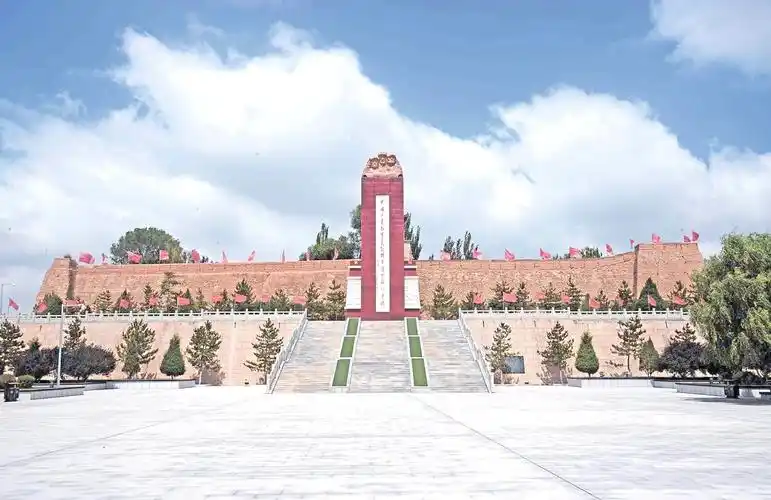
**Architecture and Setting** — The site's centerpiece is the Red Army Reunion Monument, a 26.36-meter obelisk crowned with sculptural reliefs depicting the Long March's arduous journey. Below it lies the Three Armies Memorial Hall, ingeniously nested within the crumbling walls of a centuries-old fortress—an architectural gesture akin to embedding modern art within a medieval castle like Carcassonne. Nearby, the General's Calligraphy Stone Forest preserves brush-and-ink works by revolutionary leaders, blending traditional Chinese literati aesthetics with political commemoration. Together the structures create a layered dialogue between ancient frontier defense and modern revolutionary history.
**Cultural Significance** — Beyond its patriotic function as a National Patriotic Education Demonstration Base, Jiangtaibu offers a poignant meditation on resilience, sacrifice, and the forging of national identity through struggle. Revolutionary figures including He Long and Deng Xiaoping once lived and commanded from the courtyard houses here, which remain preserved in their near-original state. Visitors will find few other locations where the Long March narrative feels so tangible—where the geography itself, the weathered ramparts and austere plateaus, still testifies to the ordeal.
**Practical Visitor Information** — The Jiangtaibu Red Army Long March Reunion Memorial Park lies about 30 kilometers south of Xiji County town and roughly 60 kilometers from Guyuan city, deep in Ningxia's loess-hill countryside. Admission is free, and the site is open daily from 9:00 a.m. to 5:30 p.m., with last entry at 5:10 p.m. No public buses serve the area directly, so renting a car or hiring a private driver from Guyuan or Xiji is strongly recommended—set your GPS to "将台堡红军长征会师纪念园." Facilities are minimal, so bring drinking water and snacks; dress modestly and respectfully given the site's commemorative nature.
**Why Visit** — For travelers drawn to the great turning points of twentieth-century history, Jiangtaibu delivers a moving, uncluttered experience that few Chinese revolutionary sites can match. It pairs the gravitas of an ancient frontier fortification with the emotional weight of one of the defining moments of modern China. Allow two to three hours to absorb the monument, the museum's exhibits, and the calligraphy stone forest at a reflective pace. Guided commentary is available and worth booking in advance through the museum to fully appreciate the site's layered stories—then continue your journey westward toward the dramatic landscapes of Liupan Mountain.
**Historical Context** — The Long March of 1934–1936, in which roughly 100,000 Communist soldiers trekked more than 9,000 kilometers across some of China's most punishing terrain, ranks among history's great forced migrations—often compared to Xenophon's Anabasis or Napoleon's disastrous retreat from Moscow. By the time the surviving First and Second Front Armies converged at Jiangtaibu in October 1936, fewer than 30,000 troops remained. October 22 has since been officially designated "Long March Victory Commemoration Day," and the site has been honored as a National Key Cultural Relics Protection Unit. It stands alongside sacred revolutionary ground such as Yan'an and Jinggangshan in the national memory of modern China.
**Architecture and Setting** — The site's centerpiece is the Red Army Reunion Monument, a 26.36-meter obelisk crowned with sculptural reliefs depicting the Long March's arduous journey. Below it lies the Three Armies Memorial Hall, ingeniously nested within the crumbling walls of a centuries-old fortress—an architectural gesture akin to embedding modern art within a medieval castle like Carcassonne. Nearby, the General's Calligraphy Stone Forest preserves brush-and-ink works by revolutionary leaders, blending traditional Chinese literati aesthetics with political commemoration. Together the structures create a layered dialogue between ancient frontier defense and modern revolutionary history.
**Cultural Significance** — Beyond its patriotic function as a National Patriotic Education Demonstration Base, Jiangtaibu offers a poignant meditation on resilience, sacrifice, and the forging of national identity through struggle. Revolutionary figures including He Long and Deng Xiaoping once lived and commanded from the courtyard houses here, which remain preserved in their near-original state. Visitors will find few other locations where the Long March narrative feels so tangible—where the geography itself, the weathered ramparts and austere plateaus, still testifies to the ordeal.
**Practical Visitor Information** — The Jiangtaibu Red Army Long March Reunion Memorial Park lies about 30 kilometers south of Xiji County town and roughly 60 kilometers from Guyuan city, deep in Ningxia's loess-hill countryside. Admission is free, and the site is open daily from 9:00 a.m. to 5:30 p.m., with last entry at 5:10 p.m. No public buses serve the area directly, so renting a car or hiring a private driver from Guyuan or Xiji is strongly recommended—set your GPS to "将台堡红军长征会师纪念园." Facilities are minimal, so bring drinking water and snacks; dress modestly and respectfully given the site's commemorative nature.
**Why Visit** — For travelers drawn to the great turning points of twentieth-century history, Jiangtaibu delivers a moving, uncluttered experience that few Chinese revolutionary sites can match. It pairs the gravitas of an ancient frontier fortification with the emotional weight of one of the defining moments of modern China. Allow two to three hours to absorb the monument, the museum's exhibits, and the calligraphy stone forest at a reflective pace. Guided commentary is available and worth booking in advance through the museum to fully appreciate the site's layered stories—then continue your journey westward toward the dramatic landscapes of Liupan Mountain.