Qilian Mountains Observation Deck
⭐ 4.00
Xiongguan Street, Jiayuguan City, Gansu Province, China
 Long before Marco Polo crossed Asia, the Qilian range served as the southern rampart of the Hexi Corridor, the narrow throat through which Silk Road caravans connected imperial China with Persia, Rome, and beyond. Often called the "Water Tower of the Northwest," these peaks function much like the Alps do for central Europe: their melting snows feed the oases that made cities like Dunhuang and Zhangye possible. Standing at the viewpoint, you're looking at the same horizon that Buddhist monks, Sogdian merchants, and Mongol horsemen once surveyed, with Jiayuguan—the Ming dynasty counterpart to Rome's Terminus or Hadrian's Wall—anchoring the landscape to the north.
The observation deck itself is a model of restrained contemporary design. Built in a tiered, open-plan steel-and-timber structure that hugs the mountainside, it offers stepped platforms and elevated wooden boardwalks that let visitors shift between altitudes and angles unobstructed. Simple amenities—shaded pergolas, bench seating, and clear interpretive panels—blend cleanly into the rugged highland setting, so the architecture reads as part of the scenery rather than an intrusion upon it.
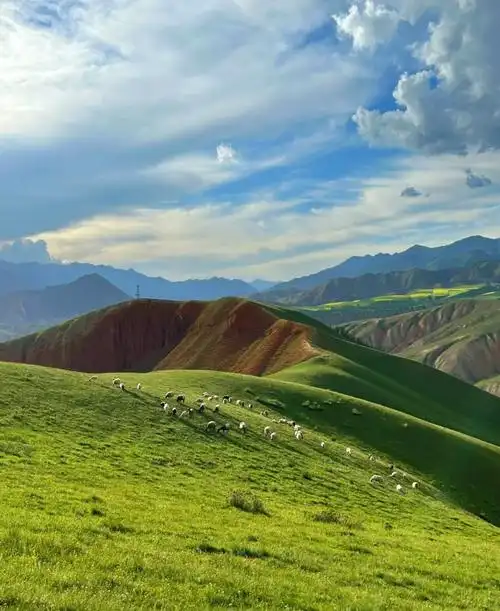
On clear days the view unfolds in stark, cinematic layers: permanent snowfields glittering against cobalt skies, pale Gobi gravel stretching to the horizon, and emerald pasture ribbons where yaks, sheep, and scattered white yurts dot the slopes. The stillness is immense, broken only by wind and the occasional cry of a herder. For travelers accustomed to the manicured Alps or the rolling Pyrenees, the Qilian landscape offers a comparable grandeur with a distinctly raw, frontier character that feels closer in spirit to Patagonia or the Scottish Highlands than to mainland Europe.
The deck's signature moment arrives at dusk, when the lowering sun ignites the snowline in a slow-burning crimson and gold. This "Sunshine on the Golden Mountain" effect, beloved across the Tibetan and Himalayan worlds, can last half an hour as light crawls across the ridges. A dedicated sunset seating area means you don't need to stake out a spot—just arrive, settle in, and let the show unfold. Photographers should bring a polarizing filter and tripod; everyone else should bring patience and an open jaw.
Access is refreshingly simple. Entry is free year-round with a valid passport or ID, and no reservation is required. The well-paved route from Jiayuguan takes about an hour, running along the scenic Qilian Mountain Route 9, and roadside pull-offs invite spontaneous stops. Because the site sits above 3,000 meters, travelers should pack strong sunscreen, layered clothing for cool evenings, and a basic awareness of mild altitude symptoms. The sweet spot runs June through October, with July and August delivering the greenest meadows and the most reliable skies—arrive before noon to catch the morning light, then stay through sunset.
For the full Silk Road experience, pair the viewpoint with a two- or three-day loop from Jiayuguan: walk the ramparts of Jiayuguan Fortress in the morning, drive to the cantilevered Hanging Wall Great Wall by midday, and continue to the crevasse fields of the Qiyi Glacier before looping back through the Qilian foothills to the deck for golden hour. Few places in Asia compress so much geography, history, and natural drama into a single roadside stop.
Long before Marco Polo crossed Asia, the Qilian range served as the southern rampart of the Hexi Corridor, the narrow throat through which Silk Road caravans connected imperial China with Persia, Rome, and beyond. Often called the "Water Tower of the Northwest," these peaks function much like the Alps do for central Europe: their melting snows feed the oases that made cities like Dunhuang and Zhangye possible. Standing at the viewpoint, you're looking at the same horizon that Buddhist monks, Sogdian merchants, and Mongol horsemen once surveyed, with Jiayuguan—the Ming dynasty counterpart to Rome's Terminus or Hadrian's Wall—anchoring the landscape to the north.
The observation deck itself is a model of restrained contemporary design. Built in a tiered, open-plan steel-and-timber structure that hugs the mountainside, it offers stepped platforms and elevated wooden boardwalks that let visitors shift between altitudes and angles unobstructed. Simple amenities—shaded pergolas, bench seating, and clear interpretive panels—blend cleanly into the rugged highland setting, so the architecture reads as part of the scenery rather than an intrusion upon it.
On clear days the view unfolds in stark, cinematic layers: permanent snowfields glittering against cobalt skies, pale Gobi gravel stretching to the horizon, and emerald pasture ribbons where yaks, sheep, and scattered white yurts dot the slopes. The stillness is immense, broken only by wind and the occasional cry of a herder. For travelers accustomed to the manicured Alps or the rolling Pyrenees, the Qilian landscape offers a comparable grandeur with a distinctly raw, frontier character that feels closer in spirit to Patagonia or the Scottish Highlands than to mainland Europe.
The deck's signature moment arrives at dusk, when the lowering sun ignites the snowline in a slow-burning crimson and gold. This "Sunshine on the Golden Mountain" effect, beloved across the Tibetan and Himalayan worlds, can last half an hour as light crawls across the ridges. A dedicated sunset seating area means you don't need to stake out a spot—just arrive, settle in, and let the show unfold. Photographers should bring a polarizing filter and tripod; everyone else should bring patience and an open jaw.
Access is refreshingly simple. Entry is free year-round with a valid passport or ID, and no reservation is required. The well-paved route from Jiayuguan takes about an hour, running along the scenic Qilian Mountain Route 9, and roadside pull-offs invite spontaneous stops. Because the site sits above 3,000 meters, travelers should pack strong sunscreen, layered clothing for cool evenings, and a basic awareness of mild altitude symptoms. The sweet spot runs June through October, with July and August delivering the greenest meadows and the most reliable skies—arrive before noon to catch the morning light, then stay through sunset.
For the full Silk Road experience, pair the viewpoint with a two- or three-day loop from Jiayuguan: walk the ramparts of Jiayuguan Fortress in the morning, drive to the cantilevered Hanging Wall Great Wall by midday, and continue to the crevasse fields of the Qiyi Glacier before looping back through the Qilian foothills to the deck for golden hour. Few places in Asia compress so much geography, history, and natural drama into a single roadside stop.